


When you visit a house under construction, one stage often looks almost “complete” — even before the slab is cast. Walls are up, openings are visible, and a horizontal band runs across the structure. This stage is known as the lintel level in construction.
For many homeowners, this stage creates confusion. Is it the same as a beam? Why is it placed above doors and windows? And what happens if the height is wrong?
Lintel level may seem like a small milestone in construction, but mistakes here can affect door heights, structural alignment, and even the overall look of your home. In this guide, we’ll break down what lintel level really is, its standard height, why it matters, and the most common mistakes you should avoid on site.
What is Lintel Level in Construction?
Lintel level is the height at which a horizontal beam (lintel) is placed above doors and windows to support the load above. This beam supports the load of the wall above the openings and transfers it safely to the adjacent walls.
In simple terms, once your wall reaches the top of doors and windows, a reinforced concrete (RCC) band is cast across all openings — that height is called the lintel level.
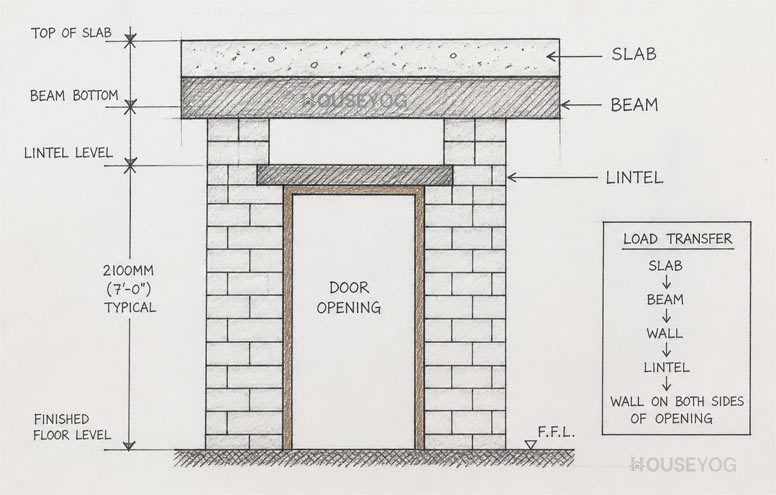
Many people confuse lintel with beams, but they serve slightly different purposes. A lintel specifically supports openings like doors and windows, while beams are part of the overall structural framework carrying slab loads. Understanding this distinction helps avoid design and execution errors during construction.
Before this stage, the structural load is primarily carried through properly designed columns in residential buildings, which form the backbone of the structure.
Standard Lintel Height in House Construction
The standard lintel height in most residential buildings is typically around 7 feet (2100 mm) from the finished floor level. This dimension is widely followed because it aligns well with standard door sizes and provides comfortable headroom.
However, this height is not fixed in all cases. In modern homes with higher ceiling heights, lintel levels are often raised to 7.5 feet or even 8 feet to maintain better proportions and ventilation. Similarly, in premium or custom-designed homes, architects may adjust lintel height based on ceiling design, window placement, and elevation aesthetics.
What’s important is not just the height, but consistency. All openings in a house should ideally align at the same lintel level unless there is a specific design reason to vary it. Uneven lintel heights can create visual imbalance and practical issues during finishing.
Lintel height should also align with overall room proportions, which are typically based on standard house building dimensions.
Why Lintel Height is Important in Construction
Lintel height plays a crucial role in both structural performance and construction accuracy. While it may look like just another concrete band, it actually ensures that loads are properly managed around openings.
From a structural perspective, lintels distribute the load of the wall above doors and windows, preventing cracks and failures. Without a proper lintel, the masonry above an opening would be unsupported and prone to collapse over time.
Beyond structural safety, lintel level also acts as a reference line during construction. It helps maintain uniformity across all openings, ensuring that doors and windows are aligned properly. This becomes especially important when installing frames, shutters, and finishes.
Another often overlooked benefit is that the lintel level creates a continuous band that ties the structure together at that height. In many cases, it also supports future slab shuttering, especially in smaller residential buildings.
Lintel vs Beam vs Slab
One of the most common confusions in house construction is the difference between a lintel, a beam, and a slab. While all three are structural elements, their roles are quite different.
A lintel is a localised structural member placed above openings like doors and windows. Its primary function is to support the load directly above these openings.
A beam, on the other hand, is part of the main structural framework. It runs across columns and supports the load of slabs, walls, and other structural elements. Beams are usually deeper and more heavily reinforced compared to lintels.
The size and strength of beams are critical, which is why understanding standard beam size in house construction becomes important for structural safety.
The slab is the horizontal surface that forms the floor or roof of the building. It transfers its load to beams and columns, forming the primary usable surface of the structure.
Quick Comparison: Lintel vs Beam vs Slab
Here’s a quick comparison for better clarity:
| Element | Location | Purpose | Load Carried | Typical Use |
| Lintel | Above doors & windows | Supports masonry above openings | Localized wall load | Openings (doors/windows) |
| Beam | Between columns | Supports slab & structural loads | Slab + wall + live loads | Structural framework |
| Slab | Floor/Roof level | Creates usable surface | Transfers load to beams | Floors & roofs |
In simple terms, lintels support openings, beams support the structure, and slabs form the usable surface of the building.
Similarly, slab performance depends on proper design and thickness, which you can understand better in this guide on standard slab thickness in house construction.
Common Mistakes at Lintel Level
Lintel level is one of those stages where small on-site mistakes can lead to long-term problems — both structural and visual.
One frequent mistake is maintaining uneven lintel levels across different rooms. This often happens due to poor marking or a lack of supervision. The result is misaligned doors and windows, which become very noticeable after finishing.
Another issue is incorrect height selection. If the lintel level is too low, it can make rooms feel cramped and affect door usability. If it is too high without proper planning, it can disrupt window proportions and elevation design.
Poor shuttering and support for the lintel during casting is another problem area. Weak or misaligned shuttering can lead to uneven lintels, honeycombing, or even slight deflection, which affects both strength and appearance.
Inadequate reinforcement or improper placement of steel bars can compromise the structural integrity of the lintel. Since lintels carry the load from the wall above, this is not an area where shortcuts should be taken.
Finally, curing is often neglected at this stage. Like any concrete element, lintels require proper curing to achieve strength. Skipping this step can lead to cracks and reduced durability.
Practical Site Tips for Lintel Level
A few simple checks at the lintel level can prevent costly corrections later.
Getting lintel level right doesn’t require complex techniques, but it does require attention to detail and coordination on site.
Before casting, always ensure that the lintel level is clearly marked across all walls using a level instrument. This single step can prevent alignment issues later.
It’s also important to coordinate lintel height with door and window frame sizes in advance. Many problems arise when civil work and carpentry decisions are not aligned.
During casting, ensure proper shuttering support and check levels again before pouring concrete. Even small deviations can create noticeable errors later.
After casting, curing should be done properly for at least a few days to ensure strength development. This is a simple step but often overlooked in fast-paced construction.
Frequently Asked Questions About Lintel Level
Lintel level is the height at which a horizontal structural beam is placed above doors and windows to support the load of the wall above.
The standard lintel height in most residential buildings is around 7 feet (2100 mm) from the finished floor level. However, it may vary depending on ceiling height and design preferences.
A lintel supports the load of the wall above doors and windows. It helps distribute weight safely and prevents cracks or structural failure around openings.
Incorrect lintel height can lead to misaligned doors and windows, poor ventilation, and an imbalanced look. In some cases, it may also affect structural performance.
No, a lintel is not the same as a beam. A lintel supports openings like doors and windows, while a beam is a major structural element that carries loads from slabs and transfers them to columns.
Yes, lintels are essential in all masonry construction where there are door and window openings. Without lintels, the wall above openings would be structurally weak.
Conclusion
Lintel level may appear to be a small step in the construction process, but it has a significant impact on both the structure and usability of your home.
From supporting wall loads above openings to ensuring proper alignment of doors and windows, lintels play a critical role in maintaining construction quality. Paying attention to correct height, proper execution, and site coordination at this stage can prevent many common issues later.
It should always be planned along with other structural elements like columns, beams, and slabs to ensure a well-balanced and durable structure.
If you’re building a house, this is one stage where a little awareness can go a long way in ensuring a smoother and better-finished home.
Getting this level right early can save you from visible mistakes and costly fixes later.