
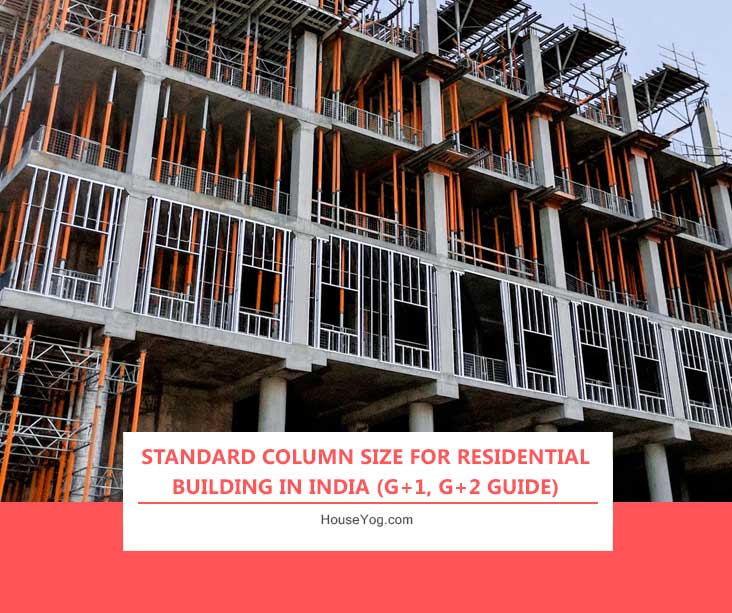

Planning to build your dream home and wondering what column size is safe? This is one of the most confusing and important questions in house construction.
There is no fixed standard column size for residential buildings. It depends on multiple factors like load, soil condition, and the number of floors. And, getting it wrong can lead to cracks, safety issues, or unnecessary extra cost.
In simple terms, a column is the vertical structural member that carries the entire load of your house, from slabs and beams down to the foundation. So its size is not something you should guess or copy from another plan.
In India, many people pick a floor plan from the internet (like our ready house plans) and rely on a contractor or mistri to decide column sizes on site. While this is common, it often leads to overdesign (extra cost) or underdesign (safety risk).
This guide will help you understand typical column sizes used in Indian homes, what actually affects column size, and how to make smarter decisions, even if you don’t have a technical background.
Why There Is No Standard Column Size
Column size is not one-size-fits-all because every house carries a different load and sits on different soil. That’s why there is no single “standard” size that works everywhere.
In simple terms, column size mainly depends on:
- Load on the building: More floors mean more weight coming down on each column
- Soil condition: Weak soil needs stronger (and often larger) columns to safely transfer the load
- Number of floors: A G+2 or G+3 house puts very different stress compared to a single-floor home
A column size that works for a 1-floor house may not be safe for a 3-floor building.
Common Column Sizes Used in Indian Homes
If you look at typical residential construction across India, you’ll notice some commonly used column sizes based on the number of floors.
These are practical site practices followed by contractors, not fixed standards.
Typical Column Sizes by Floors
If you’re searching for the standard column size for residential buildings, this table gives a practical reference used in many Indian homes.
| Number of Floors | Typical Column Size (inches) | Approx (mm) |
| Ground Floor (G) | 9” x 9” | 230 x 230 mm |
| G + 1 Floor | 9” x 12” | 230 x 300 mm |
| G + 2 Floors | 12” x 12” | 300 x 300 mm |
| G + 3 Floors | 12” x 15” | 300 x 380 mm |
What This Table Actually Means
- These sizes are commonly used for small to mid-size residential houses
- As the number of floors increases, the column size increases to handle more load
- Many contractors follow these thumb rules while building G+1 or G+2 homes
Important: These are commonly used sizes on site, not design standards. Actual RCC column size for a residential building should always be based on proper structural calculations by a structural engineer.
What Actually Decides Column Size
Instead of looking for a fixed “standard” column size, it’s more useful to understand what actually controls the size of a column in your house.
In simple terms, column size is decided by how much load it needs to carry and how that load is distributed across the structure.
Here are the key factors that affect it:
1. Number of Floors
- More floors = more load on each column
- A G+2 or G+3 house puts significantly higher stress than a single-floor home
2. Soil Condition
- Soft soil (like clay): Needs stronger columns and a larger footing
- Hard soil: Can safely support relatively smaller column sizes
If you’re unsure about your soil type, it’s always better to get it tested before construction.
You can read this detailed guide on soil testing before construction to understand why it matters.
3. Column Spacing
- Wider spacing between columns increases the load on each column
- Closer spacing distributes the load more evenly
4. Beam Size and Layout
- Beams transfer load from slabs to columns
- Bigger or longer beams can increase the load on columns
5. Total Load on the Building
This includes:
- Walls and slabs
- Overhead water tank
- Future floors (very common in India)
Many people plan for G+1 initially, but later build G+2 or G+3.
If the right column size and layout are not planned from the beginning, the structure may not safely support future floors.
Minimum Column Size for House
In many small residential houses in India (typically single-floor or compact G+1 homes), a 9” x 9” (230 x 230 mm) column is often considered a practical minimum.
But here’s the reality:
- Going smaller than this is rare and generally unsafe in RCC construction
- Even a 9” x 9” column may not be sufficient for a big single-storey home.
So while this size is often quoted as the minimum column size for a house, it is not universally safe or applicable to every project.
Column Size Based on Number of Floors
If you’re trying to estimate the standard column size for a residential building, the number of floors is one of the biggest deciding factors.
As you add more floors, the load on each column increases. That’s why column size typically increases from a single-floor house to G+1 or G+2 buildings.
Here’s a practical breakdown based on common residential construction in India:
Column Size for 1 Floor House
- Common practice: 9” x 9”
- Suitable for small single-storey homes
- Works best with good soil and proper column spacing
Column Size for 2 Storey House in India (G+1)
- Common practice: 9” x 12” or 12” x 12”
- Additional slab and walls increase the load
- Slightly larger columns provide a better safety margin
Column Size for 3 Storey House (G+2)
- Common practice: 12” x 12” or larger
- Higher load requires stronger structural support
- Proper structural design becomes more important at this stage
These are general guidelines based on typical site practice, not final structural specifications. Actual column size should always be confirmed through structural design.
Common Mistakes People Make While Deciding Column Size
This is where most issues in house construction actually begin, not because people ignore column size, but because they rely on guesswork or copied information.
Understanding these common mistakes can help you avoid costly problems later.
Copying Column Size from Internet Plans
Many online floor plans show room sizes, but they don’t include structural design based on your soil or location.
- What works for one house may not work for yours
- Same plan, different soil = different column requirement
This often leads to unsafe design or unnecessary extra cost.
Ignoring Soil Condition
Soil plays a major role in how your building behaves over time.
- Weak soil can cause settlement and cracks
- Strong soil can safely carry more load
Without proper understanding, column and footing size can be completely misjudged.
Using the Same Column Size Everywhere
Not all columns carry the same load.
- Corner columns, middle columns, and load-bearing areas behave differently
- Using one uniform size everywhere may lead to overdesign (higher cost) or underdesign (risk)
Building Without a Structural Drawing
This is one of the most common practices in small residential projects.
- Decisions are taken on-site based on experience
- No clear calculation of load, spacing, or reinforcement
While this may work in some cases, it increases the risk of long-term structural issues.
Can You Still Build Without an Engineer?
The reality is, many houses in India are built this way.
But here’s a more practical way to look at it:
- You can use guides like this to understand the basics and avoid obvious mistakes
- But final decisions on column size should ideally come from structural design, not assumptions
A Smarter Approach (Recommended):
If you already have a floor plan:
- Get a basic structural drawing prepared
- Confirm column size, beam size, and footing before starting construction
This is a one-time cost that can prevent major repair costs later.
When You MUST Consult a Structural Engineer
While small houses are sometimes built using site experience, there are situations where relying only on guesswork can be risky. In these cases, involving a structural engineer is essential for safety and long-term durability.
You should definitely consult a structural engineer if:
- You are building G+2 or more floors: Higher floors significantly increase the load on columns and the foundation
- Your soil condition is weak or unknown: Without a proper understanding, the entire structure may face settlement issues
- Your house has large open spaces or long spans: Bigger spans put additional stress on beams and columns
- You are planning rental floors or future expansion: Columns must be designed for future load from the beginning
In these cases, column size cannot be decided based on experience or thumb rules; it requires proper structural design.
Skipping this step may save some cost initially, but it can lead to cracks, structural issues, or expensive repairs later.
FAQs on Column Size for Residential Buildings
There is no fixed standard column size for residential buildings. It depends on factors like the number of floors, soil condition, column spacing, and total load. However, sizes like 9”x9”, 9”x12”, and 12”x12” are commonly used in Indian homes as site practices.
A 9” x 9” column may work for small G+1 houses under certain conditions, but it is not always safe. In most cases, slightly larger sizes like 9” x 12” or 12” x 12” are preferred for better strength and safety.
In RCC construction, 9” x 9” (230 x 230 mm) is often considered a practical minimum. However, the actual minimum column size depends on load, soil condition, and structural design.
For a G+2 house, column sizes like 12” x 12” or larger are commonly used. Since the load increases significantly, proper structural design is strongly recommended.
You can get a basic idea from general guidelines, but the final column size should always be decided through structural design. Relying only on guesswork or site experience can lead to safety issues.
Yes, soil condition plays a major role. Weak soil requires stronger columns and larger footings, while strong soil can support relatively smaller column sizes.
As the number of floors increases, the load on each column also increases. To safely carry this load, column size and strength must increase accordingly.
Conclusion
There is no one-size-fits-all answer to the question of standard column size for residential buildings. Every house is different, and column size depends on load, soil condition, and building plans.
But if you remember a few key points, you can avoid the most common mistakes:
- 9” x 9” is often a starting point, not a universal solution
- Column size increases with the number of floors and the total load
- Soil condition and column spacing play a major role in safety
Most importantly, treat these as practical guidelines, not as a substitute for structural drawings.
A little awareness at this stage can save you from costly repairs, structural issues, or redesign later.
Need Help with Safe Structural Design?
If you already have a floor plan and want to build with confidence, it’s always better to get your structure checked before starting construction.
At Houseyog, we can help you with:
- Structural drawings and column sizing
- Beam and footing design
- Complete architectural and construction support
Get your plan reviewed by our experts and build safely from day one.