

If you’re building a house, at some point this question comes up on-site or during planning: What is the standard slab thickness for a house in India?
Is 4 inches enough? Should you go for 5 or 6 inches? And does increasing slab thickness actually make your house stronger, or just more expensive?
It sounds like a small technical detail, but slab thickness has a direct impact on your construction cost, structural performance, and how your house behaves over time. The challenge is that there isn’t a single fixed number that works for every house.
And that’s exactly why you’ll hear different answers on different sites or from different contractors.
In most residential buildings, the slab thickness is kept uniform across a floor. But how that thickness is decided depends on factors like room spans, load conditions, and the overall structural design.
That’s where many homeowners get confused — either following what others have done, or making changes without understanding the real impact.
In this guide, you’ll get a clear and practical understanding of what slab thickness is typically used in Indian homes, how it varies in real projects, and how to make the right decision for your house.
What is Slab Thickness in House Construction?
Slab thickness simply means the depth of the RCC (Reinforced Cement Concrete) layer that forms the floor or roof of your house.
This slab is a structural element that carries the load of everything above it, including people, furniture, and even walls in some cases. That load is first transferred to the beams, then to the columns, and finally down to the foundation.
Standard Slab Thickness for House in India (Quick Answer)
For most residential buildings, the standard slab thickness for a house in India typically ranges between 4 inches to 6 inches (100 mm to 150 mm), depending on the span and load conditions.
In actual construction, this is how it is commonly followed on site:
- 4 inches (100 mm) → Minimum thickness, used only for very small spans or low-load areas
- 5 inches (125 mm) → Common in smaller residential rooms
- 5–6 inches (125–150 mm) → Standard range for most houses
- 6 inches and above (150 mm+) → Used for larger spans or areas with higher load
For a typical house, a 5–6 inch slab thickness is considered standard and safe when supported by proper structural design.
Why Slab Thickness is Not Fixed
One of the biggest misconceptions in house construction is that there is a single “correct” slab thickness you can apply everywhere.
In reality, the thickness is decided based on how the slab behaves in your specific layout, and one of the biggest factors affecting that is the distance between beams, also known as the span.
1. Span Between Beams (Most Important Factor)
Think of the slab like a flat surface supported by beams on its sides. The wider the gap between those supports, the more the slab tends to bend under load.
That’s why span plays a major role in deciding thickness:
- Short span (8–10 ft) → thinner slab can safely work
- Medium span (10–14 ft) → standard thickness is typically used
- Long span (15+ ft) → thicker slab becomes necessary
A simple way to understand this is:
The larger the room or open space, the more the slab has to “stretch” without support, so it needs extra thickness to handle that bending safely.
2. Load on the Slab
Another key factor is how the slab will actually be used after construction.
Not all areas in a house carry the same load. A regular bedroom or living room has predictable usage, but some areas put much higher stress on the slab.
For example:
- Normal residential use → standard thickness works well
- Water tanks or storage areas → add a significant concentrated load
- Terrace use (seating, garden, heavy activity) → may require extra thickness
This is why terrace slabs or utility areas are often designed more carefully than regular room slabs.
3. Structural Design (Engineer’s Calculation)
In actual construction, slab thickness is not decided by guesswork; it is derived from structural design calculations.
A structural engineer considers:
- The loads acting on the slab
- How the steel reinforcement will be placed
- The overall layout of beams and columns
Based on this, the slab thickness is finalised along with reinforcement details.
That’s why two houses with similar size or layout can still have different slab thickness, because their design conditions are not the same.
4. Type of Slab
The type of slab used in construction also influences thickness.
Common types include:
- One-way slab
- Two-way slab
- Flat slab (without beams)
In most residential houses in India, beam-supported slabs (one-way or two-way) are used. In such cases, slab thickness typically falls within the 5–6-inch range, depending on the span and load.
Flat slabs, which are more common in apartments or commercial buildings, may have different thickness and design requirements.
How Slab Connects with Other Structural Elements
A house doesn’t work as separate parts—the entire structure behaves like a connected system.
When you place weight on the slab (people, furniture, walls), that load doesn’t stay there. It moves through the structure in a sequence: Slab → Beam → Column → Footing (foundation).
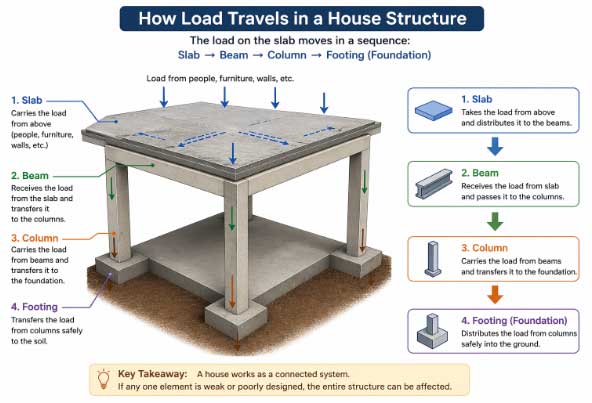
In simple terms:
- The slab passes the load to the beams
- Beams carry it to columns
- Columns transfer it safely into the foundation
This is why slab design cannot be done in isolation. Its thickness, reinforcement, and performance are directly linked to how beams and columns are designed.
If you want a deeper understanding of these elements, you can also check:
- Beam size in house construction
- Standard column size for residential building
- Standard footing size for a house
Cost Impact of Slab Thickness
This is where many homeowners unintentionally overspend.
It’s natural to think that increasing slab thickness will make the house stronger. But in reality, even a small increase in thickness directly adds to your construction cost. Since slab casting covers the entire floor area, even small changes get multiplied across hundreds or thousands of square feet.
Here’s why:
A thicker slab means more concrete is used across the entire floor area. At the same time, the amount of steel reinforcement also increases to support that additional depth. Since slab work covers a large portion of the structure, even a 1-inch increase in thickness can noticeably raise the total material cost.
What this means in practice:
A slab that is thicker than required doesn’t just add strength—it also adds unnecessary cost across concrete, steel, and overall structural work.
Important: A thicker slab does not automatically mean a safer house. The goal is to use the right thickness based on design, not simply go thicker “for safety.”
Common Mistakes to Avoid
Even with the right intent, many homeowners make small decisions around slab thickness that lead to either higher costs or long-term issues.
Here are some common ones to watch out for:
1. Assuming one thickness works everywhere
Using a fixed number without considering span or load conditions can lead to inefficient design.
2. Increasing thickness “just to be safe”
Adding extra thickness without proper reasoning often increases cost, without adding real structural benefit.
3. Relying only on the contractor’s advice
While experience matters, slab design should always be backed by proper structural calculation—not just a rule of thumb.
4. Not planning for future use
If you’re considering an additional floor, water tank, or heavy terrace usage later, it needs to be factored in at the design stage itself.
Practical Recommendation (What Should You Do?)
If you’re planning your house construction, here’s a simple way to approach slab thickness:
- Use 5–6 inches as a general reference range for most residential slabs
- Always finalise thickness based on a structural design, not guesswork
- Think ahead about future loads, like extra floors or terrace usage
- Avoid blindly copying what’s been done in neighbouring houses
If you’re still in the planning stage, you may also find this guide helpful for overall planning: standard house building dimensions in India.
Conclusion
Slab thickness may seem like a small detail, but it has a direct impact on both the safety and cost of your house.
Instead of relying on guesswork or copying what others have done, it’s worth taking a little time to understand what actually affects slab design and how those decisions play out during construction.
A well-designed slab is not the thickest one. It’s the one that is right for your specific layout, span, and usage.
If you’re in the process of planning your house, getting this part right early can help you avoid unnecessary costs and structural issues later.
If you found this guide useful, consider sharing it with someone who is planning their construction. It might help them make a more informed decision.
FAQs on Standard Slab Thickness
Minimum is usually around 4 inches (100 mm), but it is rarely recommended for main residential slabs.
Yes, 5 inches is commonly used in residential construction, depending on span and load.
Not always. It increases cost and is only needed for larger spans or higher loads.
In most cases, slab thickness is kept uniform across a floor. However, it may vary between different parts of a house or in special design conditions.