

Planning to build a 1000 sq ft house? One of the first questions you’ll probably ask is: “How much budget should I keep?”
It’s a simple question, but the answer isn’t as straightforward as multiplying the area by an average construction rate.
A 1000 sq ft house can cost significantly different amounts depending on where you’re building, the quality of construction you expect, your architectural design, labour rates, and the materials you choose. Two homes with the same built-up area can easily differ by several lakhs because of these factors.
That’s why experienced architects don’t estimate a project’s budget based only on square footage. They look at the complete picture—design, structural requirements, specifications, site conditions, and the homeowner’s expectations.
This guide has been created to help you do the same.
Instead of simply telling you the average construction cost, we’ll walk you through the entire budgeting process. You’ll understand how much a typical 1000 sq ft house costs, where that money is spent, when you’ll need it during construction, the materials involved, and the expenses that many first-time home builders overlook.
Whether you’re building your first family home, constructing on an inherited plot, or preparing a budget before applying for a home loan, this guide will help you plan with greater confidence.
What Is the Construction Cost of a 1000 Sq Ft House in India?
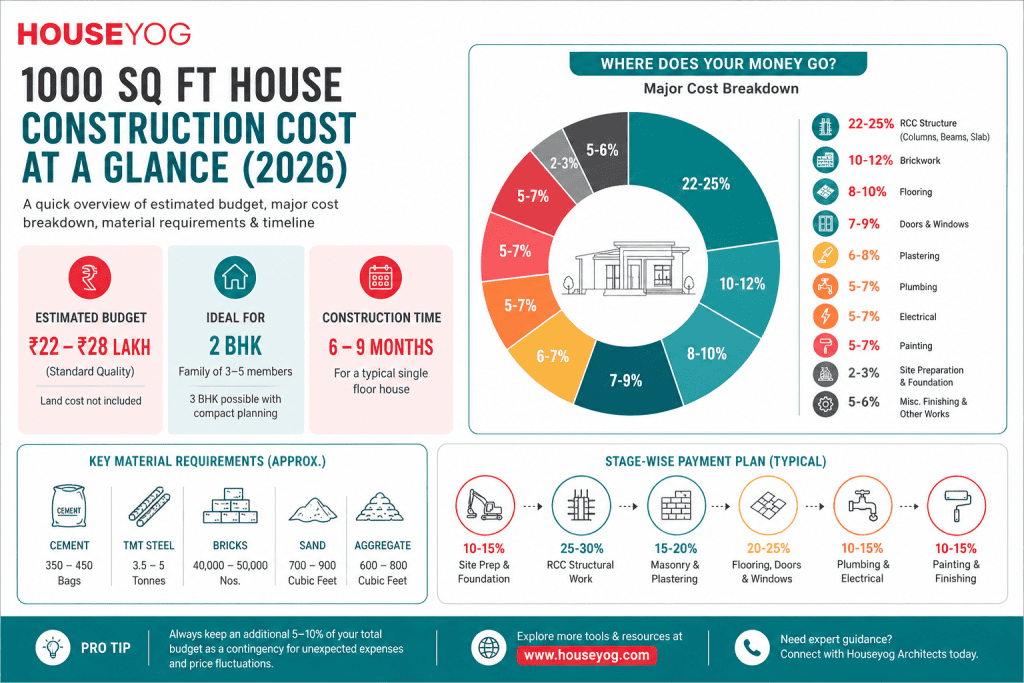
In 2026, the construction cost of a standard-quality 1000 sq ft house in India typically ranges from ₹22 lakh to ₹28 lakh, excluding the cost of land. A basic specification house may cost around ₹18–22 lakh, while a premium home with high-end finishes can cost ₹28–35 lakh or more.
| Construction Quality | Approximate Cost per Sq Ft | Estimated Budget | Suitable For |
| Basic Finish | ₹1,800–₹2,200 | ₹18–22 lakh | Budget-conscious homes with standard finishes |
| Standard Finish | ₹2,200–₹2,800 | ₹22–28 lakh | Most modern family homes |
| Premium Finish | ₹2,800–₹3,500+ | ₹28–35 lakh+ | Luxury finishes and premium specifications |
Note: These estimates cover the building construction only. Land cost, boundary wall, major interior work, furniture, landscaping, and certain approval charges are generally not included.
Rather than focusing only on the final figure, it’s more useful to understand why construction costs vary.
The overall budget depends on factors such as:
- Your city and local labour rates
- Construction quality and finishing level
- Structural design and architectural complexity
- Soil conditions and foundation requirements
- Material prices during construction
- Labour contract or turnkey execution
Knowing these factors helps you prepare a realistic budget instead of relying on a single average rate.
Houseyog Recommendation: Along with your estimated construction cost, keep an additional 5–10% contingency fund. Material price fluctuations and minor design changes are common during construction, and this reserve helps you manage them without disrupting the project.
Is a 1000 Sq Ft House Right for Your Family?
For most families of three to five members, a well-planned 1000 sq ft house provides comfortable space for a 2 BHK layout with essential amenities. Depending on the plot dimensions and design, it can also accommodate a compact 3 BHK or be planned for future vertical expansion.
Choosing the right house size isn’t only about affordability. It also affects your lifestyle, maintenance costs, and future flexibility.
A thoughtfully designed 1000 sq ft house can comfortably include:
- Living room
- Two bedrooms
- One or two bathrooms
- Kitchen with utility area
- Dining space
- Small pooja area
- Parking or porch (subject to plot size)
- Staircase provision for a future floor
Many homeowners assume a larger house automatically offers a better living experience. In reality, efficient planning often matters more than additional square footage. Good natural lighting, ventilation, room proportions, and circulation can make a 1000 sq ft home feel much more spacious than expected.
Can you build a 3 BHK in 1000 sq ft?
Yes, but with compromises.
A compact 3 BHK is possible if the design prioritises functionality over room size. However, if comfort and storage are your priorities, a spacious 2 BHK is usually a better long-term choice.
Should you plan for future expansion?
If you expect your family’s requirements to grow, discuss this with your architect during the planning stage.
Many homeowners build a structurally designed ground floor today while keeping provisions for a future first floor. This spreads the investment over time and avoids expensive structural modifications later.
Architect’s Tip: Build for the next 10–15 years, not just for today. A house that balances present needs with future expansion often provides the best long-term value.
Where Will Your Construction Budget Be Spent?
Nearly half of the construction budget goes into the structural shell—including the foundation, RCC framework, and masonry—while the remaining amount is spent on flooring, doors, windows, plumbing, electrical work, painting, and finishing.
One question naturally follows the overall estimate: “If I’m spending ₹25 lakh, where exactly is that money going?”
Understanding this breakdown helps you allocate your budget wisely and avoid overspending on areas that can be upgraded later.
| Construction Activity | Approx. Share | Estimated Cost (₹22–28 lakh Budget) |
| Site preparation | 2–3% | ₹45,000–₹75,000 |
| Foundation | 8–10% | ₹1.8–2.8 lakh |
| RCC structure | 22–25% | ₹4.8–7.0 lakh |
| Brickwork | 10–12% | ₹2.2–3.3 lakh |
| Plastering | 6–8% | ₹1.3–2.2 lakh |
| Flooring | 8–10% | ₹1.8–2.8 lakh |
| Doors & windows | 7–9% | ₹1.5–2.5 lakh |
| Plumbing | 5–7% | ₹1.1–2.0 lakh |
| Electrical | 5–7% | ₹1.1–2.0 lakh |
| Painting | 5–6% | ₹1.1–1.7 lakh |
| Miscellaneous finishing | 5–7% | ₹1.1–2.0 lakh |
Rather than examining every item in isolation, it helps to think of the project in two broad parts.
The structural shell—foundation, RCC work, and masonry—forms the backbone of your home. These components determine its strength, durability, and long-term safety.
The second part consists of services and finishes, including flooring, windows, plumbing, electrical work, painting, and other visible elements. These influence the comfort and appearance of your home and offer greater flexibility if you need to optimise costs.
This distinction is important because finishes can usually be upgraded later, whereas structural work cannot.
Stage-wise Budget Planning: When Will You Need the Money?
You don’t need the full construction budget on day one. A house is built in stages, and your expenses increase gradually as the project progresses. Understanding this cash flow helps you plan savings, manage home loan disbursements, and avoid work stoppages due to a shortage of funds.
Knowing that your house may cost around ₹25 lakh is useful, but it doesn’t mean you need the entire amount before construction begins.
Residential construction follows a predictable sequence. As each stage is completed, the next begins, and your spending moves accordingly. Thinking of construction as a series of planned investments—not one large expense—makes budgeting much easier.
A typical 1000 sq ft house follows a pattern similar to this:
| Construction Stage | Approx. Share of Budget | Major Activities |
| Site preparation & foundation | 10–15% | Excavation, footing, PCC, foundation |
| RCC structural work | 25–30% | Columns, beams, slab, staircase |
| Masonry & plastering | 15–20% | Brickwork, partitions, plaster |
| Flooring, doors & windows | 20–25% | Tiles, doors, windows, waterproofing |
| Plumbing & electrical | 10–15% | Concealed services, fittings |
| Painting & finishing | 10–15% | Paint, sanitary fixtures, final finishing |
Although every project differs slightly, this sequence remains broadly the same across most residential houses.
How Should You Plan Your Cash Flow?
Let’s assume your estimated construction cost is ₹25 lakh.
Instead of arranging the entire amount at once, you can broadly plan your finances around construction milestones.
| Construction Milestone | Approximate Cumulative Budget |
| Foundation completed | ₹3–4 lakh |
| RCC structure completed | ₹10–12 lakh |
| Brickwork & plaster completed | ₹16–18 lakh |
| Flooring & joinery completed | ₹21–22 lakh |
| Final completion | ₹25 lakh + contingency |
This approach gives you much better financial control. It also helps if you’re building with a home loan, as banks generally release funds in stages based on construction progress.
Common Budget Planning Mistakes
In our experience, cost overruns are often caused by planning mistakes rather than construction itself.
Some of the most common ones include:
- Starting construction without arranging sufficient funds for the structural phase.
- Upgrading finishes midway through the project.
- Forgetting to budget for approval charges or utility connections.
- Making design changes after construction has started.
- Not keeping a contingency reserve.
Houseyog Recommendation: Prepare a simple construction budget sheet before work begins. Tracking planned expenses against actual spending throughout the project helps you identify budget overruns early instead of discovering them near completion.
Material Requirements for a 1000 Sq Ft House
A standard 1000 sq ft RCC house generally requires around 350–450 bags of cement, 3.5–5 tonnes of TMT steel, 40,000–50,000 bricks, 700–900 cubic feet of sand, and 600–800 cubic feet of aggregate. These are planning estimates and should not replace project-specific calculations prepared from structural drawings.
Once you know your budget and understand when it will be spent, the next logical question is: “How much material will my house actually require?”
Construction materials account for a major share of the overall project cost. Planning them correctly not only helps you estimate your budget more accurately but also reduces wastage and improves purchasing decisions.
The following table provides a practical planning estimate for a typical 1000 sq ft single-floor house.
| Material | Typical Planning Estimate | Primary Usage |
| Cement | 350–450 bags | RCC, masonry, plaster, flooring |
| TMT Steel | 3.5–5 tonnes | Foundation, columns, beams, slab |
| Bricks | 40,000–50,000 | External and internal walls |
| Sand | 700–900 cubic feet | Concrete, masonry and plaster |
| Aggregate | 600–800 cubic feet | PCC and RCC concrete |
These quantities may change depending on your structural design, walling system, floor height, and whether the building is designed for future expansion.
Understanding the Major Materials
Let’s understand the major construction materials that will be required to build the house.
Cement
Cement is used throughout the construction process—from the foundation and RCC work to plastering, flooring, and tile fixing. Because it is consumed in almost every stage, changes in cement prices have a noticeable impact on the overall construction budget.
If you’re looking for a detailed quantity calculation, material consumption by stage, and practical buying tips, read our guide on Cement Required for a 1000 Sq Ft House.
TMT Steel
Steel provides the structural strength of the building and is primarily used in foundations, columns, beams, slabs, and staircases.
The exact quantity depends on the structural engineer’s design, so treat standard estimates only as a budgeting reference.
For a detailed breakdown, see our article on Steel Required for House Construction.
Bricks
Bricks or blocks form the walls of your house. The total quantity depends on the number of partitions, wall thickness, openings, and the type of masonry material selected.
If you’re comparing clay bricks, fly ash bricks, or AAC blocks, check our detailed guide on Bricks Required for a 1000 Sq Ft House Construction.
Sand and Aggregate
Sand is used in concrete, mortar, plastering, and tile bedding, while aggregate forms an essential part of concrete for foundations and RCC work.
Quality matters as much as quantity. Reliable sourcing and proper grading contribute significantly to the strength and durability of the finished structure.
Our detailed guides on Sand Required for a 1000 Sq Ft House Construction explain these calculations in greater detail.
Should You Buy All Materials Together?
Generally, no.
Buying materials according to the construction schedule usually works better because it:
- Improves cash flow.
- Reduces storage requirements.
- Minimises weather-related damage.
- Helps prevent unnecessary inventory.
However, if you expect major price increases or have adequate storage facilities, purchasing selected materials such as TMT steel in advance may sometimes be beneficial.
Discuss the procurement schedule with your architect or contractor before placing large orders.
Labour Contract vs Turnkey Construction: Which Should You Choose?
A labour contract usually offers better cost control if you can supervise construction yourself, while a turnkey contract provides greater convenience because the contractor manages both labour and materials. The better option depends on your availability, budget, and level of involvement.
Before construction begins, you’ll also need to decide how the project will be executed.
Should you purchase materials yourself, or let the contractor manage everything?
| Aspect | Labour Contract | Turnkey Contract |
| Materials | Purchased by homeowner | Managed by contractor |
| Cost control | Higher | Moderate |
| Site supervision | More involvement | Less involvement |
| Convenience | Moderate | High |
| Best suited for | Local homeowners | Working professionals and NRIs |
If you live close to the construction site and can spend time supervising the work, a labour contract often provides better flexibility and greater control over quality.
On the other hand, if you’re busy, live in another city, or simply prefer a hassle-free experience, turnkey construction can save considerable time by placing responsibility with a single contractor.
Whichever method you choose, define the scope of work, material specifications, payment schedule, and completion timeline clearly before construction starts.
Architect’s Tip: Most construction disputes arise from unclear expectations rather than poor workmanship. A detailed written agreement protects both the homeowner and the contractor.
Hidden Costs Most Homeowners Forget
The quoted construction cost usually covers only the building itself. Expenses such as architectural design, government approvals, utility connections, compound walls, septic tanks, and interior work are often budgeted separately. Planning for these costs in advance helps avoid unpleasant financial surprises.
One of the biggest mistakes first-time home builders make is assuming that the contractor’s estimate represents the total project cost.
In reality, building a house involves several additional expenses that are easy to overlook during the planning stage. Individually, some of these may seem small, but together they can increase your overall investment by several lakhs.
The table below highlights some of the most common costs that fall outside a standard construction estimate.
| Additional Expense | Why It Matters |
| Architectural & structural design | Professional planning ensures safety, functionality, and efficient use of space. |
| Building approvals | Municipal approval charges and local authority fees vary by location. |
| Soil testing | Helps determine the appropriate foundation design. |
| Borewell or water connection | Essential for construction and future household use. |
| Boundary wall & gate | Often planned separately from the main building. |
| Septic tank or sewer connection | Depends on local infrastructure and regulations. |
| Temporary electricity | Required during construction before the permanent connection is available. |
| Interior work | Modular kitchen, wardrobes, furniture, false ceiling, lighting, etc. |
| Contingency fund | Covers unexpected expenses and price fluctuations. |
The easiest way to avoid budget stress is to recognise these costs before construction begins rather than treating them as unexpected additions later.
Houseyog Recommendation: Along with your construction estimate, prepare a separate list of project-related expenses. This gives you a much clearer picture of the total investment required to complete and occupy your home.
How to Reduce Construction Cost Without Compromising Quality
The best way to reduce construction costs is through better planning—not by compromising on structural quality. A finalized design, realistic budgeting, timely material procurement, and careful contractor selection often save far more money than choosing cheaper materials.
Every homeowner wants to build economically, but cost reduction should never come at the expense of durability or safety.
Instead of looking for shortcuts, focus on making smarter decisions throughout the project.
Finalize the Design Before Construction Starts
Design changes during construction often lead to demolition, rework, material wastage, and additional labour charges.
A finalized plan is one of the simplest ways to control your budget.
Compare Detailed Quotations
When evaluating contractors, don’t compare only the total price.
Look at:
- Material specifications
- Scope of work
- Payment schedule
- Completion timeline
- Items excluded from the quotation
A slightly higher quotation may actually provide better value if it includes higher-quality materials or additional services.
Purchase Materials Strategically
Buying materials according to the construction schedule improves cash flow and reduces storage-related losses.
At the same time, keep an eye on market trends. If prices are expected to rise sharply and you have safe storage space, purchasing selected materials in advance may be worthwhile.
Prioritize Structural Quality
If your budget becomes tight, postpone upgrades such as premium tiles, decorative lighting, or luxury fittings.
Avoid compromising on:
- Foundation
- RCC structure
- Waterproofing
- Concealed plumbing
- Concealed electrical wiring
These are difficult and expensive to modify once construction is complete.
Track Your Budget Regularly
Maintain a simple spreadsheet or budget tracker throughout the project.
Reviewing planned versus actual spending every few weeks helps identify cost overruns before they become major problems.
Architect’s Tip: The most successful construction projects aren’t necessarily the cheapest—they’re the ones where every major decision is planned before construction begins. Refer to our detailed guide on How to reduce construction costs in India, where we have discussed more smart ideas.
Sample Budget for a Standard 1000 Sq Ft House Construction
The example below illustrates how a typical ₹25 lakh construction budget may be distributed for a standard-quality 1000 sq ft house.
| Construction Activity | Approximate Cost |
| Site preparation | ₹60,000 |
| Foundation | ₹2,20,000 |
| RCC structure | ₹5,60,000 |
| Brickwork | ₹2,70,000 |
| Plastering | ₹1,60,000 |
| Flooring | ₹2,10,000 |
| Doors & windows | ₹1,80,000 |
| Plumbing | ₹1,30,000 |
| Electrical | ₹1,25,000 |
| Painting | ₹1,30,000 |
| Miscellaneous finishing | ₹1,55,000 |
| Estimated Building Cost | ₹22,00,000 |
| Contingency (10%) | ₹2,20,000 |
| Other project expenses | ₹80,000 |
| Estimated Total Budget | ₹25,00,000 |
Treat this only as a planning reference. The actual cost of your project will depend on your location, structural design, material choices, labour rates, and construction specifications.
Plan Your Project with These Houseyog Resources
Planning a home becomes much easier when you have access to the right information and tools. The following Houseyog resources can help you prepare a more accurate construction budget and make informed decisions throughout your project.
| Resource | How It Helps |
| Construction Cost Calculator | Estimate your construction budget based on area and specifications. |
| House Construction Cost Per Sq Ft in India | Compare average construction rates across different quality levels. |
| Cement Required for a 1000 Sq Ft House | Estimate cement consumption accurately. |
| Steel Required for House Construction | Understand approximate reinforcement requirements. |
| Bricks Required for a 1000 Sq Ft House | Calculate brick quantity based on your layout. |
| Sand Required for a 1000 Sq Ft House | Estimate sand requirement for different construction stages. |
| Aggregate Required for a 1000 Sq Ft House | Plan aggregate quantities for concrete work. |
| House Plans and Designs | Browse professionally designed floor plans for different plot sizes. |
| Architectural Design Services | Get personalised planning and design assistance from Houseyog’s architects. |
Need Professional Help with Your House Construction?
If you’re looking for a reliable construction partner, Houseyog offers end-to-end house construction services, from planning and architectural design to project execution.
Whether you’re building your first home or planning a custom residence, our team can help you with quality construction, transparent pricing, and professional project management.
Key Takeaways
✓ Budget around ₹22–28 lakh for a standard-quality 1000 sq ft house.
✓ Keep an additional 5–10% contingency.
✓ Nearly half the budget goes into the structural shell.
✓ Purchase materials in stages.
✓ Decide between labour contract and turnkey before construction begins.
✓ Don’t forget approval charges and interior work.
Frequently Asked Questions
Yes, it’s possible in some locations with a simple design, basic finishes, and careful cost management. However, for a standard-quality home in most parts of India, you should generally budget around ₹22–28 lakh, excluding land and major interior work.
No. The figures in this guide cover only the construction of the house. Land cost, registration charges, stamp duty, and site purchase expenses are separate.
Generally, no. Items such as modular kitchens, wardrobes, furniture, decorative lighting, false ceilings, and loose appliances are usually budgeted separately unless specifically included in your contractor’s quotation.
A labour contract usually offers better cost control if you can supervise the project yourself. Turnkey construction provides greater convenience by placing responsibility for materials and labour with a single contractor.
Keeping 5–10% of your estimated construction budget as a contingency reserve is recommended. This provides flexibility for design changes, material price fluctuations, and unforeseen site conditions.
A typical single-floor 1000 sq ft house usually takes 6–9 months to complete, depending on labour availability, weather, design complexity, and the speed of decision-making.
Yes. Better planning, a finalized design, strategic material procurement, and choosing the right contractor often reduce costs without compromising the strength or durability of the building.
In most cases, no. Purchasing materials according to the construction schedule helps improve cash flow, reduces storage requirements, and minimises the risk of damage or theft.
Over to You
Planning your home is one of the biggest financial decisions you’ll make. A little preparation today can save significant money, time, and stress during construction.
Whether you’re still estimating your budget or ready to begin construction, careful planning is the foundation of a successful home-building journey.
If you’d like professional guidance, Houseyog can help you at every stage—from house plans and architectural design to complete house construction services. Our team works closely with homeowners to turn ideas into practical, well-built homes that match their budget and requirements.
You can also explore our Construction Cost Calculator, detailed material estimation guides, and professionally designed house plans to plan your project with greater confidence.
Ready to build your dream home? Learn more about our House Construction Services and see how Houseyog can help bring your vision to life.