

Building a house involves hundreds of decisions, but one question almost every homeowner asks during the planning stage is: How much steel will I need for my house?
Steel is one of the most important structural materials used in RCC (Reinforced Cement Concrete) construction. It provides tensile strength to foundations, columns, beams, slabs, staircases, and other structural components. Since steel is also among the costliest construction materials, estimating the required quantity early helps you plan your budget more accurately.
As a general rule, a typical RCC residential house in India requires approximately 3.5 to 5 kg of steel per sq ft of built-up area. For a 1000 sq ft house, this usually translates to 3.5 to 5 tonnes of steel, depending on the structural design, number of floors, seismic requirements, and loading conditions.
In this guide, we’ll explain how steel quantity is estimated, how much steel different house sizes typically require, factors that influence steel consumption, and how to estimate the likely cost of TMT bars for your project.
Steel Required Per Sq Ft for House Construction
Steel consumption varies depending on the type of structure and the number of floors. A single-storey house generally requires less reinforcement than a G+1 or G+2 building because the structural elements carry lower loads.
The table below provides a practical estimate commonly used during preliminary planning.
| Construction Type | Steel Requirement |
| Single Storey RCC House | 3.5–4.5 kg/sq ft |
| G+1 House | 4.0–5.0 kg/sq ft |
| G+2 House | 4.5–6.0 kg/sq ft |
| 1000 sq ft House | 3.5–5 tonnes |
| Typical Steel Cost | ₹2–3 lakh |
These values are intended for budgeting and initial planning purposes only. The actual quantity should always be determined by a qualified structural engineer based on soil conditions, architectural layout, span lengths, and local building requirements.
Quick Example
Suppose you are constructing a 1000 sq ft single-storey RCC house.
Steel required: 1000 x 4 kg/sq ft = 4,000 kg
Since 1 tonne equals 1,000 kg: 4,000 kg = 4 tonnes of steel
This is why many contractors and engineers estimate that a typical 1000 sq ft RCC house requires around 4 tonnes of TMT steel.
Steel Required for Different House Sizes
If you’re still in the planning stage, the following table can help you estimate the approximate steel requirement for different house sizes.
| Built-up Area | Approximate Steel Requirement |
| 600 sq ft | 2.1–3 tonnes |
| 800 sq ft | 2.8–4 tonnes |
| 1000 sq ft | 3.5–5 tonnes |
| 1200 sq ft | 4.2–6 tonnes |
| 1500 sq ft | 5.2–7.5 tonnes |
These estimates assume conventional RCC residential construction. Homes with large spans, heavy cantilever projections, open floor plans, or additional future floor provisions may require more steel than shown above.
How to Calculate Steel Quantity for a House
For preliminary estimation, engineers often use a steel consumption factor based on the built-up area.
Formula
Steel Quantity (kg) = Built-up Area (sq ft) × Steel Consumption Factor (kg/sq ft)
Example Calculation
For a 1200 sq ft house:
Built-up area = 1200 sq ft
Assumed steel consumption = 4.5 kg/sq ft
Steel required: 1200 × 4.5 = 5,400 kg or 5.4 tonnes
This method is useful for rough budgeting. However, final steel quantities are calculated from structural drawings by measuring reinforcement required in foundations, columns, beams, slabs, lintels, staircases, and other RCC elements.
Steel Required in Different Structural Components
After estimating the total steel requirement for a house, many homeowners want to know where that steel is actually used.
In an RCC house, steel reinforcement is distributed across foundations, columns, beams, slabs, staircases, and other structural elements. The exact quantity varies from one project to another, but the table below provides a useful rule-of-thumb distribution for typical residential construction.
Understanding this breakdown helps you verify material estimates, plan procurement in phases, and better understand your structural drawings during construction.
| Structural Component | Typical Share of Total Steel |
| Foundation | 15–20% |
| Columns | 20–25% |
| Beams | 20–25% |
| Slabs | 25–30% |
| Staircase & Miscellaneous RCC Works | 5–10% |
For example, if your house requires approximately 4 tonnes (4,000 kg) of steel, around 1,000–1,200 kg may be consumed in slabs, 800–1,000 kg in beams, and another 800–1,000 kg in columns. The remaining steel is typically distributed among foundations, staircases, lintels, sunshades, and other RCC components.
Keep in mind that these percentages are indicative only. Houses with large cantilever balconies, long beam spans, heavy roof loads, or special earthquake-resistant detailing may have a different steel distribution. Your structural engineer’s design should always be considered the final authority for quantity estimation.
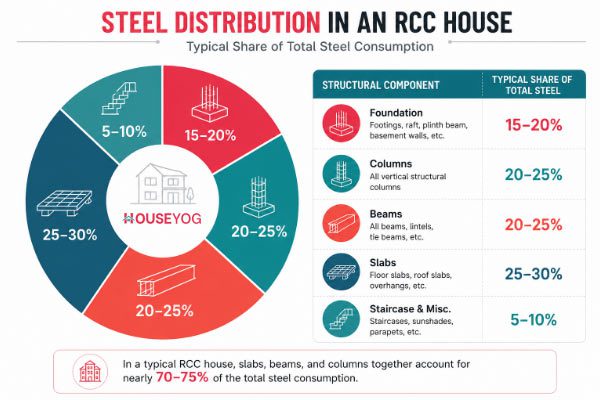
In a typical RCC house, slabs, beams, and columns together account for nearly 70–75% of the total steel consumption.
Factors Affecting Steel Requirement in House Construction
Many online calculators provide a single number, such as “4 kg per sq ft,” but real projects are rarely that simple. Several design and site factors influence how much steel your house will actually require.
Number of Floors
One of the biggest factors is the number of floors.
A single-storey house experiences lower structural loads than a G+1 or G+2 building. As floors are added, columns, beams, and foundations must carry greater loads, which generally increases reinforcement requirements.
If you plan to construct additional floors in the future, your engineer may design stronger foundations and columns from the beginning, increasing steel consumption even during Phase 1 construction.
Seismic Zone Requirements
Earthquake-resistant design plays a significant role in steel quantity.
Many parts of Bihar, North Bengal, Sikkim, and neighbouring regions fall within moderate to high seismic zones. Structures in these locations often require additional reinforcement detailing to improve ductility and earthquake performance.
As a result, steel consumption may be higher than that of similar houses constructed in lower seismic zones.
Column Spacing and Structural Layout
Houses with larger room spans and fewer columns generally require stronger beams and slabs.
For example, a home with a large living room measuring 18–20 feet across will often need more reinforcement than a layout with shorter spans and more closely spaced columns.
Cantilever Balconies and Projections
Balconies, sunshades, entrance canopies, and other cantilever elements create additional bending stresses.
The larger the projection, the more reinforcement is typically required to safely support these structural elements.
Staircase Design
Different staircase configurations can affect steel consumption.
Dog-legged staircases, floating staircases, and cantilever stair designs often require varying levels of reinforcement depending on span and support conditions.
RCC Structure vs Load-Bearing Construction
Steel requirements differ significantly between RCC-framed structures and load-bearing buildings.
In a load-bearing house, walls transfer much of the structural load, reducing the number of RCC members required. In contrast, RCC framed structures depend on columns, beams, and slabs, which increases steel consumption.
If you’re evaluating the two construction approaches, read our detailed guide on RCC vs Load-Bearing Construction to understand the structural and cost implications of each system.
Steel Cost for House Construction
Once you estimate the quantity, the next question is usually:
How much will the steel cost?
TMT steel prices vary by brand, grade, location, and market conditions. In most parts of India, residential projects typically see steel prices ranging between ₹55 and ₹70 per kg.
Example Cost Calculation
Assume:
Steel quantity = 4 tonnes
Steel price = ₹60 per kg
Since 4 tonnes equals 4,000 kg:
4,000 x ₹60 = ₹2,40,000
Therefore, the approximate steel cost would be:₹2.4 lakh
The table below shows indicative costs for different steel quantities.
| Steel Quantity | Approximate Cost at ₹60/kg |
| 3 tonnes | ₹1.8 lakh |
| 4 tonnes | ₹2.4 lakh |
| 5 tonnes | ₹3.0 lakh |
| 6 tonnes | ₹3.6 lakh |
Always check current local market rates before finalising your budget because steel prices can fluctuate significantly throughout the year.
Steel is only one component of your structural budget. If you’re estimating materials for a new home, you may also want to calculate the cement required for a 1000 sq ft house and the bricks required for a 1000 sq ft house. Together with steel estimates, these figures provide a much clearer picture of your overall construction material requirements and budget.
Common Mistakes While Estimating Steel Requirement
Many homeowners underestimate steel requirements during budgeting. Here are some common mistakes to avoid.
Relying Solely on Generic Kg Per Sq Ft Values
The 3.5–5 kg per sq ft rule is useful for planning, but every building is different. Actual quantities can vary significantly depending on structural design.
Ignoring Future Floor Provisions
Many homeowners plan a single-storey house initially and later decide to add another floor. If future expansion is considered during design, steel requirements in foundations and columns may increase.
Not Accounting for Wastage
Cutting, bending, overlaps, and handling losses can contribute to material wastage. A small allowance should be included when planning procurement.
Purchasing Steel Before Structural Design Is Complete
Buying steel without approved structural drawings can lead to incorrect quantities, unnecessary expenses, and procurement challenges later in the project.
For accurate estimation, always rely on structural drawings prepared by a qualified engineer.
FAQs About Steel Quantity
A typical RCC house of 1000 sq ft usually requires around 3.5 to 5 tonnes of steel. The exact quantity depends on factors such as structural design, number of floors, seismic requirements, column spacing, and foundation type.
Most residential RCC houses require approximately 3.5 to 6 tonnes of steel for every 1000 sq ft of built-up area. Larger homes or multi-storey buildings generally require higher quantities.
For preliminary estimation, steel consumption in residential RCC construction typically ranges from 3.5 to 5 kg per sq ft. Multi-storey structures may require more, depending on load and design considerations.
If a 1000 sq ft house requires about 4 tonnes of steel and the market rate is ₹60 per kg, the estimated steel cost would be around ₹2.4 lakh. Actual costs vary based on location, brand, and prevailing steel prices.
Yes. A G+1 house generally requires more reinforcement because columns, beams, foundations, and slabs must carry additional loads from the upper floor. This increases overall steel consumption.
Buildings located in higher seismic zones often require additional reinforcement and ductile detailing to improve earthquake resistance. As a result, steel consumption may be higher than comparable structures in lower-risk regions.
Fe500 and Fe550 TMT bars are commonly used for residential construction in India. The appropriate grade depends on structural design requirements, seismic considerations, and local building conditions. Always follow the recommendations provided by your structural engineer.
Conclusion
Steel is one of the most important structural materials used in house construction, and understanding its approximate requirements can help you plan your project budget more effectively. For most RCC residential buildings, steel consumption typically ranges from 3.5 to 5 kg per sq ft, although the actual quantity depends on factors such as the number of floors, structural design, seismic zone, span lengths, and future expansion plans.
As a rough estimate, a 1000 sq ft house generally requires between 3.5 and 5 tonnes of steel, while larger homes will need proportionately more reinforcement. Using a simple steel consumption factor can help during the planning stage, but final quantities should always be calculated from structural drawings prepared by a qualified engineer.
At Houseyog, we routinely prepare structural and architectural plans for residential projects across Bihar, Jharkhand, West Bengal, and other parts of India, where steel requirements vary significantly based on site conditions and structural design.
It is equally important to remember that steel prices fluctuate based on location, brand, and market conditions. Therefore, both quantity estimation and current steel rates should be considered when preparing your construction budget.
At Houseyog, we recommend using these estimates as a starting point and obtaining a proper structural design before purchasing materials. Doing so helps ensure safety, cost efficiency, and long-term durability for your home.