

If you’re planning to build a 1000 sq ft house, one of the first questions that comes up is: How many bricks will I need?
Whether you’re preparing a construction budget, discussing material requirements with a contractor, or simply trying to understand the overall cost of building a house, knowing the approximate brick requirement can help you make better decisions.
The challenge is that there is no single answer.
The actual quantity depends on several factors, including wall thickness, floor height, number of rooms, door and window openings, parapet walls, and whether the house is built using RCC framed construction or a load-bearing structure.
For a typical 1000 sq ft RCC framed 2 BHK house, the brick requirement generally falls between 8,000 – 10,000 bricks for internal and external walls. However, this should be treated as a planning estimate rather than an exact quantity.
If you are planning a new home and want a realistic estimate of the bricks you may need, this guide will help you understand both the quick estimation method and the factors that influence the final quantity.
In this guide, we will explain:
- How many bricks are typically required for a 1000 sq ft house
- How to calculate brick quantity using a simple formula
- Factors that affect brick consumption
- Approximate brick cost for a 1000 sq ft house
- Brick requirements for different house sizes
By the end of this article, you will have a much clearer understanding of how to estimate brick quantities for your own project.
Bricks Required for a 1000 Sq Ft House (At a Glance)
| Item | Estimate |
| House Size | 1000 sq ft |
| Construction Type | RCC Framed |
| Approximate Bricks Required | 8,000–10,000 |
| Estimated Brick Cost (@ ₹8/brick) | ₹64,000–₹80,000 |
| Includes | Internal and external walls |
| Excludes | Boundary wall, parapet wall, decorative masonry |
How Many Bricks Are Required for a 1000 Sq Ft House?
For preliminary planning, most RCC-framed residential houses in India fall within the following range:
| Built-up Area | Approximate Bricks Required |
| 500 sq ft | 4,000 – 5,000 |
| 800 sq ft | 6,500 – 8,000 |
| 1000 sq ft | 8,000 – 10,000 |
| 1200 sq ft | 9,500 – 12,000 |
| 1500 sq ft | 12,000 – 15,000 |
As a rule of thumb, a standard 1000 sq ft 2 BHK house with 10-foot wall height usually requires around 8,000 to 10,000 bricks for wall construction.
However, this estimate generally excludes:
- Boundary walls
- Compound walls
- Decorative masonry features
- Large parapet walls
- Additional outbuildings
If your project includes these elements, the total brick requirement can increase significantly.
Quick Brick Requirement Estimate
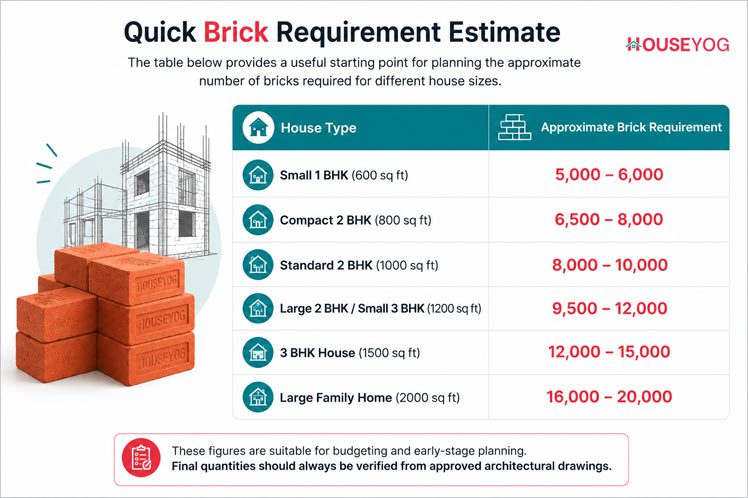
If you only need a rough planning estimate, the table below provides a useful starting point.
| House Type | Approximate Brick Requirement |
| Small 1 BHK (600 sq ft) | 5,000 – 6,000 |
| Compact 2 BHK (800 sq ft) | 6,500 – 8,000 |
| Standard 2 BHK (1000 sq ft) | 8,000 – 10,000 |
| Large 2 BHK / Small 3 BHK (1200 sq ft) | 9,500 – 12,000 |
| 3 BHK House (1500 sq ft) | 12,000 – 15,000 |
| Large Family Home (2000 sq ft) | 16,000 – 20,000 |
These figures are suitable for budgeting and early-stage planning. Final quantities should always be verified from approved architectural drawings.
How to Calculate Brick Quantity for House Construction
If you want a more accurate estimate, it helps to understand the basic calculation method used on construction projects.
Step 1: Calculate Total Wall Length
Let’s assume a typical 1000 sq ft 2 BHK house has:
- External wall perimeter: 130 ft
- Internal partition walls: 120 ft
Total wall length:
130 + 120 = 250 ft
Step 2: Calculate Wall Volume
Assume:
- Wall height = 10 ft
- Wall thickness = 4.5 inches (0.375 ft)
Wall volume: 250 x 10 x 0.375 = 937.5 cubic ft
Step 3: Convert Wall Volume into Brick Quantity
For standard brick masonry, approximately 13.5 bricks are required per cubic foot of brickwork.
Therefore:
937.5 x 13.5 = 12,656 bricks
Step 4: Deduct Openings
Now deduct the volume occupied by:
- Main doors
- Internal doors
- Windows
- Ventilators
After accounting for openings, the practical requirement may reduce to approximately 10,000–11,000 bricks
This simple method provides a far better estimate than relying on a fixed brick-per-square-foot assumption.
Why Two 1000 Sq Ft Houses May Need Different Brick Quantities
One of the biggest misconceptions in house construction is assuming that all 1000 sq ft houses require the same number of bricks.
In practice, two houses with identical floor areas can have very different masonry requirements.
Wall Thickness Makes a Big Difference
A house built with 9-inch external walls will require significantly more bricks than a house using thinner partition walls throughout. This is one reason why two houses with the same built-up area can have noticeably different brick requirements.
More Rooms Mean More Bricks
A compact 2 BHK layout typically requires fewer partition walls than a 3 BHK design.
More rooms create more internal walls, increasing total masonry volume and brick consumption.
Larger Windows Mean Fewer Bricks
Modern homes often feature larger windows for better ventilation and natural light.
Because windows replace portions of masonry walls, houses with larger openings generally require fewer bricks.
Load-Bearing Construction Uses More Bricks
In a load-bearing structure, walls support the building load.
These walls are usually thicker and consume considerably more bricks than an RCC-framed building.
If you’re comparing construction methods, you may also find our guide on RCC vs Load-Bearing Construction useful.
Modern RCC Framed Houses Use Fewer Bricks
Most modern houses use RCC columns and beams to carry structural loads.
Since the walls primarily act as partitions and enclosures, brick consumption is generally lower.
Parapet Walls Increase Brick Requirement
Parapet walls around the terrace can add approximately 500 to 1,500 bricks depending on height and perimeter length.
Boundary Walls Can Add Thousands of Bricks
Many homeowners overlook boundary walls during estimation.
A medium-sized compound wall can easily consume several thousand additional bricks and significantly affect the total material budget.
Brick Cost for a 1000 Sq Ft House
After estimating the quantity, the next logical question is cost.
If brick prices in your area average around ₹8 per brick, the approximate material cost would be:
| Brick Quantity | Approximate Cost |
| 8,000 Bricks | ₹64,000 |
| 9,000 Bricks | ₹72,000 |
| 10,000 Bricks | ₹80,000 |
Keep in mind that these figures cover brick purchase costs only.
Your actual brickwork budget may also include:
- Transportation
- Loading and unloading
- Labour charges
- Mortar materials
- Wastage allowance
Since brickwork is only one part of the overall masonry budget, you may also want to understand the cement required for a 100 sq ft house construction and the labour cost involved in brick masonry work
Bricks Required for Different House Sizes
As house size increases, wall lengths generally increase as well, leading to higher brick consumption.
| House Size | Approximate Bricks Required |
| 600 sq ft | 5,000 – 6,000 |
| 800 sq ft | 6,500 – 8,000 |
| 1000 sq ft | 8,000 – 10,000 |
| 1200 sq ft | 9,500 – 12,000 |
| 1500 sq ft | 12,000 – 15,000 |
| 2000 sq ft | 16,000 – 20,000 |
These estimates are suitable for planning purposes and should be refined once architectural drawings are available.
Common Mistakes While Estimating Bricks
Many first-time home builders underestimate brick requirements because they overlook several important factors.
The most common mistakes include:
- Ignoring internal partition walls
- Excluding parapet wall quantities
- Forgetting boundary wall construction
- Not accounting for brick wastage
- Assuming all houses of the same size require identical quantities
- Using load-bearing estimates for RCC-framed buildings
Avoiding these mistakes can prevent material shortages and costly delays during construction.
You may also find our guide on Cement Required for House Construction helpful when planning masonry work.
FAQs About Brick Requirements
A typical 1000 sq ft RCC framed house generally requires around 8,000 to 10,000 bricks. The exact quantity depends on wall thickness, room layout, wall height, and the number of doors and windows.
Most 2 BHK houses require approximately 7,000 to 12,000 bricks, depending on the built-up area and construction method. Smaller RCC-framed homes use fewer bricks, while larger or load-bearing structures require more.
There is no fixed brick requirement per square foot because brick consumption depends on wall lengths and wall volume rather than floor area alone. However, many RCC-framed houses fall within a broad range of 8–10 bricks per sq ft of built-up area.
If bricks cost around ₹8 each, the brick purchase cost for a typical 1000 sq ft house may range between ₹64,000 and ₹80,000. Labour, transportation, and mortar costs are additional.
A 1200 sq ft house generally requires approximately 9,500 to 12,000 bricks. The final quantity depends on the floor plan, wall thickness, and number of openings.
Yes. Boundary walls can add several thousand bricks to a project. For larger plots, compound wall construction may significantly increase overall masonry quantities and costs.
Load-bearing houses typically require more bricks than RCC framed structures because the walls carry structural loads and are usually thicker. Depending on the design, brick consumption may increase substantially.
Conclusion
If you’re trying to estimate the bricks required for a 1000 sq ft house, a practical planning figure is around 8,000 to 10,000 bricks for a standard RCC framed 2 BHK home. While this estimate is useful for budgeting and preliminary material planning, the actual requirement depends on several design factors, including wall thickness, room configuration, wall height, door and window openings, parapet walls, and boundary walls.
Rather than relying on a fixed rule of thumb, it is always better to understand the basic calculation process and review the architectural drawings before finalising material quantities. Even two houses with the same built-up area can have noticeably different brick requirements due to differences in layout and construction method.
Need a More Accurate Brick Estimate?
If you already have a floor plan, Houseyog can help you estimate brickwork quantities more accurately based on the actual wall layout, wall thickness, and construction method. This can help reduce material wastage and improve construction budgeting before work begins on site.
At Houseyog, we recommend using preliminary estimates for budget planning and then validating quantities through detailed architectural and construction drawings. A little planning at the beginning can help you avoid material shortages, reduce wastage, and keep your construction budget under control.