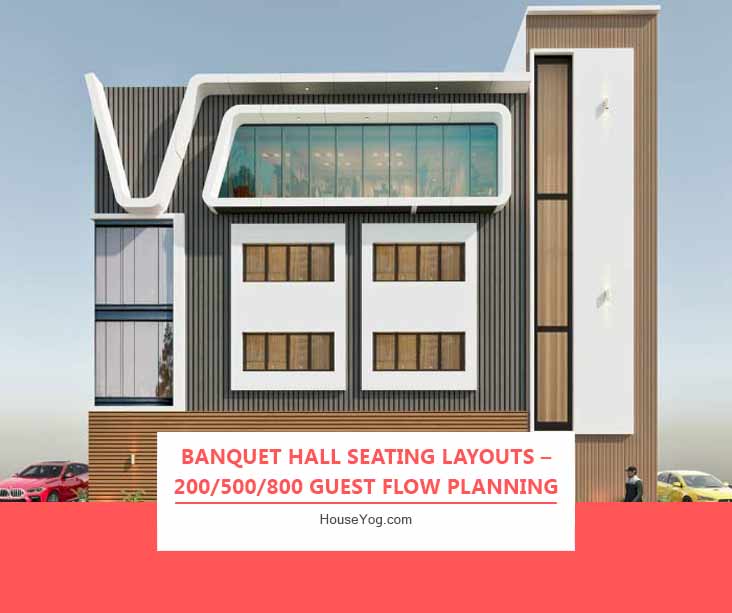
Designing the perfect banquet hall seating layout isn’t just about arranging tables and chairs. It’s about creating a smooth, comfortable, and visually appealing event experience where guests can eat, talk, watch, and move freely without feeling crowded. Whether you’re planning a wedding, reception, corporate event, or designing a new banquet or marriage hall, the layout directly influences guest comfort, movement, and the overall functionality of the space.
This guide walks you through seating types, stage placement, buffet planning, guest flow design, and sample layouts for 200, 500, and 800 guests. As architectural designers involved in banquet hall planning and construction across India, we’ve blended real-world design principles with event-flow logic to help you create layouts that feel elegant, functional, and guest-friendly.
Understanding Banquet Hall Seating Layouts (and Why They Matter)
A banquet hall seating layout is the master plan that defines how guests will be seated, how they will move, and how key event zones—such as the stage, buffet counters, dining areas, lounges, and walkways—will work together. At its core, a good layout ensures visibility, comfort, and effortless circulation throughout the event.
A well-designed banquet hall seating layout:
Improves visibility of ceremonies and performances
Prevents crowding near buffet counters and entry points
Allows catering and service staff to move efficiently
Ensures every guest feels comfortable and at ease
When layouts are poorly planned, events become chaotic. Guests struggle to locate their seats, queues spill into walkways, the stage becomes hard to see, and people constantly cross each other near the buffet. These issues not only disrupt the event but also detract from the overall experience.
This is why architects and event planners treat banquet hall seating layouts as a core part of event design. An effective layout balances aesthetics, functionality, safety, and comfort, and this guide will help you understand exactly how to achieve that.
We’ve designed banquet and marriage halls of all scales—from compact community halls to multi-storey banquet complexes across India. Here are a few of our recent projects that demonstrate how smart seating layouts, zoning, and guest-flow planning translate into real-world designs:
These real-world designs reflect many of the principles discussed in this guide, especially seating efficiency, zoning, and guest flow planning.
Types of Banquet Seating Arrangements
Choosing the right banquet seating arrangement is the foundation of an effective event layout. Each seating style supports a different purpose and works best for specific guest counts, hall dimensions, and event activities. Understanding these options helps you design a banquet hall that feels organised, comfortable, and visually balanced.
1. Banquet Seating (Round Tables)
Banquet-style seating with round tables is the most popular arrangement for weddings and receptions in India. It offers a premium, spacious look and encourages interaction among guests. A 5–6 ft round table typically accommodates 6–10 guests depending on chair spacing and aisle width.
This layout works especially well when you want an elegant dining experience with clear movement paths for serving staff and guests.
2. Theatre-Style Seating
Theatre-style seating is ideal for events where the stage is the main attraction, such as sangeets, ceremonies, cultural shows, or presentations. Since this arrangement removes tables, you can seat more guests in a compact area.
The key challenge is ensuring well-planned aisles so elderly guests can move comfortably and exits remain unobstructed.
3. Classroom Seating
Classroom seating combines tables and chairs facing the stage and is more common in conferences, workshops, and training sessions. Though not typically used for weddings, it works well in multipurpose banquet halls that host a mix of corporate and social events.
This arrangement supports note-taking, workshops, and longer seated sessions.
4. Cabaret or Half-Moon Seating
Cabaret seating takes round tables and orients all chairs toward the stage, leaving the back portion unused. This enhances visibility and creates a more performance-focused environment.
It’s a great option for sangeet nights, live performances, award functions, or events where audience engagement matters.
5. Mixed Seating Layouts
Modern Indian weddings often blend multiple seating styles to create different experience zones within the same hall. You might find round tables for families, lounge seating for younger guests, bar-height cocktail tables near food stations, and theatre rows closer to the stage.
Mixed layouts add variety and help manage large guest numbers by distributing crowd density across zones.
6. Family-Style Rectangular Seating
Rectangular dining tables are commonly used in community halls, temple dining spaces, and events where quick service and higher seating density are priorities. This arrangement allows more guests to sit in less space, making it ideal for buffet-heavy or time-sensitive events.
Family-style seating streamlines food service and movement, particularly during large traditional gatherings.
Seating Dimensions and Space Planning Essentials
A banquet hall seating layout can only succeed when the arrangement is supported by the right distances, circulation space, and well-planned proportions. Even a beautifully decorated hall can feel uncomfortable if tables are placed too close together, aisles are narrow, or guests struggle to walk toward the buffet or stage.
Thoughtful space planning ensures guests can sit comfortably, move around with ease, and enjoy the event without feeling cramped, while also giving service staff enough room to operate smoothly. This section outlines the key dimensions and spacing standards that elevate a layout from merely functional to truly guest-friendly.
Recommended Space Per Guest
Correct space allocation per guest forms the foundation of a successful banquet layout. Each seating style requires a different amount of floor area, and using the right benchmarks helps prevent both overcrowding and unnecessary hall expansion.
Round table banquet seating: 10–12 sq ft per guest
Rectangular dining seating: 8–10 sq ft per guest
Theatre-style seating: 6–8 sq ft per guest
Standing or buffet-heavy events: 8–10 sq ft per guest
When the right space per guest is maintained, the hall feels proportionate, comfortable, and easy to navigate—even during peak dining hours or performance segments.
Table Spacing Guidelines
Once the per-guest area is determined, the next priority is creating the right spacing between tables, walkways, and service paths. Proper spacing prevents congestion, reduces noise from tightly packed seating, and allows staff to move efficiently between tables.
Distance between round tables: 1.5 to 2 metres
Minimum aisle width: 1.2 metres
Main aisle leading to the stage: 1.5–2 metres
Buffet circulation zone: 6–8 ft in front of counters
These guidelines maintain smooth, unobstructed movement across the hall and prevent buffet queues from spilling into the dining area or blocking access to the stage.
Ideal Stage Dimensions
The stage is the visual and ceremonial focal point in most Indian events, making its size and placement crucial. The dimensions not only affect visibility but also determine how the backdrop, décor, photographers, and performers can operate comfortably.
Wedding stage: 16 ft × 24 ft (minimum)
Performance or DJ stage: 20 ft × 30 ft or larger
Hindu wedding mandap: 12 ft × 12 ft to 16 ft × 16 ft
A stage height of 1.5 to 2 ft generally offers the best balance—high enough for clear visibility, yet low enough for guests to feel connected to the ceremony without excessive strain.
Ceiling Height, Ventilation & Overall Comfort
Indian banquet events often run for several hours and involve large groups, continuous photography, elaborate décor, and warm lighting—all of which increase the need for proper ventilation and ceiling height.
A ceiling height of 12–16 ft is ideal because it accommodates floral backdrops, hanging décor, LED walls, and sound equipment while also improving air circulation. Adequate ventilation and the right air-conditioning capacity ensure guests remain comfortable even during peak dining and movement periods.
Banquet Hall Seating Layouts for 200, 500 and 800 Guests
This is the core of the guide, where broader planning principles translate into clear, ready-to-use seating layouts for different event sizes. Each layout is designed to support smooth guest flow, comfortable seating, efficient food service, and good stage visibility. Whether you are planning for 200, 500, or 800 guests, the following formats offer a practical starting point that can be adapted to your hall’s size and design requirements.
Seating Layout for 200 Guests
A 200-guest event feels intimate and elegant, which makes layout planning comparatively simple. Most halls between 2,000 and 3,000 sq ft can comfortably accommodate this size with a balanced mix of dining space and stage visibility.
What works best
For a 200-guest layout, the following configuration provides the best balance of comfort, visibility, and service efficiency:
20 round tables seating 8–10 guests
A compact stage with clear view lines
One primary buffet counter
A simple, one-way circulation path from entry → seating → buffet → exit
Guest Flow Logic
To ensure a seamless experience for a 200-guest event, the guest movement should follow a simple and intuitive flow. The flow should feel effortless—guests enter, greet, take their seats, and move toward the buffet without crossing the stage or crowding near the entrance. With a smaller group, symmetry, open aisles, and uncluttered spacing make the layout feel premium.
Why does this layout feel comfortable
This layout works particularly well for 200 guests because the additional breathing room around tables reduces noise, prevents congestion, and creates a relaxed, upscale ambience. This gives the hall a relaxed, upscale ambience and ensures smooth service throughout the function.
Seating Layout for 500 Guests
A 500-guest banquet requires more intentional planning. At this scale, even minor layout flaws can create bottlenecks—queues lengthen, aisles get blocked, and movement across the hall becomes chaotic unless the zones are clearly defined.
Ideal hall size
A well-functioning 500-guest banquet typically requires 6,000–8,000 sq ft, depending on stage size, buffet length, and expected foot traffic, to support comfortable seating, circulation, and service efficiency.
Recommended layout features
To design an efficient and organised layout for 500 guests, these elements should be incorporated into the floor plan:
50–55 round tables seating 8–10 guests
A dedicated “family zone” near the stage
Two buffet counters or an island buffet
A wide main aisle leading directly to the stage
A separate staff service corridor to minimise interruptions
Guest Flow Logic
A practical flow for this guest count is: Entry → sign-in/photography → seating → buffet loop → dessert station → exit
Reducing cross-movement is crucial. Buffet counters should be placed away from the stage and primary aisles so that dining queues do not mix with stage-side activity or family gathering zones.
Why this layout works
This layout succeeds because it prioritises clear movement paths and intuitive zoning, allowing guests and service staff to operate without interruption. It prioritises movement instead of crowding. Guests intuitively understand where to go, and service staff can operate without obstructing major pathways. The event feels organised, even when multiple activities happen simultaneously.
Seating Layout for 800 Guests
An 800-guest event must be planned like a mini event ecosystem, with seating, food service, and circulation zones working together seamlessly. These events are usually held in halls measuring 10,000–15,000 sq ft or larger.
Recommended approach
Designing for 800 guests requires a zoning-based approach that breaks the hall into manageable, high-functioning sections:
Divide the seating into clusters instead of a continuous grid
Use a circular or U-shaped flow system to guide guests
Provide three buffet counters or a long, multi-point island buffet
Ensure a wide central aisle for VIP entry and photography
Add a lounge or standing area to manage overflow
Position the stage so that all clusters have clear visibility
Guest Flow Logic
With an 800-guest gathering, the flow must remain smooth and predictable even during peak activity periods. At this scale, crowd movement must feel natural and never intersect sharply. Broad aisles, strategically placed food stations, and intuitive access to restrooms prevent congestion and maintain a smooth flow throughout the event.
Why this layout succeeds
Large weddings and receptions have constant foot traffic, guests visiting the buffet, meeting family, greeting the hosts, and returning to their seats. Clustering seating zones and spreading out food counters ensures that no single area becomes overwhelmed, making the event feel spacious and well-managed despite the high headcount.
Guest Flow Planning: The Secret to a Well-Designed Banquet Hall
In banquet hall architecture, guest flow is one of the most influential factors shaping the event experience. Even the most elegant seating layout can feel chaotic if the movement paths, entry points, and service zones are not designed thoughtfully. Good guest flow is not about event management; it begins at the architectural level, with a layout that intuitively guides people through the space without congestion or confusion.
Below are the key architectural considerations that help a banquet hall function smoothly during any event.
Entry and Welcome Area
The design of the entry and welcome zone plays a major role in how guests transition into the main hall. The entrance sets the tone for the entire event. Architecturally, it should be designed to accommodate gathering, greeting, and photography without obstructing incoming guests.
A wide porch or foyer, a recessed welcome zone, or a slightly expanded entry lobby prevents bottlenecks and creates a smooth transition into the main hall. These design elements not only elevate the first impression but also help regulate guest movement from outside to inside.
Aisles and Circulation Paths
Circulation pathways must be planned thoughtfully to ensure predictable movement between all key zones within the hall. Clear, well-proportioned circulation paths are essential in any banquet hall layout. As architects, the goal is to create predictable, unobstructed movement corridors that connect the entrance, seating zones, stage, and dining areas.
A dedicated main aisle leading to the stage supports ceremonial entry, photography, and crowd movement, while secondary aisles ensure that guests and staff can move around the hall without interfering with ongoing activities. Proper aisle width and placement also enhance safety and evacuation efficiency.
Buffet and Food Counter Flow
Buffet counters generate the highest density of movement in a banquet hall, which makes their placement a critical architectural decision. Counters should be located away from the main entrance, stage, and high-activity zones so that queues do not obstruct visibility or disrupt seating.
Providing adequate circulation space around buffet counters, and using a one-directional flow pattern, helps prevent queue loops and crossover movement. Thoughtful counter positioning improves the hall’s functionality and enhances the dining experience without requiring constant event supervision.
Movement to Restrooms and Outdoor Areas
Restrooms, outdoor lounges, smoking areas, and secondary exit points must be easily accessible through clear, well-lit walkways. Good architectural planning ensures that these paths remain distinct from primary activity zones, reducing crowding around the dining and stage areas.
Signage, lighting, and intuitive spatial cues play a major role in helping guests, especially seniors and children, navigate the hall confidently and safely.
Stage, DJ, Mandap & Photo Zone Planning
Banquet halls are more than dining spaces, they are event environments shaped by a series of visual anchors that define how people see, move, and experience the celebration. From the wedding stage to the DJ area and photo zones, each focal element must be positioned thoughtfully within the architectural layout so the hall functions beautifully during real events.
Smart placement of these elements enhances visibility, supports crowd flow, improves acoustics, and creates opportunities for memorable photographs without disrupting movement.
Stage Positioning
The stage or mandap naturally becomes the central visual element of any Indian event, so its placement should maximise visibility for the largest number of guests. Architecturally, the stage is best positioned along a long wall or at the far end of the hall, allowing seating to orient toward it without obstructing circulation paths.
Avoid placing the stage too close to entry doors, service passages, or buffet zones, as these areas tend to generate noise and movement that can disrupt ceremonies. Adequate depth behind the stage is equally important for décor, lighting rigs, and photography equipment.
Lighting & Acoustics
Lighting and sound are not afterthoughts, they are part of the spatial design. The hall should offer balanced, glare-free lighting that highlights the stage without washing out faces or overpowering the décor. Diffused or layered lighting typically works better than harsh direct beams.
Acoustics should also be accounted for during the design stage. Proper speaker placement, sound dispersion planning, and acoustic treatment in key areas help ensure that announcements, music, and ceremonies are heard clearly across the hall without echo or distortion. This is especially important in halls with high ceilings or large seating capacities.
Photo Zone Placement
Modern events generate constant photography demand, and without a designated area, guests tend to crowd the stage for pictures. Architecturally, it is wise to create a dedicated photo zone, a corner or backdrop placed away from the main stage and aisles.
Positioning this zone near the entrance, lounge, or along a side wall helps distribute guest movement and prevents gathering around ceremonial areas. It also improves the flow of family photography and social media moments without interfering with service circulation.
Special Design Considerations for Indian Banquet Halls
Indian celebrations come with cultural patterns, large family structures, and multi-stage ceremonies that place unique demands on banquet hall design. Unlike Western banquet layouts, Indian events often involve extended gatherings, high movement density, elaborate décor, and simultaneous rituals. As architects, the layout must anticipate these behaviours and translate them into spatial solutions that feel natural and intuitive for guests.
For deeper insights into Vastu, parking design, and movement planning for Indian marriage halls, you can also explore our detailed marriage hall design guidelines.
Below are key cultural and functional considerations that significantly influence how an Indian banquet hall should be planned.
Group Seating Preferences
Indian families tend to sit in groups—often extended families of 8–20 people. To support this, banquet halls benefit from flexible seating clusters that allow round tables or rectangular setups to be grouped without restricting circulation. Designing areas that accommodate larger groups helps avoid last-minute rearrangements that can disrupt the planned layout.
Separate Veg and Non-Veg Food Counters
Many Indian events require distinct veg and non-veg serving areas. From an architectural standpoint, this means allocating two clearly defined buffet zones with independent circulation paths so queues do not converge. Proper ventilation around food counters is important as well, since live counters and tandoor sections generate heat and aroma that must be managed.
Ventilation and Thermal Comfort
Indian weddings and receptions often last several hours, with large guest counts and elaborate décor lighting that generate considerable heat. Designing for adequate AC tonnage, fresh-air circulation, and a comfortable ceiling height is essential. Poor ventilation quickly becomes noticeable in crowded events, so HVAC planning must be integrated early in the architectural design.
Accessibility for Elderly Guests
Elderly guests form a significant portion of attendees at Indian ceremonies. Wider aisles, shorter walking distances, and seating zones closer to the stage or exits ensure comfort and safety. Incorporating ramps, non-slip flooring, handrails, and well-lit pathways elevates the hall’s usability for people of all ages.
Accommodating Multiple Ceremonies
Indian weddings often include sequential or parallel events—mehendi, engagement, sangeet, and pheras. Banquet halls designed for Indian functions benefit from multi-purpose zones, movable partitions, or secondary lounges that can adapt to changing needs throughout the event. Providing adequate backstage or preparation areas also helps manage shifting décor and vendor requirements.
Designing for Cultural Flow
Overall, the layout must support the dynamic, celebratory nature of Indian events. Spaces should feel generous, flexible, and intuitive, with clear distinctions between dining, ceremonial, and social areas. When these cultural behaviours are accounted for in the architectural stage, the hall performs effortlessly during real events—no matter how many activities unfold at once.
Banquet Hall Seating Layout vs Dining Hall Seating Plan
Although the terms sound similar, banquet hall seating layouts and dining hall seating plans serve very different architectural purposes. Understanding this distinction is essential when designing event spaces, because each layout involves its own circulation patterns, functional zones, and spatial requirements.
A banquet hall seating layout is a comprehensive plan that accommodates the full event experience. It includes ceremonial areas, stage placement, buffet counters, photo zones, lounges, aisles, and dining sections—all arranged to support guest flow, visibility, and multi-activity usage. The layout must balance movement, décor zones, acoustics, and service access so the hall performs smoothly throughout the event.
In contrast, a dining hall seating plan is primarily focused on mealtime efficiency and seating density. The priority is to optimise table arrangement, server circulation, and comfort during dining, without the complexity of ceremonies, performances, or high-traffic zones. Dining halls rarely require stages, lounges, or segregated event areas, making the layout more linear and functional.
By recognising these differences, architects can design spaces that truly fit their intended use, whether it’s a multifunctional banquet hall or a streamlined dining facility.
Conclusion
A well-planned banquet hall seating layout is far more than a collection of tables, aisles, and counters, it is the architectural framework that determines how comfortably guests move, how ceremonies are experienced, and how efficiently the event unfolds. Whether the hall is designed for 200 guests or for large gatherings of 500 or 800, thoughtful spatial planning ensures that every part of the event feels organised, intuitive, and visually cohesive.
From seating styles and stage positioning to buffet flow and cultural considerations, each design decision plays a direct role in shaping the overall atmosphere. When these elements are planned deliberately at the architectural stage, the hall performs effortlessly during real events, reducing congestion, improving visibility, and enhancing guest comfort.
At Houseyog, we provide complete banquet hall design services — from concept planning and seating layouts to elevation, interiors, and construction supervision.
If you’re building a new banquet hall or upgrading an existing one, we’d be glad to help you create an architecture-first layout that elevates guest comfort, improves event flow, and maximises the value of your space.
If you’re evaluating budget and feasibility, our latest guide on the cost of constructing a marriage hall in India will help you plan your investment more effectively. Contact us today to discuss your banquet hall project and explore custom design options tailored to your space.