

Building your own house is an exciting journey, but it also comes with hundreds of decisions—many of which directly affect your budget. One of the most common questions homeowners ask before construction begins is: How much sand is required for a 1000 sq ft house?
Unlike cement or steel, sand is used throughout almost every stage of construction. From preparing the foundation and casting RCC members to laying bricks, plastering walls, and fixing floor tiles, sand plays a vital role in ensuring the strength, durability, and finish of your home. Ordering too little can delay construction, while purchasing too much locks up your money and occupies valuable site space.
Unfortunately, there isn’t a single universal answer. The total quantity of sand depends on several factors, including the structural design, foundation type, wall thickness, number of floors, plaster thickness, flooring specifications, and the type of sand used.
In this guide, we’ll help you estimate the sand required for a typical 1000 sq ft single-storey RCC house using practical thumb rules and engineering-based calculations. We’ll also explain where sand is used during construction, convert the quantity into practical buying units such as CFT, cubic metres, tractor loads and truckloads, estimate the overall cost, and compare River Sand with M Sand to help you make an informed purchase.
Whether you’re preparing your construction budget or discussing material requirements with your contractor, this guide will help you understand the numbers with confidence.
Quick Answer: How Much Sand is Required for a 1000 Sq Ft House?
A typical 1000 sq ft single-floor RCC house generally requires approximately 1,100 to 1,250 cubic feet (CFT) of sand, or 31 to 35 cubic metres (m³). This estimate includes sand used for the foundation, PCC, RCC work, brick masonry, internal and external plastering, flooring mortar, tile bedding, and a small allowance for normal material wastage.
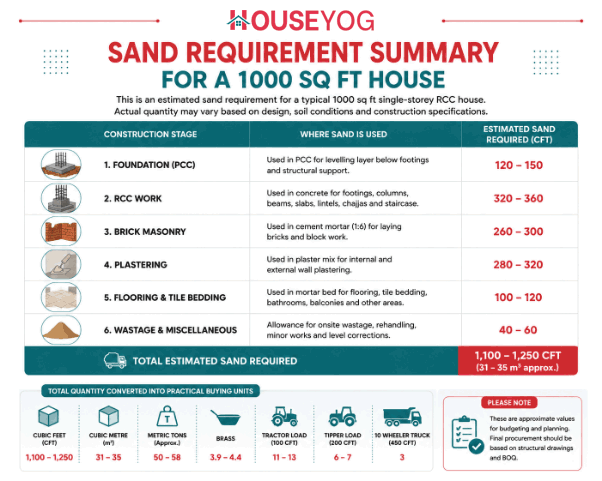
For most residential projects, this quantity translates to approximately:
| Unit | Approximate Quantity |
| Cubic Feet (CFT) | 1,100–1,250 |
| Cubic Metres (m³) | 31–35 |
| Metric Tons* | 50–58 |
| Brass | 3.9–4.4 |
| Tractor Loads (100 CFT each) | 11–13 |
| Tipper Loads (200 CFT each) | 6–7 |
| 10-Wheeler Truck (450 CFT each) | 3 |
Note: These figures are intended for budget estimation. The actual quantity may vary depending on your structural drawings, foundation depth, wall thickness, construction specifications, and local building practices.
Sand Requirement Summary for a 1000 Sq Ft House
The table below provides a stage-wise estimate of sand consumption for a typical 1000 sq ft residential house.
| Construction Stage | Estimated Sand Required (CFT) |
| Foundation PCC | 120–150 |
| RCC Work (Footings, Columns, Beams & Slab) | 320–360 |
| Brick Masonry | 260–300 |
| Internal & External Plaster | 280–320 |
| Flooring & Tile Bedding | 100–120 |
| Normal Wastage (5–8%) | 40–60 |
| Total Estimated Sand Required | 1,100–1,250 CFT |
This table provides a practical estimate for homeowners planning a conventional RCC house. Estimates are based on conventional RCC residential construction practices followed across India and are intended for preliminary budgeting. Your engineer’s Bill of Quantities (BOQ) should always be considered the final reference for procurement.
Assumptions Used for This Estimate
Before diving into the calculations, it’s important to understand the assumptions behind these estimates. Every house is unique, and no two projects consume exactly the same quantity of materials.
The calculations in this guide assume the following:
- Built-up area of approximately 1000 sq ft
- Single-storey RCC residential house
- Conventional reinforced concrete (RCC) frame structure
- 9-inch external brick walls and 4.5-inch internal partition walls
- M20 grade RCC concrete (commonly used in residential construction)
- Normal soil conditions require an average foundation depth
- Conventional cement mortar for masonry and plastering
- Standard floor tile bedding
- Material wastage of approximately 5–8%
If your project includes a basement, stilt parking, heavy retaining walls, premium flooring, or multiple floors, the actual sand requirement will naturally be higher.
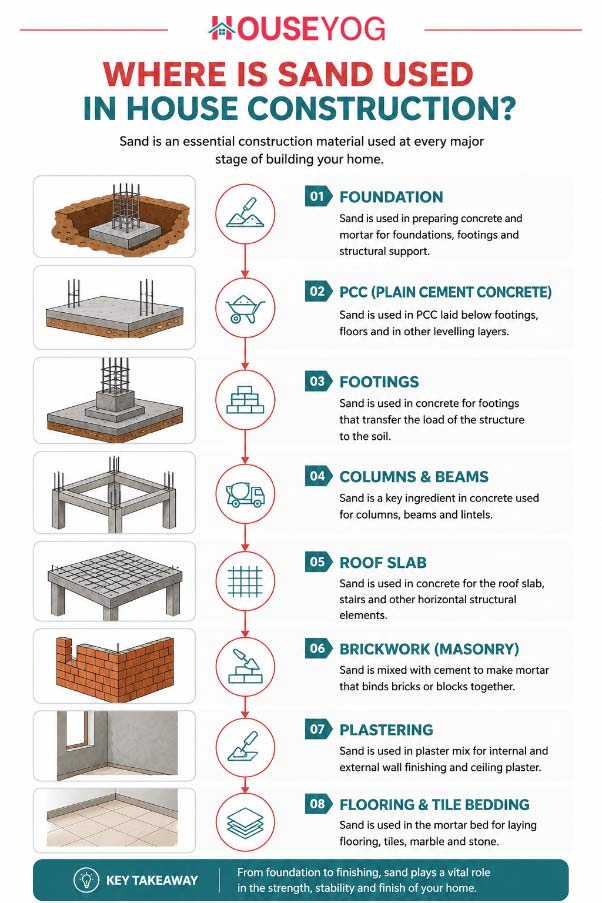
Where is Sand Used in House Construction?
Many first-time homeowners assume that sand is used only for making concrete. In reality, it is one of the most extensively used construction materials and is required at nearly every stage of building a house.
Understanding where sand is consumed helps you appreciate why the total requirement is much higher than expected.
1. Foundation and PCC
Construction begins with excavation and the preparation of the foundation. Before the reinforced concrete footings are cast, a layer of Plain Cement Concrete (PCC) is laid to create a clean, level, and stable base.
PCC is typically prepared using a mix of cement, sand, and coarse aggregate. The sand fills the voids between aggregates and contributes to the workability and strength of the concrete.
Although the PCC layer is relatively thin, it covers the entire footing area and therefore consumes a noticeable quantity of sand.
2. RCC Work
The largest share of sand is consumed in reinforced cement concrete.
Concrete for footings, columns, beams, lintels, chajjas, staircases, and roof slabs all require sand as fine aggregate.
In RCC, sand serves several important purposes:
- Fills the voids between coarse aggregates
- Improves workability during mixing
- Helps achieve proper compaction
- Contributes to the strength and durability of concrete
- Produces a dense and homogeneous concrete mix
Since RCC forms the structural skeleton of your house, it accounts for a significant portion of the total sand requirement.
3. Brick Masonry
Once the RCC framework is complete, brick walls are constructed using cement mortar.
Mortar is generally prepared using cement and sand in ratios such as 1:6 or 1:5, depending on the structural requirements.
Although bricks form the visible wall, the mortar joints between them consume a considerable quantity of sand throughout the project.
A typical 1000 sq ft house contains several hundred square feet of wall area, making brick masonry one of the major consumers of sand.
The quantity of mortar also depends on the number of bricks used. You can estimate this using our Brick Required for 1000 Sq Ft House guide.
4. Internal and External Plastering
Plastering provides a smooth, level, and durable finish to brick walls while protecting them from moisture and weathering.
Plaster mortar is prepared using cement and fine sand.
Since plaster is applied to almost every internal wall, external wall, and ceiling, this stage alone can consume nearly as much sand as brick masonry.
The exact quantity depends on:
- Wall area
- Ceiling area
- Plaster thickness
- Number of coats
- Surface finish required
5. Flooring and Tile Bedding
Before floor tiles are fixed, a cement-sand mortar bed is prepared to achieve proper levels and provide a stable base.
Bathrooms, balconies, kitchens, utility areas, verandahs, and living spaces all require bedding mortar beneath the tiles.
Although flooring uses less sand than RCC or plastering, it still contributes meaningfully to the overall material requirement.
6. Other Construction Activities
Besides the major stages discussed above, sand is also used in several smaller construction activities, including:
- Fixing door and window frames
- Staircase finishing
- Coping and parapet work
- Tile pointing and grouting
- Repair and patchwork
- Minor external development works
Individually, these activities may consume only small quantities, but together they justify including a reasonable allowance for wastage and miscellaneous site work in your estimate.
Step-by-Step Sand Calculation for a 1000 Sq Ft House
Now, let’s understand how the total estimate of 1,100–1,250 CFT is derived.
Rather than relying solely on a thumb rule, we’ll break down the sand requirement according to the major construction stages. This approach gives you a clearer understanding of where your material is actually being used.
Step 1: Sand Required for Foundation PCC
The first stage, where sand is consumed, is the Plain Cement Concrete (PCC) layer laid beneath the footing.
For a typical 1000 sq ft RCC house, the PCC volume generally ranges between 8 and 10 cubic metres, depending on the number of footings, their size, and soil conditions.
Assuming a conventional PCC mix, the sand requirement works out to approximately:
Estimated Sand Required for PCC: 120–150 CFT
If your site has weak soil requiring larger or deeper footings, the PCC quantity—and consequently the sand requirement—will increase.
Step 2: Sand Required for RCC Work
The RCC framework includes:
- Footings
- Pedestals
- Columns
- Plinth beams
- Roof beams
- Roof slab
- Staircase
- Lintels and sunshades
Together, these components generally account for the highest consumption of sand in the entire project.
For a standard 1000 sq ft single-floor RCC house, the total concrete volume typically falls in the range of 20–24 cubic metres.
Based on standard concrete proportions used in residential construction, this translates to an approximate sand requirement of:
Estimated Sand Required for RCC: 320–360 CFT
This quantity may increase if your design includes larger spans, cantilever balconies, heavy staircases, or additional structural members.
Step 3: Sand Required for Brick Masonry
After the RCC framework is complete, brick masonry begins. At this stage, sand is primarily used to prepare cement mortar that binds the bricks together.
For most residential buildings, brickwork mortar is prepared in a 1:6 (cement:sand) ratio. Depending on the quality of bricks, wall thickness, workmanship, and mortar joint thickness, the quantity of mortar required can vary slightly from one project to another.
A typical 1000 sq ft house with 9-inch external walls and 4.5-inch internal partition walls usually requires around 13,000–15,000 bricks. (You can also read our detailed guide on Brick Required for 1000 Sq Ft House to understand brick estimation in detail.)
Based on this wall area and the mortar required, the estimated sand consumption for brick masonry is:
| Construction Activity | Estimated Sand Required |
| Brick Masonry | 260–300 CFT |
Although brick masonry doesn’t consume as much sand as the RCC structure, it still accounts for nearly one-fourth of the total sand requirement. This is why contractors usually order additional sand before masonry work begins.
Step 4: Sand Required for Plastering
Once the brick walls are completed, internal and external plastering begins.
Plastering serves several important purposes:
- Creates a smooth surface for painting.
- Protects masonry from weather and moisture.
- Covers joints and minor surface irregularities.
- Improves the appearance of the building.
Most residential projects use a 12 mm thick plaster for internal walls and 15–20 mm thick plaster for external walls, typically prepared using 1:4 or 1:6 cement mortar, depending on the location and finish required.
Since almost every wall and many ceiling surfaces are plastered, this stage consumes a surprisingly large quantity of sand.
For a typical 1000 sq ft house, the estimated sand requirement for plastering is:
| Construction Activity | Estimated Sand Required |
| Internal & External Plaster | 280–320 CFT |
The exact quantity depends on:
- Total wall area
- Ceiling plaster (if applicable)
- Thickness of plaster
- Number of coats
- Surface undulations requiring additional mortar
Poor-quality brickwork often requires thicker plaster, which increases sand consumption. Good workmanship during masonry can therefore help reduce both material usage and finishing costs.
Step 5: Sand Required for Flooring and Tile Bedding
Before floor tiles, marble, granite, or vitrified tiles are laid, a cement-sand mortar bed is prepared to level the surface and provide proper support.
The thickness of this bedding layer usually ranges between 20 mm and 40 mm, depending on the flooring material and site conditions.
Areas such as the living room, bedrooms, kitchen, balconies, toilets, and utility spaces all require bedding mortar.
For a standard residential house, the estimated sand requirement for flooring is:
| Construction Activity | Estimated Sand Required |
| Flooring & Tile Bedding | 100–120 CFT |
If your home includes stone flooring, thick marble, outdoor paving, or decorative landscaping, the actual quantity may be slightly higher.
Total Sand Required for a 1000 Sq Ft House
Now let’s combine the estimates from all major construction activities.
| Construction Stage | Estimated Sand Required (CFT) |
| Foundation PCC | 120–150 |
| RCC Structure | 320–360 |
| Brick Masonry | 260–300 |
| Internal & External Plaster | 280–320 |
| Flooring & Tile Bedding | 100–120 |
| Wastage & Miscellaneous Work | 40–60 |
| Total Estimated Sand Required | 1,100–1,250 CFT |
Key Takeaway
For budgeting purposes, you can safely assume that a conventional 1000 sq ft RCC house requires around 1,200 CFT of sand.
This estimate is sufficiently accurate for:
- Preparing a construction budget
- Comparing contractor quotations
- Planning material purchases
- Estimating transportation requirements
However, always use the structural drawings and Bill of Quantities (BOQ) prepared by your architect or structural engineer for final procurement.
Converting Sand Quantity into Practical Buying Units
One of the biggest challenges homeowners face is that sand suppliers rarely sell sand in cubic feet alone.
Depending on your location, sand may be sold in:
- Cubic feet (CFT)
- Cubic metres (m³)
- Tons
- Brass
- Tractor loads
- Tipper loads
- Truckloads
Understanding these conversions makes it much easier to compare quotations from different suppliers.
Approximate Conversion Table
| Unit | Equivalent for 1,200 CFT |
| Cubic Feet (CFT) | 1,200 |
| Cubic Metres (m³) | 34 |
| Metric Tons* | 54–56 |
| Brass | 4.25 |
| Tractor Loads (100 CFT) | 12 |
| Mini Tipper (150 CFT) | 8 |
| Tipper (200 CFT) | 6 |
| 10-Wheeler Truck (450 CFT) | 3 |
Note: The conversion to tons depends on the moisture content and bulk density of the sand. Wet sand weighs more than dry sand, so actual tonnage may vary.
How Many Tractor Loads of Sand Are Required?
In many towns and semi-urban areas across India, sand is commonly supplied using tractor trolleys.
Although the carrying capacity varies, a typical tractor trolley holds approximately 90–100 CFT of sand.
For a 1000 sq ft house:
- Total sand required: 1,100–1,250 CFT
- Tractor capacity: 100 CFT (approx.)
Therefore, you will require approximately 11–13 tractor loads of sand
If your supplier uses a smaller trolley, the number of trips will naturally increase.
How Many Truckloads of Sand Are Required?
Larger residential projects generally procure sand using tipper trucks.
Typical capacities are:
| Vehicle | Approximate Capacity |
| Mini Tipper | 150 CFT |
| Medium Tipper | 200 CFT |
| 10-Wheeler Truck | 400–450 CFT |
Based on an average requirement of 1,200 CFT:
- Mini Tipper: 8 trips
- Medium Tipper: 6 trips
- 10-Wheeler Truck: 3 trips
This information helps you estimate transportation costs and negotiate better rates with suppliers.
Estimated Sand Cost for a 1000 Sq Ft House
The total cost of sand depends on several factors, including:
- River Sand or M Sand
- Local availability
- Transportation distance
- Government royalty
- Seasonal demand
- City and state
As a broad estimate, sand usually accounts for 3–5% of the total construction cost of a residential house.
Approximate Material Cost
| Sand Type | Estimated Quantity | Approximate Cost Range* |
| River Sand | 1,100–1,250 CFT | ₹90,000–₹1,80,000 |
| M Sand | 1,100–1,250 CFT | ₹70,000–₹1,40,000 |
*Prices are indicative and vary significantly across different regions of India.
For the latest regional prices and a detailed comparison of different sand types, read our guide on Sand Cost in India: River Sand vs M Sand.
Did You Know?
Sand typically represents only 3–5% of the total construction cost, but incorrect estimation can delay construction and increase transportation expenses.
River Sand vs M Sand: Which One Should You Choose?
Choosing the right type of sand is just as important as estimating the correct quantity.
Today, homeowners generally have two options:
- Natural River Sand
- Manufactured Sand (M Sand)
Both have their advantages, and the right choice depends on your construction stage, local availability, budget, and project specifications.
River Sand
River sand is naturally formed through the weathering of rocks over thousands of years. Its rounded particles provide excellent workability and have traditionally made it the preferred choice for residential construction.
Advantages:
- Excellent workability
- Smooth plaster finish
- Easy to mix with cement
- Widely accepted by contractors
- Suitable for almost every construction activity
Limitations:
- Expensive in many regions
- Supply restrictions in several states
- Illegal mining concerns
- Quality can vary if not properly screened
Manufactured Sand (M Sand)
M Sand is produced by crushing hard stones into fine aggregates using modern manufacturing processes.
When manufactured according to Indian Standards, M Sand offers consistent quality and has become a popular alternative to river sand.
Advantages:
- Consistent particle size
- Better availability
- Lower cost in many cities
- Environmentally more sustainable
- Excellent for RCC work
Limitations:
- May require careful selection for premium plaster finishes
- Quality depends heavily on the manufacturing process
- Excessive stone dust in low-quality M Sand can affect workability
Houseyog’s Recommendation
For most modern residential projects, M Sand is an excellent choice for RCC work, including foundations, columns, beams, and slabs, provided it conforms to relevant quality standards.
However, many contractors still prefer well-graded river sand or premium plaster sand for plastering and finishing work, as it often produces a smoother surface with less effort.
If both options are available in your area, a practical approach is to use M Sand for structural concrete and high-quality river sand (or premium plaster sand) for plastering and finishing, balancing both cost and performance.
Factors That Affect Sand Requirement
By now, you’ve probably noticed that most engineers provide a range rather than an exact quantity for sand estimation. That’s because no two houses are exactly alike. Even if two homes have the same built-up area, their material requirements can differ depending on the design and construction specifications.
Here are the key factors that influence the total sand required for a house.
1. Structural Design
The structural design has the biggest impact on sand consumption. A house with larger columns, deeper beams, thicker slabs, or longer spans requires more concrete, which in turn increases the quantity of sand.
This is why two 1000 sq ft houses designed by different structural engineers may require different amounts of sand.
2. Soil Conditions and Foundation Depth
The type of soil on your plot determines the size and depth of the foundation.
For example:
- Hard rocky soil generally requires smaller foundations.
- Soft or loose soil often requires wider and deeper footings to safely transfer the building load.
Larger foundations mean more PCC, more RCC, and consequently, more sand.
3. Wall Thickness and Layout
The number and thickness of walls also affect sand consumption.
A house with:
- 9-inch external walls
- Multiple internal partition walls
- Larger bathrooms
- Utility rooms
- Store rooms
will consume more mortar than a compact layout with fewer walls.
4. Plaster Thickness
Ideally, good-quality brickwork should require only the standard plaster thickness.
However, uneven masonry often needs thicker plaster to achieve a level finish.
Even an additional 3–5 mm of plaster over hundreds of square feet can significantly increase sand consumption.
5. Flooring Material
Different flooring materials require different bedding thicknesses.
For example:
- Ceramic tiles usually need a thinner mortar bed.
- Natural stone flooring often requires a thicker mortar layer.
- Outdoor paving and pathways also consume additional sand.
6. Number of Floors
This guide assumes a single-storey (G+0) house.
If you plan to construct a G+1 or G+2 building, the sand requirement increases substantially due to additional RCC work, masonry, plastering, and flooring.
7. Construction Quality and Material Wastage
No construction project is completely free from wastage.
Sand may be lost due to:
- Improper storage
- Rainwater contamination
- Rehandling
- Mixing losses
- Transportation spills
A practical estimate usually includes 5–8% wastage, while poorly managed sites may experience even higher losses.
Common Mistakes Homeowners Make While Estimating Sand
One of the biggest reasons for cost overruns is not the price of sand—it’s inaccurate estimation and poor planning.
Here are some common mistakes you can easily avoid.
Ordering the Entire Quantity at Once
Many homeowners purchase all the sand before construction begins to avoid future price increases.
However, storing large quantities on-site for several months can lead to contamination, theft, moisture absorption, and unnecessary wastage.
It’s often better to procure sand in phases based on the construction schedule.
Choosing Sand Based Only on Price
The cheapest sand isn’t always the most economical.
Low-quality sand containing excessive silt, clay, or impurities may require additional cement and can affect the strength and finish of the work.
Always prioritise quality over a small saving in material cost.
Ignoring Moisture Content
Wet sand occupies more volume than dry sand due to a phenomenon known as bulking of sand.
If sand is measured by volume without considering moisture content, the actual quantity delivered may differ from your expectations.
This is one reason experienced contractors inspect the material before unloading.
Not Verifying the Vehicle Capacity
Many suppliers sell sand by “one tractor” or “one truck.”
However, vehicle capacities are not standard across all regions.
Before placing an order, ask your supplier:
- What is the carrying capacity in CFT or cubic metres?
- Is the body size standard?
- Is the load measured or heaped?
Understanding these details helps you compare quotations fairly.
Ignoring the Structural Drawings
Thumb rules are excellent for budgeting, but they should never replace the material quantities derived from structural drawings and the Bill of Quantities (BOQ).
Before placing your final order, always consult your architect or structural engineer.
Practical Tips to Reduce Sand Wastage
Good material management can save both money and construction time.
Here are a few practical tips we recommend to homeowners.
- Store sand on a clean, level surface rather than directly on soil.
- Cover sand with a tarpaulin during heavy rain to minimise contamination and moisture variation.
- Purchase sand in stages instead of ordering the entire quantity upfront.
- Ensure mortar and concrete are mixed according to the specified proportions.
- Avoid unnecessary rehandling of sand around the site.
- Supervise material unloading to ensure the delivered quantity matches the order.
- Use quality sand suitable for the intended application instead of using one type for every construction activity.
These simple practices can significantly reduce wastage and improve overall construction quality.
Frequently Asked Questions
A typical single-storey RCC house of 1000 sq ft generally requires 1,100 to 1,250 CFT (31–35 m³) of sand. This estimate includes sand used for PCC, RCC work, brick masonry, plastering, flooring, and a small allowance for normal construction wastage. The exact quantity depends on the structural design and construction specifications.
For most residential projects, you can estimate approximately 1,200 CFT of sand. This is a practical planning figure for budgeting and discussing material requirements with your contractor before the detailed Bill of Quantities is prepared.
Assuming one tractor trolley carries around 100 CFT, a typical 1000 sq ft house requires approximately 11 to 13 tractor loads of sand. Since tractor capacities vary by location, always confirm the actual carrying capacity with your supplier.
If you’re purchasing sand using a 10-wheeler truck carrying approximately 400–450 CFT, you’ll generally need about three truckloads to complete a 1000 sq ft house. Smaller tipper trucks will require more trips.
The quantity remains almost the same as river sand—approximately 1,100 to 1,250 CFT. The choice between M Sand and River Sand mainly affects quality, workability, availability, and cost rather than the total quantity required.
Yes, quality M Sand manufactured as per relevant Indian Standards can safely replace River Sand for RCC work such as foundations, columns, beams, and slabs. For premium plaster finishes, many builders still prefer well-graded river sand or plaster sand because it often provides a smoother surface.
Fine, clean, and well-graded sand with minimal silt content is generally preferred for plastering. Depending on local availability, high-quality river sand or specially graded plaster sand usually provides the best finish. If using M Sand for plastering, ensure it is specifically manufactured for plaster applications.
Different contractors may assume different foundation depths, wall layouts, plaster thicknesses, and structural designs. Some estimates also include wastage and miscellaneous work, while others do not. Comparing estimates is easier when you understand the assumptions behind the calculations rather than looking only at the final quantity.
Conclusion
Estimating the sand required for a house is about much more than arriving at a single number. It involves understanding where sand is used, how different construction activities contribute to the total requirement, and how factors such as structural design, foundation depth, wall thickness, and workmanship influence the final quantity.
For a typical 1000 sq ft single-storey RCC house, you can safely plan for approximately 1,100 to 1,250 CFT of sand as a reliable budget estimate. However, your architect’s and structural engineer’s drawings should always be the basis for final procurement.
If you’re planning your dream home, don’t estimate sand in isolation. Calculating the correct quantities of bricks, cement, steel, and aggregates is equally important for controlling costs and avoiding delays.
To help you plan with confidence, explore Houseyog’s complete material estimation guides:
- Brick Required for 1000 Sq Ft House
- Cement Required for 1000 Sq Ft House
- Steel Required for House Construction
- Aggregate Required for House Construction
You can also use our Construction Cost Calculator to get an approximate budget for your project before construction begins.
With proper planning and accurate estimates, you’ll be better prepared to discuss quantities with your contractor, purchase materials efficiently, and keep your home construction project on budget.