
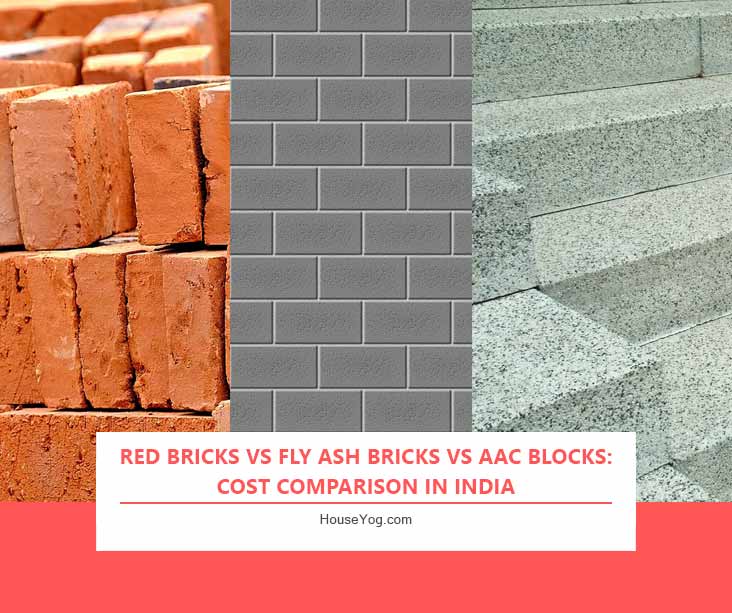

When you plan your house construction in India, one of the biggest early decisions is choosing the right brick. And almost every homeowner eventually asks:
Red bricks vs fly ash bricks vs AAC blocks, which is cheaper, and which is better for my house?
At first glance, the difference seems simple: just compare the price per brick or per block. But the real cost difference between red bricks, fly ash bricks, and AAC blocks goes much deeper.
It affects:
- Your total walling cost per sq ft
- Labour charges
- Mortar and plaster consumption
- Structural load on the building
- Long-term thermal comfort
If you’re comparing red bricks vs AAC blocks price, or trying to understand whether fly ash bricks are more cost-effective than red bricks, this detailed guide explains the full cost picture, in practical Indian construction terms.
Let’s break it down clearly and calmly.
Quick Comparison: Red Bricks vs Fly Ash Bricks vs AAC Blocks (Per Sq Ft Cost)
Before analysing each material in detail, here’s a side-by-side cost comparison for residential construction projects in India (2026 average rates).
| Material | Material Cost (₹/sq ft) | Labour Cost (₹/sq ft) | Plaster Requirement | Total Walling Cost (Approx ₹/sq ft) |
| Red Bricks | ₹35 – ₹50 | ₹8 – ₹12 | Higher | ₹55 – ₹75 |
| Fly Ash Bricks | ₹30 – ₹45 | ₹8 – ₹12 | Moderate | ₹50 – ₹70 |
| AAC Blocks | ₹40 – ₹60 | ₹12 – ₹18 | Lower | ₹60 – ₹80 |
These are indicative market rates across India. Actual cost may vary depending on city, transport distance, wall thickness, and contractor pricing.
Now, let’s understand what these numbers mean for your actual home construction budget.
Understanding Red Bricks Cost in India
Red bricks (clay bricks) are the most traditional and widely used walling material in Indian residential construction. In many Tier-2 and Tier-3 cities, they are still the default choice.
When you search for red bricks vs AAC blocks price, red bricks often appear cheaper upfront. But let’s examine the full picture.
Material Cost
- Per brick: ₹8 – ₹10 (depending on quality and location)
- Bricks required per sq ft: 7–8 bricks (9-inch wall)
- Approx material cost per sq ft: ₹35 – ₹50
If you want a detailed quantity calculation, you can refer to our complete red brick price per sq ft and quantity guide.
Labour & Mortar Cost
Red brick masonry typically requires:
- Cement mortar
- Proper alignment
- Higher curing
Labour cost typically ranges between ₹8 – ₹12 per sq ft.
Because red bricks are slightly irregular in size, mortar consumption is higher. This increases:
- Cement usage
- Sand usage
- Final plaster thickness
Over an entire house, this difference becomes noticeable.
When Red Bricks Make Sense
Red bricks may be suitable for you if:
- You are building in smaller towns where supply is local.
- Labour is skilled in traditional masonry.
- Budget is tight, and AAC availability is limited.
However, you should also factor in a higher plaster cost and a slightly heavier structural load.
Now let’s compare this with fly ash bricks.
Fly Ash Bricks Price and Cost Comparison
Fly ash bricks are manufactured using industrial by-products and are more uniform in shape compared to red bricks. They are becoming increasingly common in urban and semi-urban construction.
If you are comparing red bricks vs fly ash bricks price, the difference is usually moderate, but the performance and finish may vary.
Material Cost
- Per brick: ₹5 – ₹8
- Better dimensional accuracy
- Approx material cost per sq ft: ₹30 – ₹45
In many regions, fly ash bricks are slightly cheaper than red bricks when purchased in bulk..
Labour and Mortar Impact
Because fly ash bricks are more uniform:
- Mortar joints are thinner and more consistent
- Cement consumption is slightly lower
- Masonry work is neater
Labour cost remains similar to red bricks: ₹8 – ₹12 per sq ft.
Overall Cost Position
Compared to red bricks, you may save:
- 5–10% in mortar
- Some plaster thickness
- Minor reduction in wastage
Fly ash bricks are often seen as a balanced option, affordable, reasonably strong, and more uniform than traditional clay bricks.
But now let’s look at AAC blocks, which are often marketed as a modern and energy-efficient alternative.
AAC Blocks Cost in India (Are They Really Expensive?)
AAC (Autoclaved Aerated Concrete) blocks are lightweight, larger in size, and widely used in metro cities and large residential projects.
When homeowners compare red bricks vs AAC blocks price, AAC blocks appear costlier at first glance. But per-piece cost can be misleading.
Material Cost
- AAC block price: ₹2,800 – ₹3,500 per cubic metre
- Approx equivalent wall cost: ₹40 – ₹60 per sq ft
Yes, the material cost per sq ft is higher than red or fly ash bricks.
Labour Cost
AAC block masonry requires:
- Skilled masons
- Thin joint adhesive instead of thick cement mortar
- More precise alignment
Labour cost: ₹12 – ₹18 per sq ft.
So upfront, AAC blocks appear more expensive. But this is where total cost analysis becomes important.
Hidden Cost Differences Most Homeowners Miss
When comparing red bricks vs AAC blocks for house construction, you should also consider these factors:
1. Structural Load
AAC blocks are significantly lighter than clay bricks. Lower dead load can result in:
- Slight structural steel optimisation
- Reduced foundation load
In multi-storey houses, this difference becomes more meaningful.
2. Mortar and Cement Usage
AAC blocks use thin joint adhesive. This reduces:
- Cement consumption
- Sand consumption
3. Plaster Thickness
Surface finish comparison:
- Red bricks: 12–15 mm plaster
- Fly ash bricks: 10–12 mm plaster
- AAC blocks: 8–10 mm plaster
Thinner plaster means savings in cement and sand.
You can also check our detailed plastering cost per sq ft in India guide to understand how plaster thickness affects your overall budget.
4. Construction Speed
AAC blocks are larger in size. This means:
- Faster wall completion
- Shorter construction timeline
If labour is daily-wage-based, faster completion can reduce total labour expenditure.
So while AAC blocks are costlier per sq ft initially, the total walling cost difference may reduce after accounting for plaster and structural factors.
Labour Cost Comparison: Red Bricks vs AAC Blocks
Labour typically accounts for 30–40% of walling cost.
You may also want to understand the current labour cost per sq ft for house construction before negotiating with contractors.
Here’s a simplified view:
- Red bricks: ₹8 – ₹12 per sq ft
- Fly ash bricks: ₹8 – ₹12 per sq ft
- AAC blocks: ₹12 – ₹18 per sq ft
In metro cities, AAC labour is easily available. In smaller towns, limited skilled labour may increase rates.
However, AAC construction is faster. So the project duration may be reduced.
If your contractor works on a per-sq-ft basis, the difference is predictable. If labour is on a daily basis, faster work can reduce the total cost.
Cost Comparison for a 1000 Sq Ft House (Real Example)
Let’s assume your house has approximately 3,000 sq ft of total wall area.
Using Red Bricks
Average walling cost: ₹65 per sq ft
Total cost: ₹1,95,000
Using Fly Ash Bricks
Average walling cost: ₹60 per sq ft
Total cost: ₹1,80,000
Using AAC Blocks
Average walling cost: ₹70 per sq ft
Total cost: ₹2,10,000
Difference between lowest and highest: around ₹30,000.
Now ask yourself:
Would you spend ₹30,000 extra for better insulation and a lighter structural load?
For some homeowners, yes.
For others, the savings matter more.
This is where your priorities define the right choice.
Thermal Performance and Long-Term Comfort
Cost is immediate. Comfort is long-term.
AAC blocks provide:
- Better thermal insulation
- Cooler interiors in hot climates
- Potential reduction in AC load
Red bricks provide moderate thermal performance.
Fly ash bricks perform slightly better than traditional red bricks.
In very hot regions, AAC may help reduce long-term electricity bills. In moderate climates, the financial benefit may not be substantial.
Which Is Most Cost-Effective for Your House Construction?
If your priority is the lowest upfront cost, fly ash bricks may suit you.
If traditional material and easy availability matter, red bricks remain practical.
If you value thermal comfort, structural efficiency, and modern construction, AAC blocks may justify the higher cost.
There is no universal best option. The right choice depends on:
- Your city and climate
- Labour availability
- Structural design
- Budget flexibility
- Project scale
Before finalising, it’s always advisable to evaluate the complete construction cost per sq ft in India, not just the brick rate.
FAQs: Red Bricks vs Fly Ash vs AAC Blocks
Red bricks typically cost ₹35–₹50 per sq ft (material only), while AAC blocks cost around ₹40–₹60 per sq ft. However, when you include labour, mortar, plaster thickness, and structural load impact, the total walling cost difference usually narrows to ₹5–₹10 per sq ft in most residential projects.
Fly ash bricks are more uniform, eco-friendly, and may offer a slightly better finish and lower mortar consumption.
AAC blocks have a hWhich Isigher upfront cost but may offer savings in plaster, cement, and structural load.
The best material depends on your budget, climate, structural design, and long-term expectations.
Over to You
When comparing red bricks vs fly ash bricks vs AAC blocks cost in India, avoid looking only at the per-piece price. Evaluate the complete walling cost, material, labour, mortar, plaster, structural impact, and long-term performance.
In many residential projects:
- Fly ash bricks offer a balanced cost-performance ratio.
- Red bricks remain viable in smaller towns.
- AAC blocks suit urban and performance-focused homes.
If you are planning your house construction and feel unsure about the right material for your design and budget, you can connect with Houseyog for a detailed construction cost consultation. We help you evaluate structure, material selection, and complete budgeting before work begins on-site.
And if this guide helped you make a clearer decision, consider sharing it with someone about to start building their home.
It’s over to you now.