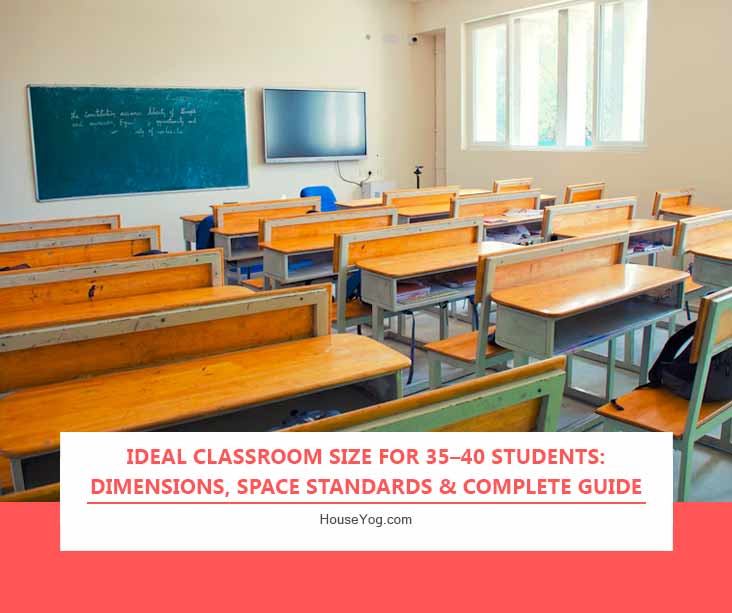
Designing the right classroom is one of the most essential aspects of school building planning. The size, shape, and layout of a classroom directly affect student comfort, learning outcomes, ventilation, safety, and teaching efficiency.
If you’re wondering what the ideal classroom size for 35–40 students should be, this detailed guide covers everything you need. As architectural planners who have designed multiple school buildings across India, we’ll walk you through the exact recommended dimensions, area requirements, CBSE/NCERT norms, and international space standards used in modern educational infrastructure.
Whether you’re building a new school, upgrading an existing campus, or evaluating space requirements, this guide explains how to design a standard, comfortable, and efficient classroom for 35–40 students—step by step.
We will also explain the classroom size standards in India along with CBSE/NCERT norms and international recommendations, so you can plan classrooms that are both practical and compliant.
Classroom size recommendations in India are based on long-standing guidelines issued by bodies such as CBSE, NCERT, and widely accepted international best practices.
These standards evolve slowly and remain consistent over many years. Unless regulatory norms change significantly, the classroom dimensions and planning principles explained in this guide remain valid for most school projects across India.
Why Classroom Size Matters in School Design
Classroom size is one of the most critical factors in school infrastructure planning. The dimensions, usable area, and internal layout of a classroom directly influence how effectively students learn and how comfortably teachers can manage daily activities. A well-designed classroom improves productivity, focus, and safety—while a poorly sized room can disrupt the entire learning environment.
Under-sized classrooms often lead to congestion, poor airflow, and frequent distractions, negatively impacting learning outcomes. Oversized rooms, on the other hand, increase unnecessary construction and maintenance costs without improving effectiveness.
Recommended Floor Area Per Student (CBSE, NCERT & International Norms)
To determine the ideal classroom size for 35–40 students, it’s important to understand how much floor area each student requires. Most global educational design standards — including CBSE norms, NCERT guidelines, and international school planning benchmarks — recommend 1.0 to 1.4 sq.m per student (approximately 10.5–15 sq ft).
Using these standards, here’s the recommended classroom area:
Recommended Classroom Area for 35–40 Students
According to CBSE classroom size requirements, schools should allocate around 1.0–1.4 sq m per student, ensuring enough space for circulation and comfortable seating.
Students
Minimum Area Required
Ideal Area
35
35–40 sq.m (375–430 sq ft)
45–50 sq.m (480–540 sq ft)
40
40–45 sq.m (430–480 sq ft)
50–55 sq.m (540–600 sq ft)
Ideal Target Range
480–600 sq ft (45–55 sq m) per classroom
This size ensures:
Comfortable seating arrangements
Efficient circulation and movement
Improved ventilation and air quality
Space for group activities and teaching aids
Better supervision and student engagement
A classroom within this range provides the right balance between comfort, usability, and cost efficiency.
These recommendations align closely with the official CBSE Affiliation Bye-Laws (2018), which outline minimum infrastructure and classroom area norms for schools.
Ideal Classroom Dimensions for 35–40 Students
Once you know the recommended area per student, the next step is selecting the right classroom dimensions. The ideal size should balance usable floor space, layout efficiency, ventilation, and furniture placement.
Based on school design standards and our architectural experience, the following school classroom dimensions are widely used because they offer the right proportion for teaching efficiency and student comfort:
Ideal Classroom Size (Recommended)
28 ft × 20 ft (560 sq ft)
This is the most efficient and practical size for a class of 35–40 students. It provides enough space for:
Dedicated teacher area
Storage for learning materials
Comfortable circulation space
Space for display boards and teaching aids
Small activity or group-learning zones
Better natural light and ventilation
Standard Classroom Size
24 ft × 20 ft (480 sq ft)
Suitable for 30–35 students. This layout is compact yet functional and supports standard single or paired desk arrangements.
Minimum Acceptable Size
22 ft × 20 ft (440 sq ft)
Works for up to 35 students, but becomes crowded for 40. Movement becomes restricted, and ventilation is less efficient, so this is not recommended for larger individuals.
International bodies such as UNESCO also emphasise ventilation, natural light, and flexible seating as critical elements of classroom design.
If your school layout requires custom dimensions, our team can prepare customised school architectural drawings based on your plot size and state board guidelines.
Ceiling Height Standards for Classrooms
Ceiling height plays a crucial role in ensuring good air quality, thermal comfort, and effective ventilation inside a classroom. A properly designed vertical height helps maintain cooler indoor temperatures, improves airflow, and supports better lighting distribution.
Recommended Ceiling Height for Classrooms
Minimum Height:10 ft Suitable for smaller classrooms or air-conditioned environments.
Ideal Height:11–12 ft Ensures better ventilation, improved temperature control, and a more comfortable learning environment for 35–40 students.
Premium Height:13–14 ft Recommended for hot climates, naturally ventilated schools, or classrooms with high occupancy. Helps reduce heat buildup and supports stack ventilation.
Ideal Shape of a Classroom in Schools
The shape of a classroom is just as important as its size. The right proportions help maximise visibility, acoustics, furniture arrangement, and circulation space.
Best Classroom Shape for 35–40 Students
A rectangular classroom layout with an aspect ratio of 1:1.3 to 1:1.4 is considered ideal for most teaching environments. This proportion allows:
Better visibility of the board and the teacher
Optimal desk arrangement
Efficient movement paths
Improved light distribution
Clear separation of teaching and student zones
Ideal Classroom Shape Examples
20 × 28 ft (Aspect ratio ≈ 1:1.4)
22 × 30 ft (Aspect ratio ≈ 1:1.36)
Avoid Square Rooms
Square classrooms often result in inefficient seating layouts and reduced visibility from the back rows. This also creates acoustic issues and limits circulation flow.
Ventilation & Natural Lighting Requirements
Proper ventilation and natural lighting are essential components of effective classroom design. A well-lit, well-ventilated classroom enhances student concentration, improves air quality, boosts energy efficiency, and promotes overall comfort—especially in classrooms accommodating 35–40 students.
A well-designed classroom should include the following:
Windows
20–25% of the total wall area should be windows for adequate daylight and airflow
Preferably placed on two adjacent walls to improve cross-ventilation
Window sill height: around 3 ft for safety and optimal daylight penetration
Ventilators above door level to allow hot air to escape naturally
Natural Lighting
Aim for 300–350 lux of natural light at desk level
Ensure there are no dark corners or glare spots
Light should ideally enter from the left side of the students (traditional recommendation)
Air Quality
Cross-ventilation is essential, especially in warm and humid regions
High ceilings (11–12 ft or more) further improve air circulation
Consider operable windows and ventilators for continuous airflow
A classroom following these ventilation and lighting standards will feel brighter, healthier, and more comfortable throughout the school day.
You can also explore our guide on Modern Home Ventilation & Lighting Standards, which covers practical strategies applicable to institutional buildings as well.
Fire Safety & Emergency Planning in Classrooms
Fire safety is a non-negotiable aspect of school design. Classrooms accommodating 35–40 students must support quick, orderly evacuation and integrate seamlessly into the school’s overall emergency response strategy.
Key fire safety considerations for classroom planning include:
Door Design & Opening Direction
Classroom doors should always open outwards, in the direction of exit travel.
Outward-opening doors prevent crowding at exits during emergencies and enable faster evacuation.
Door hardware should allow easy operation without complex locking mechanisms.
Unobstructed Exit Routes
No furniture, storage units, or teaching aids should obstruct the exit path.
A clear minimum 3 ft wide circulation aisle should be maintained near the door.
Bags, shelves, or movable items should be kept away from escape routes.
Visibility & Corridor Connection
Classroom doors should ideally have vision panels or glass strips for visibility.
This helps teachers monitor corridor conditions before opening doors during an emergency.
Visibility also reduces the risk of collisions during high-movement situations.
Integration with School Evacuation Planning
Classroom layouts must align with the school’s overall fire escape and evacuation plan.
Exit routes should lead directly to protected corridors or staircases without confusion.
Classroom planning should consider travel distances, stair widths, and assembly point access as part of the larger campus design.
Well-planned fire safety measures not only protect students and staff but also improve day-to-day circulation discipline within the classroom.
While classroom-level fire safety and circulation planning are critical, these decisions must align with the overall campus layout, corridor widths, staircases, and evacuation routes. For a broader understanding of zoning, compliance, and infrastructure planning, refer to our complete guide on How to Plan a School Building in India, which explains school-wide planning principles in detail.
Furniture Layout & Circulation Space for Classrooms
An efficient furniture layout is essential for creating a classroom that feels comfortable, organised, and safe for 35–40 students. Proper spacing between desks ensures smooth movement, better supervision, and compliance with safety and evacuation norms.
A well-planned classroom should include:
Student Desk Dimensions
Standard desk width: 2 ft
Desk depth: 1.5–2 ft
Chair depth: 1.5 ft
The combination should allow students to sit comfortably without blocking pathways.
Circulation & Movement Space
2–2.5 ft of clear space between desk rows for easy movement.
3 ft of space in front of the class for the teacher’s zone.
3 ft clear aisle along one side (preferably near the door) for emergency circulation.
The layout should allow the teacher to walk between rows and reach every student effortlessly.
Layout Efficiency Tips
Avoid placing desks too close to windows or doors to reduce distractions.
Ensure the teaching wall is unobstructed and visible from all angles.
Use rectangular classrooms to align rows efficiently without wasting space.
Provide designated zones for bags, materials, and classroom equipment.
A well-designed furniture layout enhances learning efficiency, safety, and classroom management, especially in medium-strength classrooms with 35–40 students.
For optimised furniture layout and ergonomic planning, explore our Interior Design Services, where we design functional, student-friendly classroom layouts.
Designing Classrooms for Future Teaching Methods
Teaching methods and learning environments are evolving rapidly. Classrooms designed today must be flexible enough to adapt to future pedagogical changes, technology integration, and activity-based learning models.
A future-ready classroom design for 35–40 students should include the following considerations:
Smart Boards & Digital Teaching Walls
Allow adequate wall width and electrical planning for smart boards, digital screens, or interactive panels.
Avoid placing windows on the teaching wall to reduce glare on digital displays.
Plan concealed conduits and data points during the design stage to avoid surface wiring later.
Flexible Furniture Layouts
Use modular desks and chairs that can be rearranged easily.
Layouts should support traditional rows, group clusters, and U-shaped arrangements.
Adequate circulation space ensures smooth transitions between layouts.
Support for Activity-Based Learning
Provide open zones within the classroom for discussions, demonstrations, or collaborative tasks.
Slightly larger classrooms (500–600 sq ft) offer the flexibility needed for hands-on learning without congestion.
Storage for activity materials should be integrated into the classroom design.
Convertible Classroom Use
Classrooms should be capable of switching between:
Daily teaching mode
Examination setup
Activity or workshop layouts
Clear floor areas, movable furniture, and efficient lighting design make this conversion quick and practical.
Designing classrooms with adaptability in mind ensures that school buildings remain relevant, efficient, and valuable for decades—regardless of how teaching methods evolve.
Teacher Area & Teaching Wall Guidelines
A well-planned teacher area and teaching wall significantly improve classroom management, visibility, and the overall learning experience. In a classroom designed for 35–40 students, the placement and size of the teaching zone must support clear instruction and minimise distractions.
Teaching Wall
The teaching wall is the primary focal point of the classroom and should be:
8–10 ft wide to accommodate the writing board and teaching aids
Positioned on the shorter side of the room for better visibility from the back rows
Free from windows to prevent glare and visibility issues
Painted or finished with materials that reduce reflection
Board height:
The lower edge should be at 3 ft from the floor for comfortable visibility and writing.
Teacher’s Zone
The teacher’s working area should ideally include:
A minimum 5 ft × 8 ft clear space in front of the board
A teacher’s desk is positioned to maintain visibility of all students
Space for storage, teaching materials, and technology (projectors, smartboards, laptops)
A clear circulation path that allows the teacher to move freely
Best Practices
Avoid placing doors directly behind the teacher to reduce distractions.
Keep the front area clutter-free for safety and visual clarity.
Ensure the teacher can easily supervise all corners of the classroom.
A well-designed teaching zone supports effective instruction, student engagement, and smooth classroom flow.
Door Placement in Classrooms
Door placement plays a critical role in maintaining safety, reducing distractions, and ensuring smooth circulation inside a classroom. In classrooms designed for 35–40 students, the door location must support efficient entry/exit and clear visibility for the teacher.
Best Location for the Classroom Door
Place the door at the rear corner or rear side of the classroom. This minimises disturbances during ongoing lessons and prevents students from getting distracted by movement outside.
Door Swing Direction
The door should open outwards, especially in school buildings, to support safe and quick evacuation during emergencies.
Outward-opening doors also keep the entrance area clear inside the classroom.
Safety & Visibility Considerations
Avoid placing the door directly behind the teacher or near the teaching wall.
Keep a 3 ft wide circulation aisle near the door to ensure students can move freely without congestion.
Use vision panels (glass strips) in the door if possible—this improves visibility and prevents accidental collisions.
Accessibility & Inclusive Classroom Design
Inclusive classroom design ensures that learning spaces are accessible, safe, and comfortable for all students, including those with physical disabilities or temporary mobility challenges. Modern school architecture increasingly prioritises accessibility—not just for compliance, but to create an equitable learning environment.
A classroom designed for 35–40 students should incorporate the following accessibility principles:
Door Width & Entry Access
Minimum 900 mm (3 ft) clear door width to allow wheelchair access and smooth movement.
Door thresholds should be level to avoid tripping hazards.
Door hardware should be easy to operate by children and adults alike.
Wheelchair-Friendly Seating Zone
Provide at least one designated wheelchair-accessible seating area within the classroom.
This zone should be integrated into the general seating layout—not isolated—ensuring inclusivity.
Adequate turning radius and clear space should be maintained around this seating position.
Clear Circulation Paths
Maintain uninterrupted circulation aisles between desks and along exit routes.
Avoid dead ends or narrow passages that restrict movement.
Circulation paths should allow easy access to the teacher’s area, exits, and seating zones.
Visual Contrast & Wayfinding
Use visual contrast between walls, floors, and boards to improve visibility.
Steps, level changes, or platform edges (if any) should be clearly highlighted.
Teaching boards should have adequate contrast with the background to support students with visual impairments.
Designing accessible classrooms from the planning stage avoids costly retrofits later and ensures long-term usability as regulations and expectations evolve.
Acoustic & Layout Benefits
Rear placement reduces noise disruption from corridors.
It also keeps the teaching zone focused and minimises mid-class interruptions.
A thoughtfully positioned door enhances safety, accessibility, and classroom discipline, making it an important part of efficient school design.
Recommended Classroom Sizes According to Grade Levels
Different grade levels require different classroom sizes based on teaching style, furniture type, student movement, and activity needs. Below is a quick reference guide to help you determine the ideal classroom size for each stage of schooling:
Grade Level
Ideal Size
Notes / Requirements
Pre-Primary (Nursery, LKG, UKG)
600–800 sq ft
Requires extra space for activities, play zones, and free movement.
Primary (Classes 1–5)
500–600 sq ft
Flexible seating arrangements and open floor space for group activities.
Middle School (Classes 6–8)
500–550 sq ft
Standard classroom dimensions focused on structured learning.
High School (Classes 9–12)
550–650 sq ft
More space is needed for labs, technology integration, and subject-specific equipment.
These recommended dimensions help ensure that classrooms meet functional, safety, and learning requirements depending on the age group.
Cost Impact of Classroom Size
Classroom size has a direct impact on the overall construction cost of a school building. While larger classrooms require more investment, they often deliver long-term benefits in learning quality, comfort, and flexibility.
How Larger Classrooms Increase Cost
Higher construction cost due to a bigger built-up area
Higher maintenance costs over the building’s lifespan
More HVAC or ventilation requirements in some designs
Benefits of a Slightly Larger Classroom
Despite the additional cost, appropriately sized classrooms significantly improve:
Learning quality and comfort
Ventilation, natural light, and air quality
Future flexibility for changing teaching methods
Space for technology, activities, storage, and movement
Finding the Right Balance
The ideal classroom size is one that is both cost-effective and student-friendly. For 35–40 students, a 500–600 sq ft classroom offers the perfect balance between construction cost and long-term functionality.
To estimate the cost difference between 500 sq ft and 600 sq ft classrooms, try our Construction Cost Calculator for quick cost estimation based on area.
Classroom size decisions also influence the overall project budget when multiplied across multiple sections and floors. To understand how classroom area, built-up space, and planning choices affect the total investment, you may find our detailed guide on School Construction Cost in India useful, especially during the early feasibility and budgeting stages.
Over to You
Classroom size impacts the overall learning experience far more than we realise. Whether you’re designing a small private school or a large CBSE/ICSE campus, the recommended 500–600 sq ft classroom ensures better comfort, focus, and teaching efficiency.
If you’re planning a school building and need architectural drawings, planning, 3D elevation, MEP, or full project design, Call/WhatsApp us: +91 75960 58808
We design schools, colleges, hostels, and institutional buildings across India.
FAQs About Classroom Size for 35–40 Students
1. What is the ideal classroom size for 35 students?
A classroom of 480–540 sq ft is considered ideal for 35 students.
2. What is the minimum classroom size for 40 students?
The minimum recommended area is 430–480 sq ft, but 540–600 sq ft is ideal.
3. What are the CBSE classroom size requirements?
CBSE recommends 1–1.4 sq.m per student, with adequate ventilation, a 10–12 ft ceiling height, and proper circulation space.
4. Is a 20×20 ft classroom enough for 40 students?
No. A 20×20 ft (400 sq ft) room is insufficient and will lead to congestion and poor ventilation.
5. What is the ideal shape for a classroom?
A rectangular shape with a 1:1.3 to 1:1.4 ratio gives optimal visibility and layout efficiency.