

When planning a house construction project, most people focus on cement, steel, and bricks. However, aggregate, commonly known as stone chips, is another essential construction material that significantly affects the strength, durability, and quality of concrete.
Whether you are building a new home, preparing a construction budget, or estimating material requirements, understanding how much aggregate is required for house construction can help you avoid shortages, reduce wastage, and control costs.
In this guide, we will explain where aggregate is used, how much stone chips are typically required for different house sizes, how to estimate quantities, and the factors that influence aggregate consumption in residential construction.
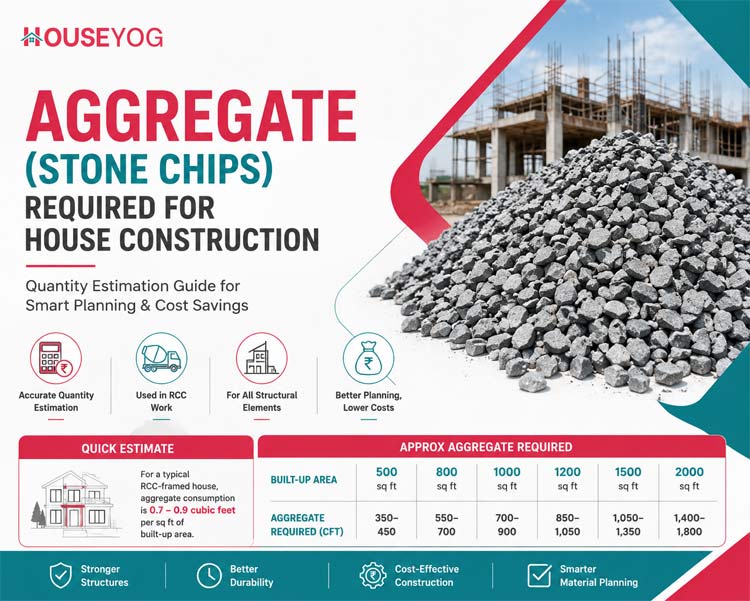
Quick Answer: Aggregate Required for Different House Sizes
The table below provides a practical estimate of the aggregate required for a typical RCC-framed residential house.
| Built-up Area | Approx Aggregate Required |
| 500 sq ft | 350–450 cft |
| 800 sq ft | 550–700 cft |
| 1000 sq ft | 700–900 cft |
| 1200 sq ft | 850–1,050 cft |
| 1500 sq ft | 1,050–1,350 cft |
| 2000 sq ft | 1,400–1,800 cft |
As a general rule, aggregate consumption increases with built-up area and RCC volume. A 500 sq ft house may require around 350–450 cft of aggregate, while a 2000 sq ft house may require 1,400–1,800 cft. These figures are useful for preliminary budgeting and material planning, but actual quantities should be verified based on structural drawings.
Note: Actual quantities may vary depending on the number of floors, foundation design, slab thickness, soil conditions, and structural requirements.
For most single-storey RCC houses, aggregate consumption generally falls between 0.7 and 0.9 cubic feet per square foot of built-up area.
What Is Aggregate in Construction?
Aggregate refers to crushed stone, gravel, or stone chips that form the bulk of concrete. In residential construction across India, crushed stone aggregates are commonly used in combination with cement, sand, and water to produce concrete for structural elements.
Depending on the application, different aggregate sizes are used:
- 10 mm aggregate – Commonly used in slabs and thin RCC sections.
- 20 mm aggregate – Most widely used for columns, beams, footings, and slabs.
- 40 mm aggregate – Sometimes used in mass concrete and larger foundation works.
In everyday construction language, contractors and suppliers often refer to aggregate simply as “stone chips” or “gitti.”
Without quality aggregate, concrete cannot achieve the desired strength and durability required for a safe structure.
Where Is Aggregate Used in House Construction?
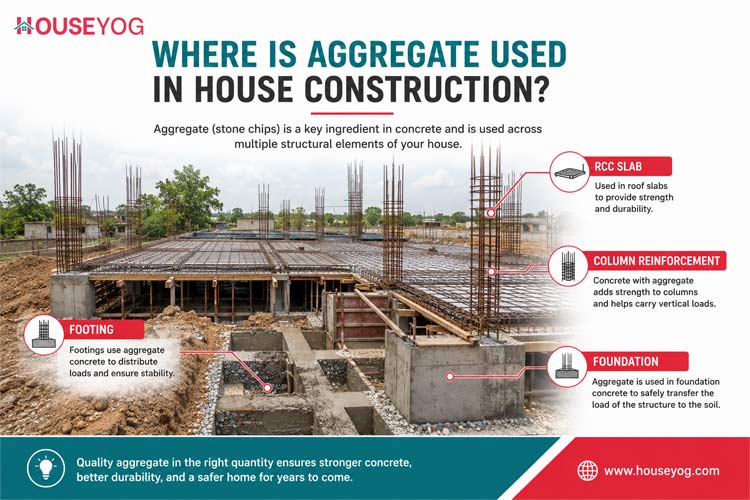
Aggregate is used throughout the structural framework of a house. Understanding these applications helps explain why accurate stone chip quantity estimation is important.
Foundation Concrete
The foundation transfers building loads safely to the soil. Concrete used in footings and foundation beams contains a significant quantity of aggregate.
Footings
Isolated footings, combined footings, and raft foundations consume substantial amounts of concrete, making them major consumers of stone chips.
Columns
RCC columns rely on properly graded aggregate to achieve structural strength and load-bearing capacity.
Plinth Beam
The plinth beam ties the structure together and prevents differential settlement. Aggregate forms an essential part of the concrete used in this element.
Roof Slab
For most residential houses, the roof slab is one of the largest concrete components and therefore consumes a large quantity of aggregate.
Staircase
RCC staircases require concrete for waist slabs, landings, and supporting beams, all of which contain aggregate.
Driveway and PCC Work
Plain Cement Concrete (PCC) below flooring, pathways, driveways, and external paving also requires stone chips.
As you can see, aggregate is used almost everywhere concrete is used.
How Much Aggregate Is Required for a 1000 Sq Ft House?
This is one of the most common questions asked during construction planning.
For a typical 1000 sq ft single-storey RCC framed house, aggregate consumption generally ranges between 700 and 900 cubic feet.
This estimate assumes:
- G+0 residential structure
- Standard RCC framed construction
- Average soil conditions
- Conventional foundation system
- Normal slab thickness
- Typical column and beam layout
In practical terms, many projects require approximately 800 cubic feet of aggregate for a 1000 sq ft house.
However, houses with larger spans, heavier foundations, or additional structural members may require higher quantities.
If you are simultaneously estimating other materials, you may also find our guides on cement required for a house, steel required for house construction, and bricks required for a 1000 sq ft house useful for preparing a complete construction budget.
Major Material Requirements for House Construction
While estimating aggregate requirements, many homeowners also want a rough idea of the other major construction materials required for a typical house.
Although actual quantities depend on structural design, soil conditions, number of floors, and construction specifications, the quantities below represent a typical 1000 sq ft single-storey RCC house. They should be used for preliminary material planning only.
| Material | Approximate Quantity |
| Cement | 350–450 Bags |
| Steel (TMT Bars) | 3.5–4.5 Metric Tons |
| Bricks | 8,000–10,000 Nos |
| Aggregate (Stone Chips) | 700–900 Cubic Feet |
| Sand | 1,000–1,300 Cubic Feet |
If you are preparing a detailed construction budget, you may also find these guides useful:
- Cement Required for a 1000 Sq Ft House – Learn how many cement bags are typically required for foundations, columns, beams, slabs, masonry, and plastering.
- Steel Required for House Construction – Understand how much TMT steel is generally used in residential RCC structures.
- Bricks Required for a 1000 Sq Ft House – Estimate brick quantities for walls, partitions, and masonry work.
- Construction Cost Calculator – Get an approximate cost estimate for your house construction project based on built-up area and location.
Reviewing these material estimates together can help you plan procurement more efficiently, prepare a realistic budget, and reduce the chances of material shortages during construction.
Aggregate Quantity Calculation Formula
At the site level, aggregate requirement is typically estimated from the total concrete volume.
A simplified formula is:
Aggregate Quantity = Concrete Volume x Aggregate Proportion
For example, consider 1 cubic meter of M20 concrete.
The nominal mix ratio is:
1 : 1.5 : 3
Where:
- 1 part = Cement
- 1.5 parts = Sand
- 3 parts = Aggregate
Since aggregate occupies the largest portion of concrete, it generally accounts for around 55% to 65% of the total dry volume.
For homeowners, the easiest approach is to estimate the total concrete volume and then calculate aggregate requirements based on the concrete grade being used.
Aggregate Requirement for Different RCC Grades
Different concrete grades contain varying quantities of aggregate.
| RCC Grade | Typical Aggregate Content |
| M15 | Higher aggregate proportion |
| M20 | Moderate aggregate proportion |
| M25 | Slightly lower aggregate proportion due to increased cement content |
In residential construction, M20 and M25 are the most commonly used grades for structural elements such as columns, beams, and slabs.
Aggregate Requirement Per Cubic Meter of Concrete
The table below provides approximate aggregate requirements for commonly used concrete grades.
| Concrete Grade | Approx Aggregate Required |
| M15 | 0.85–0.90 m³ |
| M20 | 0.80–0.85 m³ |
| M25 | 0.75–0.80 m³ |
These values are practical planning estimates and may vary slightly depending on mix design, aggregate size, and site conditions.
For detailed structural design calculations, the final quantities should always be verified by a qualified engineer.
How to Estimate Aggregate Cost
Once you know the quantity, estimating cost becomes straightforward.
Formula
Aggregate Cost = Quantity x Local Market Rate
For example:
- Aggregate Required = 800 cft
- Local Rate = ₹35 per cft
Estimated Cost:
800 x ₹35 = ₹28,000
Aggregate prices vary across cities and regions based on:
- Quarry location
- Transportation distance
- Aggregate size
- Local demand
- Seasonal availability
It is always advisable to obtain quotations from multiple suppliers before placing bulk orders.
Factors Affecting Aggregate Requirement
No two houses consume exactly the same quantity of aggregate.
Several factors influence the final requirement.
Number of Floors
A G+1 or G+2 structure requires more columns, beams, and foundations, increasing aggregate consumption.
Foundation Type
Raft foundations and combined footings generally consume more concrete than isolated footings.
Soil Condition
Poor soil may require larger foundations and additional structural reinforcement.
RCC Percentage
Architectural designs with extensive RCC elements naturally require more aggregate.
Slab Thickness
Thicker slabs consume more concrete and therefore more stone chips.
Architectural Design
Large cantilevers, balconies, staircases, and complex layouts can significantly increase aggregate requirements.
Common Mistakes While Ordering Stone Chips
Over the years, we have seen several material planning mistakes that lead to unnecessary costs and delays.
Ordering the Entire Quantity at Once
Large stockpiles occupy valuable site space and can create handling challenges. Staged deliveries are usually more practical.
Ignoring Wastage
Always include a small buffer for handling losses and site wastage.
Mixing Different Sizes Improperly
Using the wrong aggregate size can affect concrete quality and workability.
Purchasing Poor-Quality Aggregate
Dusty, flaky, or contaminated aggregates can reduce concrete strength and durability.
Focusing Only on Price
Cheaper material may result in quality issues that become expensive to rectify later.
Frequently Asked Questions
A typical 1000 sq ft RCC-framed house requires approximately 700–900 cubic feet of aggregate. The exact quantity depends on the foundation design, slab thickness, structural layout, and soil conditions. For preliminary planning, many builders assume around 800 cubic feet of stone chips.
A single-storey RCC house generally requires around 0.7–0.9 cubic feet of aggregate per square foot of built-up area. Actual consumption varies based on structural design, number of floors, and foundation requirements.
For residential RCC construction, 20 mm aggregate is the most commonly used size. In some applications, 10 mm aggregate may also be used, particularly in slabs and areas where better compaction is required.
Both sizes serve different purposes. For most residential RCC work, 20 mm aggregate is the standard choice for columns, beams, and slabs, while 10 mm aggregate is often used in thinner sections and areas requiring better compaction.
Aggregate quantity can be estimated by first calculating the total concrete volume and then applying the aggregate proportion based on the concrete mix. For preliminary planning, aggregate consumption is often estimated using standard construction benchmarks per square foot.
One cubic meter of M20 concrete typically requires approximately 0.80 to 0.85 cubic meters of aggregate. The exact quantity depends on the mix design, aggregate grading, and construction practices followed at the site.
In residential construction, the terms are often used interchangeably. Aggregate is the technical engineering term for crushed stone used in concrete, while stone chips is the common market term used by suppliers, contractors, and homeowners.
Conclusion
Aggregate is one of the most important yet often overlooked construction materials in residential projects. From foundations and columns to slabs and staircases, stone chips form a major portion of the concrete that gives your house strength and durability.
For a typical RCC-framed house, aggregate consumption generally ranges between 0.7 and 0.9 cubic feet per square foot of built-up area. A 1000 sq ft house may require approximately 700–900 cubic feet of stone chips. However, actual quantities depend on factors such as foundation design, number of floors, soil conditions, and structural specifications.
Estimating aggregate requirements early allows you to prepare a more accurate budget, schedule material deliveries efficiently, and avoid costly construction delays. When combined with proper estimates for cement, steel, and bricks, aggregate planning becomes an important step toward a smoother and more cost-effective home construction journey.
At Houseyog, we recommend preparing a material estimation plan before construction begins so that procurement, budgeting, and project scheduling can be managed more efficiently.