
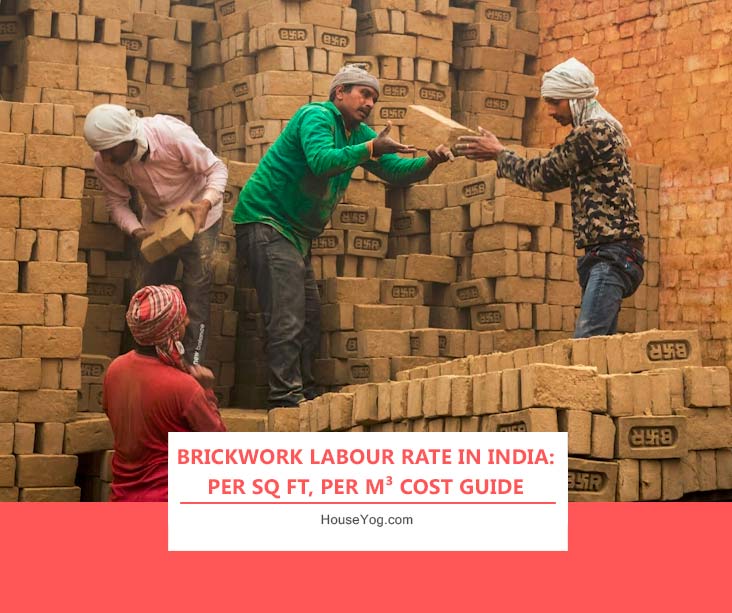

Brickwork labour rate in India typically ranges between ₹35 to ₹65 per sq ft or ₹1,000 to ₹1,600 per cubic meter (m³) for standard residential construction in most cities, depending on wall thickness, location, and brick type. In metro cities or high-rise projects, these rates can go higher due to increased height, complexity, and working conditions.
When you start building your house, one of the biggest risks is overpaying for labour without even realising it. Contractors may quote different rates for the same work, and without proper clarity, it becomes difficult to judge what is reasonable and what is not.
Brickwork is a major cost component in any construction project, and even a small difference in labour rate can significantly impact your overall budget.
If you are planning your home and want clarity on brickwork labour rates in 2026, this guide will help you understand:
- what contractors actually charge
- how these costs are calculated
- and how you can avoid overpaying
In many projects, incorrect labour estimation alone can increase your total construction cost by 5–10%. By the time you finish this post, you will have a clear, practical understanding of brickwork labour charges in India for residential construction.
This guide covers only brick/block masonry work (wall construction), not plastering or general mason labour. If you want to understand plastering costs, you can refer to our plaster labour rate per sq ft guide.
Brickwork Labour Rate per Sq Ft in India
Brickwork labour rate in India is typically ₹35 to ₹65 per sq ft for standard residential construction.
In most residential construction projects, brickwork labour is usually quoted on a per sq ft basis. The exact rate depends mainly on wall thickness and site conditions such as height and accessibility.
Here is a realistic range you can expect for standard house construction:
| Wall Type | Typical Thickness | Labour Rate (₹/sq ft) |
| Half brick wall (partition wall) | 4.5 inch | ₹35 – ₹50 |
| Full brick wall (external wall) | 9 inch | ₹50 – ₹65 |
| With scaffolding (height >10 ft) | Any | +₹5 to ₹15 extra |
For a typical 1,000 sq ft house, this difference can impact your total cost by ₹20,000 to ₹60,000.
How to interpret these rates
A 4.5-inch wall is typically used for internal partitions. Since it uses fewer bricks and less mortar, it is quicker to build and therefore costs less in terms of labour.
A 9-inch wall, which is commonly used for external walls, requires more material, better alignment, and more time to construct. This is why the labour cost per sq ft is higher.
If your construction involves wall heights above 10 feet, contractors usually include additional charges for scaffolding. This not only adds to the setup cost but also slows down the work, increasing the overall labour cost.
Brickwork Labour Rate per Cubic Meter (m³)
While most homeowners see labour quoted per sq ft, contractors and engineers often calculate brickwork labour cost on a per cubic meter (m³) basis. This method is more accurate, especially when dealing with detailed estimates or larger quantities of work.
Here is a realistic range you can expect:
| Work Type | Labour Rate (₹/m³) |
| Standard brick masonry (residential) | ₹1,000 – ₹1,600 |
| Complex work / higher floors | ₹1,600 – ₹2,200 |
When is m³ rate used?
In most house construction projects, you may not directly deal with m³ rates. However, this method is commonly used:
- in contractor agreements and BOQs
- when calculating total quantity of brickwork
- to compare quotations more accurately across vendors
Why this matters for you
Even if your contractor quotes per sq ft, understanding the m³ rate gives you better clarity on how the cost is actually calculated. It also helps you identify if a quote is unusually high or low when converted to volume-based pricing.
In simple terms, m³-based pricing is the backend calculation, while per sq ft is what you usually see on the surface.
Brickwork Labour Cost Calculation Formula
If you understand how brickwork labour cost is calculated, you can confidently evaluate contractor quotes instead of relying only on per sq ft rates.
On most construction sites, labour cost is derived using a simple volume-based approach.
How brickwork labour cost is calculated
1. Calculate the volume of brickwork
This is the starting point:
Wall volume = Wall area × thickness
For example, a thicker wall (9 inch) will automatically increase the total volume and labour required.
2. Estimate number of bricks
As a standard thumb rule:
~500 bricks are required per cubic meter (m³)
This helps in planning both material and labour effort.
3. Calculate mortar requirement
Brickwork requires cement mortar (typically 1:6 ratio of cement to sand).
More joints and thicker walls mean more mortar, which also impacts labour time.
4. Consider labour productivity
A typical team of 1 mason and 1 helper can complete approximately:
1 to 1.25 m³ of brickwork per day.
This productivity directly influences how labour cost is calculated.
Simple example (to help you understand)
Let’s say your total brickwork volume is 10 m³
- Labour rate = ₹1,200 per m³
- Total labour cost = ₹12,000
If you convert this into per sq ft terms, it generally falls within the range of: ₹40 to ₹65 per sq ft, depending on wall thickness
What this means for you
Even if your contractor quotes a per sq ft rate, the actual calculation is usually based on volume (m³).
So if you understand this basic method, you can:
- cross-check if the quoted rate is reasonable
- compare multiple contractor quotes more confidently
- avoid overpaying due to unclear calculations
Factors Affecting Brickwork Labour Cost
Brickwork labour cost is not a fixed number. Even within the same city, rates can vary depending on site conditions, design choices, and type of material used.
Understanding these factors will help you interpret contractor quotes better and avoid unexpected cost increases during construction.
1. Wall Thickness
Wall thickness has a direct impact on labour cost. A thicker wall (such as a 9-inch external wall) requires more bricks, more mortar, and more time for proper alignment.
This increases both the effort and time required, which is why labour cost per sq ft is higher compared to a 4.5-inch partition wall.
2. Height of Construction
As the height of the wall increases, the complexity of work also goes up.
For walls above 10 feet, contractors typically need to arrange scaffolding. This not only adds to the setup cost but also slows down the work, as handling materials at height takes more time and care.
As a result, labour charges increase for higher floors or double-height walls.
3. Location
Labour rates vary significantly based on your city and region.
In metro cities, contractor rates are usually higher due to increased labour demand and higher living costs. In tier 2 and tier 3 cities, labour is relatively more affordable, which brings down the overall brickwork cost.
This is why the same work can have different pricing depending on where you are building.
4. Brick Type
The type of brick or block you choose also affects labour cost.
Traditional red bricks require more joints and careful alignment, which takes time. Fly ash bricks are more uniform and slightly easier to work with. AAC blocks are larger in size, which allows faster construction and reduces labour effort per sq ft.
Because of this, labour cost can vary depending on the material used, even if the wall area remains the same.
Brick Type vs Labour Cost Comparison
The type of brick or block you choose does not just affect material cost, it also has a direct impact on labour effort, speed of construction, and overall cost per sq ft.
Here is a simple comparison to help you understand the difference:
| Brick Type | Labour Difficulty | Cost Impact |
| Red brick | Medium (more joints, manual alignment) | Base rate |
| Fly ash brick | Easier alignment (uniform size) | Slightly lower |
| AAC block | Faster installation (larger size) | Lower per sq ft |
What this means for your construction cost
Traditional red bricks are the most commonly used and form the baseline for labour rates. However, they require more joints and careful alignment, which takes time and increases labour effort.
Fly ash bricks are more uniform in shape and size, making them easier to install. This improves work speed slightly and can reduce labour cost compared to red bricks.
AAC blocks, on the other hand, are much larger in size. Because of this, fewer units are needed to build the same wall area, which significantly speeds up construction. As a result, labour cost per sq ft is usually lower.
Practical insight:
Even though AAC blocks may have a higher material cost, they can reduce overall wall construction labour cost per sq ft in India due to faster execution and lower labour time.
This is why, in many modern residential projects, AAC blocks are preferred when the goal is to optimise both time and labour cost.
Daily Labour Charges for Brickwork (Mason + Helper)
In many small or ongoing construction projects, brickwork labour is not always quoted per sq ft. Instead, contractors may provide workers on a daily wage basis, especially for repair work, extensions, or when the scope is not clearly defined.
Here is a typical range of daily labour charges you can expect:
- Mason: ₹700 – ₹1,200 per day
- Helper: ₹400 – ₹800 per day
Combined daily cost: ₹1,100 to ₹2,000 per day
When are daily rates used?
Daily labour rates are commonly used:
- for small-scale work or partial construction
- when the total quantity of work is uncertain
- for renovation or repair projects
What this means for you
While daily wage may seem flexible, it can sometimes lead to higher overall cost if the work takes longer than expected.
For larger projects like full house construction, it is usually better to agree on a per sq ft or per m³ rate, as it gives you better cost control and clarity.
However, for small or short-duration work, daily labour can be a practical and convenient option.
You can also explore our detailed guide on overall labour cost per sq ft to understand how different construction activities are priced.
Material + Labour Combined Cost (Quick Insight)
If you combine both material and labour, the total brick wall construction cost per sq ft in India typically falls in the range of:
₹120 to ₹250 per sq ft
This is a broad estimate for standard residential construction and can vary based on several factors.
What affects this total cost?
The final cost depends mainly on:
- the type of brick or block used (red brick, fly ash, AAC)
- current cement and sand prices
- location and labour rates in your city
For example, using AAC blocks may increase material cost but reduce labour cost, while traditional red brick may have lower material cost but slightly higher labour effort.
If you want to understand how much bricks, cement, and sand will cost for your project, along with quantity calculations, you can check our detailed guide on brick price per sq ft in India.
Common Mistakes in Estimating Brickwork Cost
This is where many people end up overspending during construction, not because rates are high, but because of small gaps in understanding.
If you are aware of these common mistakes, you can avoid unnecessary costs and make better decisions while dealing with contractors.
1. Mixing different types of labour
One of the most common mistakes is combining all masonry-related work into a single rate.
Brickwork labour is different from plastering or RCC work, and each has its own pricing method. If everything is clubbed together, it becomes difficult to understand what you are actually paying for.
2. Ignoring wall thickness
Wall thickness directly impacts labour cost, but it is often overlooked.
A 9-inch wall requires significantly more effort compared to a 4.5-inch wall—not just in terms of material, but also alignment and time. This can increase labour cost noticeably if not accounted for properly.
3. Not accounting for height and scaffolding
Many estimates assume standard wall height, but in reality, height plays a big role.
If your walls go above 10 feet or involve double-height areas, scaffolding becomes necessary. These charges are sometimes added later, leading to unexpected increases in cost.
4. No clarity on measurement units
Some contractors quote labour per sq ft, while others use per cubic meter (m³).
If you don’t convert and compare properly, you may end up choosing a quote that appears cheaper but is actually more expensive when calculated correctly.
5. Ignoring labour productivity and timelines
Even if the labour rate is fixed, delays in execution can increase your overall cost indirectly.
Slower work means more days on site, which can affect project timelines and increase supervision or overhead costs.
FAQs
Brickwork labour rate typically ranges from ₹35 to ₹65 per sq ft, depending on wall thickness, height, and location.
The labour cost for brickwork per cubic meter in India is usually between ₹900 and ₹1,600 per m³.
A mason charges around ₹700 to ₹1,200 per day, while a helper costs ₹400 to ₹800 per day.
AAC blocks usually reduce labour cost per sq ft because they are larger and faster to install, even though material cost is higher.
Conclusion
Brickwork is one of the most important stages in your house construction, and even small differences in labour rates can have a noticeable impact on your overall budget.
Here’s a quick summary:
- Labour rate: ₹35–₹65 per sq ft
- m³ rate: ₹1,000–₹1,600
- Daily cost: ₹1,100–₹2,000
- Best for estimation: per sq ft for users, m³ for accuracy
Once you understand how brick masonry labour rate per sq ft is calculated, it becomes much easier to evaluate contractor quotes, avoid hidden costs, and plan your construction budget with more confidence.
If you are still in the early planning stage, it’s a good idea to first understand the overall house construction cost per sq ft in India, so you can see how brickwork fits into your total budget.
And if you are looking for more hands-on support—whether it’s planning, cost estimation, or execution—you can explore our construction services, where we help you manage the entire process more smoothly.For those who are still finalising layouts or need customised designs, our house plan services can help you get started with the right foundation.