
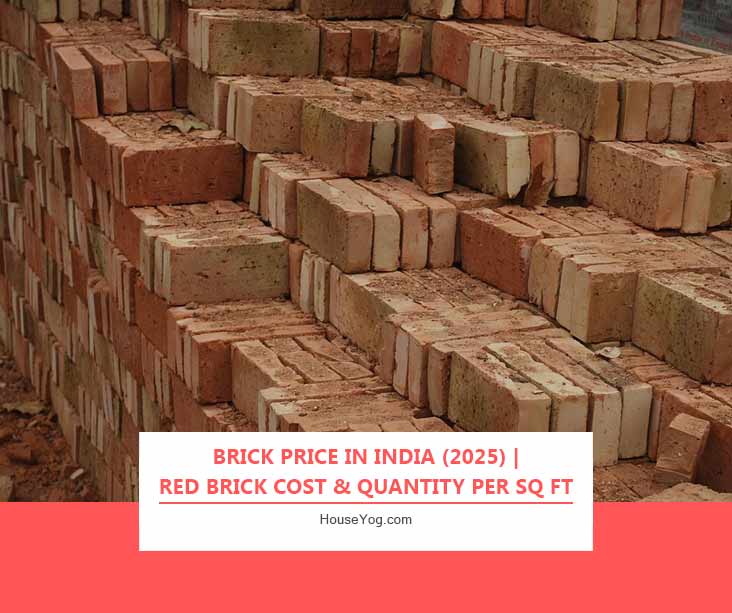

Understanding Brick Prices Before You Start Construction
Bricks are one of the most visible and widely used materials in house construction. They form the walls, partitions, and load-bearing elements in many Indian homes. Because bricks are required in very large numbers, even a small change in brick price can noticeably affect your construction budget.
If you speak to local suppliers or search online, you’ll quickly notice that brick prices vary a lot. Some dealers quote prices per brick, others talk in thousands, and the quality often differs even at similar prices. This can be confusing, especially for first-time home builders.
This guide explains brick price ranges in India, focuses on red brick cost per piece, and helps you understand how many bricks are required per sq ft of construction. The goal is not just to know today’s price, but to help you plan quantities and budget realistically.
Brick Price in India (Indicative Rates)
In most parts of India, bricks are sold per piece, and prices depend on:
- Brick type and quality
- Manufacturing method (kiln-fired or machine-made)
- Location and transport distance
- Seasonal demand and local supply
Below are realistic price ranges commonly seen across Indian cities and towns.
Red Brick Price in India (Per Piece)
Red clay bricks are the most commonly used bricks in residential house construction.
- Red brick price: ₹6 – ₹12 per brick
Lower-priced bricks are usually:
- Locally made
- Slightly irregular in shape
- Suitable for internal masonry with thicker plaster
Higher-priced bricks are generally:
- Better burnt
- More uniform in size
- Easier to work with and require less plaster correction
Fly Ash Brick Price (Where Available)
Fly ash bricks are factory-made bricks produced using coal ash and cement.
- Fly ash brick price: ₹4 – ₹8 per brick
Fly ash bricks are:
- More uniform in size
- Smoother in finish
- Increasingly used in modern RCC houses
Availability varies by region, and not all local contractors are comfortable using them without guidance.
Brick Price Variation – What Influences the Rate?
Brick prices change due to:
- Distance from brick kilns or manufacturing units
- Fuel and labour costs
- Seasonal construction demand (prices often rise in peak season)
- Transport and unloading charges
Note: Prices mentioned are indicative and meant for planning purposes. Always confirm current rates and quality locally before purchase.
Red Brick vs Fly Ash Brick – A Quick Comparison
| Factor | Red Brick | Fly Ash Brick |
| Availability | Widely available | Region-dependent |
| Shape & size | Slight variation | Uniform |
| Plaster requirement | Slightly higher | Lower |
| Cost | Medium to high | Low to medium |
| Usage | Traditional houses | Modern RCC houses |
Both brick types are used in residential construction. The choice depends on availability, cost, and contractor familiarity.
Brick Price Variation by City & Region in India
Brick prices in India are highly localised. Unlike cement or steel, bricks are usually manufactured close to construction sites, which means transport distance and local kiln availability play a major role in pricing.
Because of this, brick prices can vary significantly even within the same state. Instead of exact city rates, the ranges below help you understand what is reasonable to expect in your area.
Brick Price in Metro Cities
Metro cities generally see higher brick prices due to:
- Longer transport distances from brick kilns
- Higher labour and unloading costs
- Strong and continuous construction demand
Typical brick price range (per piece):
- Red bricks: ₹8 – ₹12
- Fly ash bricks: ₹6 – ₹8
Examples: Delhi NCR, Mumbai, Bengaluru, Chennai, Hyderabad, Kolkata
Brick Price in Tier-2 Cities
Tier-2 cities often have balanced brick pricing, especially where brick kilns or fly ash brick units operate nearby.
Typical brick price range (per piece):
- Red bricks: ₹7 – ₹10
- Fly ash bricks: ₹5 – ₹7
Examples: Patna, Ranchi, Jaipur, Indore, Bhubaneswar, Vijayawada
Brick Price in Tier-3 & Semi-Urban Areas
In smaller towns and rural belts, brick prices are often lower, but quality consistency can vary.
Typical brick price range (per piece):
- Red bricks: ₹6 – ₹9
- Fly ash bricks: ₹4 – ₹6
Note: Seasonal shortages, fuel price hikes, or kiln shutdowns can temporarily push prices higher even in smaller towns.
Brick Cost Per Sq Ft of House Construction in India
Homeowners often focus on brick price per piece, but for budgeting, brick cost per sq ft gives a much clearer picture of total expense.
Brick cost per sq ft depends on:
- Type of brick used
- Wall thickness (4.5″, 9″, or cavity walls)
- Quality of workmanship
- Amount of openings (doors and windows)
Brick Cost Per Sq Ft – Quick Overview
| Construction Type | Approx Brick Cost per Sq Ft |
| Basic / budget construction | ₹90 – ₹120 |
| Standard RCC residential house | ₹120 – ₹160 |
| Premium / high-quality construction | ₹160 – ₹200 |
Note: These figures include brick material cost only. Mortar, plaster, and labour are not included.
Why Brick Cost Per Sq Ft Varies
Several practical factors influence brick consumption and cost:
- Wall thickness: 9-inch walls consume almost double the bricks of 4.5-inch walls
- Brick size uniformity: Irregular bricks increase wastage and mortar usage
- Workmanship: Poor bonding leads to higher brick and mortar consumption
- Design complexity: More partitions increase brick quantity
Understanding these factors helps you (the homeowners):
- Spot unrealistic contractor estimates
- Make informed material choices
- Control avoidable cost escalation
Bricks Required Per Sq Ft – Simple Thumb Rules for House Construction
Exact brick quantity can only be calculated after final drawings are prepared. However, for early-stage planning and budgeting, homeowners can rely on practical thumb rules that are widely used in residential construction across India.
These thumb rules help you:
- Estimate brick quantity realistically
- Cross-check contractor calculations
- Avoid over-ordering or material shortages
Bricks Required Per Sq Ft of Wall Area
For standard burnt clay bricks (approx. 9″ × 4.5″ × 3″) with 10 mm mortar joints, the following thumb rules apply:
Brick Requirement by Wall Thickness
- 4.5-inch wall (partition walls): ~5 bricks per sq ft
- 9-inch wall (external & load-bearing walls): ~10 bricks per sq ft
Note: These figures include mortar joints and represent finished wall area.
Bricks Required for a 1000 Sq Ft House (Example)
Let’s understand this with a realistic example.
A typical 1000 sq ft RCC house has both external walls (9-inch) and internal partition walls (4.5-inch).
Example: Standard 1000 Sq Ft RCC House
Approximate brick usage:
- External walls (9-inch): ~6,000 – 7,000 bricks
- Internal walls (4.5-inch): ~4,000 – 5,000 bricks
Total bricks required: ~10,000 – 12,000 bricks
This range works well for:
- Independent houses
- G+1 or G+2 residential buildings
- Standard room layouts
How Brick Quantity Changes with Design
Brick quantity is not fixed. It varies based on:
- Number of rooms & partitions: More walls = more bricks
- Wall thickness selection: 9″ walls consume nearly double the bricks
- Door & window openings: Larger openings reduce brick quantity
- Brick size & uniformity: Irregular bricks increase wastage
This is why two houses of the same size may need different numbers of bricks.
How to Use These Brick Consumption Thumb Rules Safely
To avoid disputes or shortages:
- Keep a 5–7% buffer for breakage and wastage
- Confirm brick size before finalising quantity
- Do not compare fly ash brick quantities directly with red bricks
- Finalise quantities only after layout and wall thickness are confirmed
These thumb rules are meant for planning and understanding, not for final billing.
Red Brick vs Fly Ash Brick – Which Is Better for House Construction?
Choosing the right brick is not only about price. Strength, finish quality, availability, and workmanship all play an important role in deciding whether red bricks or fly ash bricks are better for your house.
Both types are commonly used in residential construction across India, but they perform differently in practice.
Red Bricks – Strengths & Limitations
Red bricks are traditional burnt clay bricks and are widely used across India.
Advantages of Red Bricks
- Familiar material for most contractors
- Good compressive strength for load-bearing and infill walls
- Suitable for both internal and external walls
Limitations of Red Bricks
- Size variation between batches
- Higher mortar and plaster consumption
- Quality depends heavily on kiln and firing method
- Environmental impact due to clay mining
Red bricks work well when:
- Good-quality bricks are locally available
- Skilled masons handle brick bonding properly
Fly Ash Bricks – Strengths & Limitations
Fly ash bricks are factory-manufactured bricks made from coal ash, cement, and aggregates.
Advantages of Fly Ash Bricks
- Uniform size and shape
- Lower mortar consumption due to precision
- Smoother finish, reducing plaster thickness
- Environment-friendly (uses industrial waste)
Limitations of Fly Ash Bricks
- Availability varies by region
- Some local masons are unfamiliar with handling them
- Require proper curing during manufacture
Fly ash bricks perform very well in RCC frame structures, especially where wall alignment and finish quality matter.
Red Brick vs Fly Ash Brick – Practical Comparison
| Factor | Red Brick | Fly Ash Brick |
| Shape & size | Slightly irregular | Uniform |
| Mortar consumption | Higher | Lower |
| Plaster thickness | Higher | Lower |
| Cost per wall area | Medium to high | Low to medium |
| Environmental impact | Higher | Lower |
| Best suited for | Traditional construction | Modern RCC houses |
Which Brick Should You Choose for Your House?
Practical recommendation:
- RCC houses (most modern homes): Fly ash bricks
- Areas with poor fly ash availability: Good-quality red bricks
- Budget-sensitive projects: Fly ash bricks (lower overall cost)
What matters more than brick type is:
- Brick quality
- Proper curing
- Good workmanship
Common Myths About Fly Ash Bricks (And the Truth)
- “Fly ash bricks are weak” → False (they meet IS standards when manufactured correctly)
- “Plaster cracks more on fly ash bricks” → False (cracks are usually due to poor curing)
- “Red bricks are always better” → Not necessarily
Brick performance depends more on quality control and site practices than on the material label.
Why Brick Prices Differ & How to Check Brick Quality Before Buying
Brick prices are not determined by size alone. Two bricks that look similar can perform very differently on site. Understanding why brick prices vary and how to check brick quality helps you avoid poor materials that lead to cracks, seepage, and plaster failures later.
Why Brick Prices Differ So Much in India
Manufacturing Method & Firing Quality
Brick quality depends heavily on how it is manufactured:
- Properly kiln-fired bricks are stronger and more durable
- Under-burnt bricks are soft and absorb more water
- Over-burnt bricks are brittle and difficult to work with
Better firing quality increases cost but improves performance.
Raw Material & Local Soil Quality
The clay or fly ash used affects:
- Strength
- Water absorption
- Durability
Bricks made from good-quality raw materials cost more but require less mortar and plaster correction.
Transport Distance & Handling
Bricks are heavy and fragile.
- Longer transport distance increases cost
- Poor handling increases breakage, which is often passed on to buyers
This is why bricks closer to the construction site are usually cheaper.
Dealer Practices & Seasonal Demand
Brick prices fluctuate due to:
- High demand during peak construction months
- Monsoon kiln shutdowns
- Dealer stock availability
Prices often rise when supply tightens, even if quality remains the same.
How to Check Brick Quality on Site (Simple Tests)
Homeowners don’t need laboratory tests. These simple field checks are enough to identify usable bricks.
Visual Inspection
Good-quality bricks should:
- Have a uniform red or reddish-brown colour
- Be free from cracks and excessive warping
- Have relatively sharp edges
Avoid bricks that look pale, powdery, or heavily distorted.
Soundness Test
- Strike two bricks together
Good brick:
- Produces a clear ringing sound
- Does not break easily
Dull sound usually indicates under-burnt bricks.
Water Absorption Test (Simple Check)
- Soak a brick in water for 24 hours
- Check weight increase
Good bricks should not absorb excessive water. High absorption leads to weak mortar bonding and dampness.
Drop Test (Basic Strength Check)
- Drop a brick from about 1 meter height
Good brick:
- Should not break into multiple pieces
Minor edge chipping is acceptable
Practical Buying Tips for Bricks
- Always inspect bricks before bulk purchase
- Avoid mixing different brick batches at the same site
- Order bricks in phases, aligned with construction progress
- Factor in 5–7% breakage allowance while ordering
Poor-quality bricks result in:
- Higher cement and plaster consumption
- Uneven walls
- Long-term maintenance issues
Brick Price & Quantity FAQs (India)
Brick price in India typically ranges from ₹6 to ₹12 per brick. Prices vary based on brick type (red brick or fly ash), location, quality, and transport distance.
A standard wall requires about 5–10 bricks per sq ft. 4.5-inch partition walls need around 5 bricks per sq ft, while 9-inch walls need about 10 bricks per sq ft.
A typical 1000 sq ft RCC house requires around 10,000–12,000 bricks. The exact quantity depends on wall thickness, number of partitions, and layout design.
Fly ash bricks are ideal for most RCC houses, while red bricks are commonly used where fly ash bricks are unavailable. Quality, workmanship, and curing matter more than brick type.
Yes, fly ash bricks are safe when they meet IS standards and are properly manufactured. They offer uniform size, lower mortar consumption, and good strength for RCC buildings.
Brick prices vary due to kiln availability, transport distance, fuel cost, and local demand. Seasonal supply shortages can also affect pricing.
Putting Brick Cost Into Your Overall Construction Budget
Brick cost is only one part of house construction. To plan accurately, homeowners need to understand material quantities, stage-wise expenses, and realistic cost ranges.
At Houseyog, we help homeowners plan better with:
- Home Construction Cost Calculator
- Professional house design and planning services
Check other related guides:
- Cement Price Today & Cost Per Sq Ft
- Steel Price Today & TMT Calculation Guide
- Sand Cost Per Ton & CFT Guide
Final Note
Brick prices and quantities shared in this guide are indicative and meant for planning purposes only. Always verify current rates, quality, and availability with local suppliers before finalising purchases.