
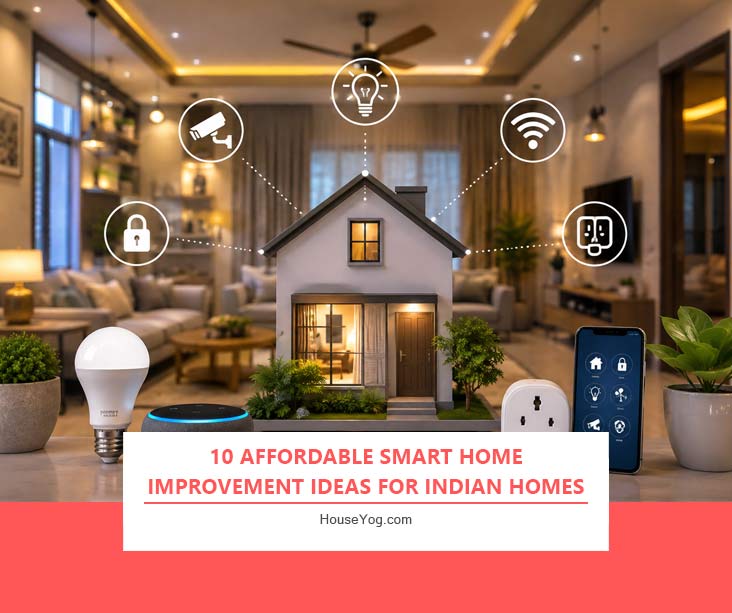

Smart home upgrades do not have to be expensive.
When most people hear the term smart home, they imagine automated villas, expensive gadgets, and complicated technology that costs several lakh rupees.
But the reality is very different.
Today, many smart home improvements cost less than a new smartphone and can be installed in just a few minutes. From smart lighting and security cameras to leak detectors and automated curtains, small upgrades can make your home safer, more comfortable, and more energy-efficient.
As architects, we often tell homeowners that a smart home is not about filling every room with technology. It is about using technology where it solves a real problem.
For example:
- Forgetting to switch off the lights
- Leaving the geyser on for hours
- Not knowing who is at the front door
- Discovering a water leak after it has already damaged the kitchen cabinet
- Returning to a dark house after a long day at work
The good news is that you do not need to renovate your entire house to enjoy these benefits.
Whether you live in an apartment in Kolkata, a duplex in Patna, or an independent house in Ranchi, these affordable smart home ideas can help you modernise your space without stretching your budget.
1. Replace Traditional Bulbs With Smart Lighting
Lighting is often the easiest place to start.
A smart bulb allows you to control brightness, set schedules, and switch lights on or off using your phone or voice commands.
Many budget-friendly smart bulbs in India work with Google Home and Amazon Alexa and cost between ₹300 and ₹800.
For example, you can:
- Turn on the balcony lights automatically after sunset
- Dim the bedroom lights at night
- Schedule the living room lights to switch off automatically at midnight
Architect’s tip: If you are building a new house, plan separate lighting circuits for decorative, ambient, and task lighting. It makes future automation much easier.
2. Install a Smart Plug Instead of Replacing Appliances
You do not need to replace all your existing appliances to create a smart home.
A smart plug can instantly convert ordinary devices into smart devices.
Simply plug it into a wall socket and connect your appliance.
You can use it with:
- Table lamps
- Ceiling fans
- Coffee makers
- Room heaters
- Air coolers
- Decorative lighting
A smart plug is particularly useful in Indian homes where people often forget to switch off appliances before leaving for work.
Most models cost between ₹500 and ₹1,000 and can be installed in less than five minutes.
3. Upgrade Home Security With Smart Cameras
A security camera is one of the most practical smart home investments.
Modern cameras offer features such as:
- Motion detection
- Night vision
- Mobile alerts
- Cloud storage
- Two-way communication
They are especially useful if you:
- Travel frequently
- Have elderly parents at home
- Employ domestic help
- Want to monitor children or pets
A basic indoor smart camera usually costs between ₹2,000 and ₹5,000.
Many apartment owners place cameras near the main entrance, while homeowners often install them near gates, parking areas, and staircases.
4. Add a Video Doorbell for Better Front Door Security
Traditional doorbells only tell you that someone is outside.
A video doorbell tells you who is outside.
Whether you are in the office, travelling, or simply relaxing upstairs, you can see visitors directly on your smartphone.
Video doorbells are particularly useful for:
- Apartment owners
- Independent houses
- Homes with elderly residents
- Families that frequently receive deliveries
If you are already upgrading your entrance, consider combining a video doorbell with professional access solutions such as garage door upgrades or automated entry systems. When planned together, they create a more secure and seamless entry experience.
5. Install Leak Detectors Before a Small Problem Becomes a Big Expense
Most homeowners think about security but rarely think about water damage.
Imagine returning from a weekend trip only to discover that a leaking washing machine has flooded the kitchen.
A simple leak detector can send an alert to your phone the moment it detects water.
Place them near:
- Washing machines
- Kitchen sinks
- Water purifiers
- Bathrooms
- Overhead water tanks
For a small investment, these devices can help prevent expensive repairs.
6. Improve Comfort With Smart Air Purifiers
Indoor air quality affects both comfort and health.
This is especially important in Indian cities where dust and pollution levels can rise significantly during certain seasons.
Smart air purifiers allow you to:
- Monitor air quality
- Adjust fan speeds remotely
- Schedule operating times
- Track filter replacement
Many models can be controlled through a mobile app or voice assistant.
If you have children, elderly family members, or allergy sufferers at home, this upgrade can make a noticeable difference.
7. Automate Curtains and Blinds
Motorised curtains may sound like a luxury, but they have become much more affordable in recent years.
Imagine waking up and having your bedroom curtains open automatically with the morning sunlight.
Smart curtains help you:
- Control natural light
- Improve privacy
- Reduce glare
- Lower indoor heat
They work particularly well in homes with:
- Large windows
- East-facing bedrooms
- Living rooms with full-height glazing
Architect’s tip: If you are constructing a new home, provide electrical points near curtain tracks during the design stage. Retrofitting later can be more expensive.
8. Use Smart Sensors on Doors and Windows
Small sensors can significantly improve home security.
These devices send notifications whenever a door or window is opened.
They are especially useful for:
- Ground-floor apartments
- Balcony doors
- Children’s rooms
- Main entrances
Some sensors can also trigger other smart devices.
For example, opening the main door can automatically turn on the foyer lights.
That is where smart homes become truly useful.
9. Add a Voice Assistant to Connect Everything
A voice assistant acts as the control centre of your smart home.
Instead of opening multiple apps, you can simply say:
- Turn on the bedroom lights.
- Switch off the fan.
- Play music.
- Set a reminder.
Voice assistants can connect multiple devices and automate everyday tasks.
You do not need an expensive setup.
A basic smart speaker can become the foundation of your entire smart home ecosystem.
10. Plan Smart Home Infrastructure During Construction
This is the most important advice architects can give homeowners.
Do not think about smart home technology after construction is complete.
Think about it during the design stage.
Proper planning during the design stage can prevent expensive modifications later. For example, electrical conduits, switch locations, internet points, and CCTV wiring should be considered before construction begins. If you are building a new home, our guide on house construction cost in India can help you understand how electrical and automation planning fits into the overall project budget.
When we design homes, we encourage clients to plan for:
- Additional electrical conduits
- Neutral wires at switch points
- Extra power outlets
- Internet and network cables
- CCTV wiring
- Smart lock provisions
- Automated lighting circuits
These small decisions cost very little during construction but can save significant time and money later.
Future-proofing your home is often smarter than installing individual gadgets one by one.
Architects often encourage homeowners to think of home automation as a complete system rather than a collection of individual gadgets. Lighting, security cameras, smart locks, gates, and garage doors should be planned together during the design stage. If your renovation includes an existing garage, consider evaluating the entire entry system rather than focusing only on lighting or security devices. In some cases, consulting an expert garage door repair service can help homeowners integrate older garage systems into a more modern and connected home.
Frequently Asked Questions
A smart bulb or smart plug is usually the best starting point because both are inexpensive and easy to install.
Yes. They can improve comfort, increase security, reduce energy consumption, and simplify everyday tasks.
Most devices use very little electricity. In many cases, they actually help reduce energy usage.
Absolutely. Most smart bulbs, plugs, cameras, and sensors work perfectly in apartments and rental homes.
Not always. Many smart devices work with your existing electrical system. However, if you are building a new house, planning for automation during construction is the better option.
Final Thoughts
A smart home does not have to be expensive or complicated.
The best smart home upgrades are not necessarily the most advanced ones. They are the ones that solve real problems and improve your everyday life.
Start small.
Install a smart bulb, add a security camera, automate your curtains, or place a leak detector near your washing machine.
Over time, these small improvements can create a safer, more comfortable, and more efficient home.
And if you are still in the planning or construction stage, talk to your architect about future-proofing your electrical and automation systems. A little planning today can save you a lot of money tomorrow.