Planning to construct a Marriage Hall? Start With This One Decision
If you own a piece of land, whether near a highway, in a small town, or within your village, starting a marriage hall can feel like a natural business opportunity. Demand is steady, land is already available, and the idea of generating monthly income from events is appealing.
But very quickly, most landowners hit a major roadblock.
What type of construction should you go for?
Should you invest heavily in a full RCC structure and build something permanent? Should you start small with a tin shed hall to keep costs low? Or is there a smarter, more balanced approach?
If you are planning a low-cost marriage hall construction in India, choosing the right structure type becomes your most important decision. This decision is not just about construction. It directly impacts your investment, risk, and how soon you start earning.
In this guide, we’ll break down the three most common marriage hall construction types in India – RCC, PEB (tin shed), and hybrid models. So you can choose what actually works in your situation, especially in Tier 2, Tier 3, and rural Indian markets.
Before finalising the structure, it also helps to understand different marriage hall design plans and layout options, so you can align your construction type with your space and business goals.
Full RCC Marriage Hall Construction in India: Cost, Pros & Use Case
For many people, a “proper” marriage hall means a full RCC (Reinforced Cement Concrete) structure. These are the kind of banquet halls you typically see in cities—multi-storey buildings with finished interiors, permanent roofing, and a premium feel.
At first glance, this option feels like the safest and most complete solution. After all, it’s durable, looks impressive, and can command higher booking rates.
However, the decision becomes more complex when you look at the cost and time involved.
In most parts of India today, a full RCC marriage hall can cost anywhere between ₹1,800 to ₹2,800 per sq ft, depending on the level of finishing. For a reasonably sized hall, this easily translates into an investment of ₹1.5 crore or more.
If you want a detailed breakdown, you can refer to our guide on marriage hall construction cost in India, where we explain material, labour, and finishing costs in detail.
Construction timelines also stretch to 12–18 months, especially when approvals, structural work, and finishing are taken into account.
What you get in return is a long-lasting, high-value asset. RCC buildings are extremely durable, require relatively lower maintenance over time, and allow flexibility for vertical expansion in the future. They also create a strong impression, which helps in attracting higher-paying customers, especially for AC weddings and premium events.
But this comes with its own challenges. The biggest one is the high upfront investment. For many landowners in smaller towns, locking such a large amount of capital without immediate returns can feel risky. There is also the pressure of recovering this investment, which depends heavily on local demand.
In practical terms, RCC construction works best when you are building for the long term, have strong financial backing, and are confident about consistent demand in your area.
PEB / Tin Shed Marriage Hall Construction: Cost, Benefits & Limitations
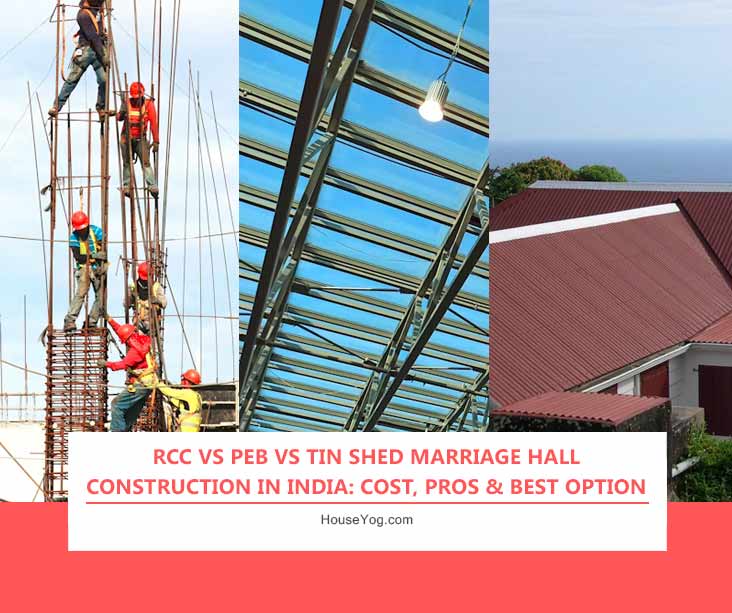
At the other end of the spectrum is the PEB or tin shed model. These are steel-structured halls with sheet roofing, commonly seen in warehouses, but widely adapted for marriage functions in rural and semi-urban India.
The biggest advantage here is simple—low cost and construction speed.
Depending on design and materials, a tin shed or PEB hall can be built for around ₹600 to ₹1,200 per sq ft, and in many cases, it can be completed within 2 to 4 months. This makes it an attractive option for landowners who want to start operations quickly without heavy investment.
Another major benefit is the ability to create large, column-free spaces, which are ideal for accommodating big gatherings of 300–800 guests. Structurally, these halls are efficient and flexible.
PEB (Pre-Engineered Building) structures are widely used for low-cost construction projects in India due to their speed and affordability.
However, the limitations become evident when you look at the user experience and perception.
In hot regions, tin sheds can become uncomfortable during summer unless proper insulation and ventilation are planned. Aesthetically, they are basic, which affects how customers perceive the venue. In many cases, this directly impacts how much you can charge per booking.
There is also a subtle but important factor—social perception. In certain areas, families prefer venues that “look permanent” or more premium, especially for weddings.
That said, in villages and smaller towns, where functionality matters more than luxury, tin shed halls perform quite well. They allow you to enter the market quickly, test demand, and start generating income without taking on significant financial risk.
Hybrid Marriage Hall Construction: Best Low-Cost Scalable Option
Between these two extremes lies a much more practical solution—one that many experienced builders and architects quietly prefer.
The hybrid model combines the strengths of both RCC and PEB construction. This model is especially popular in low-budget marriage hall construction projects across rural India.
Instead of building everything in RCC or everything in a tin shed, you divide the structure based on function. Typically, the rooms, kitchen, toilets, and entrance block are built in RCC, while the main hall is covered using a large-span steel or tin shed structure.
This approach immediately reduces the overall construction cost, bringing it to a more manageable range of ₹1,000 to ₹1,800 per sq ft, depending on design and specifications. Construction time is also shorter, usually between 4 and 8 months.
More importantly, it strikes a balance between cost, usability, and perception.
From the outside, the RCC portion gives the property a more “permanent” and respectable look. Functionally, critical areas like rooms and the kitchen benefit from solid construction. At the same time, the large-span hall keeps costs under control while still accommodating large gatherings.
But the biggest advantage of the hybrid model is not just cost—it’s flexibility.
You can start operations earlier, begin generating income, and then gradually upgrade or expand the structure based on demand. Over time, parts of the shed can be improved, interiors can be enhanced, or even converted into RCC if required.
This phased approach significantly reduces financial pressure and allows you to grow the business organically.
Cost Comparison: A Quick Snapshot
To help you quickly compare RCC vs PEB vs tin shed marriage hall construction, here is a practical cost comparison:
Type
Cost per sq ft
Investment Level
Timeline
Maintenance
Expansion Scope
RCC
₹1,800–₹2,800
High
12–18 months
Low
High
PEB/Tin Shed
₹600–₹1,200
Low
2–4 months
Medium
Limited
Hybrid
₹1,000–₹1,800
Medium
4–8 months
Balanced
High
Note: Costs vary based on location, design, and material choices.
What Actually Works in Rural and Semi-Urban India?
If you look at real markets in places like Darbhanga, Hazipur, Chhapra, Gopalganj, Motihari, eastern UP, or the outskirts of Jharkhand, a clear pattern emerges.
Land is usually not the problem. Demand exists, but customers are price-sensitive. Bookings depend more on availability and functionality than on luxury.
In such settings, building a fully premium RCC hall from day one often leads to longer recovery periods. On the other hand, going too basic with a tin shed can limit your earning potential.
This is why, in most cases, the hybrid approach works best. It aligns with local expectations, keeps investment manageable, and still allows you to position the venue decently in the market.
Think in Terms of ROI, Not Just Construction
One of the most common mistakes landowners make is focusing only on “how the building will look,” instead of “how the business will perform.”
It’s tempting to build everything perfectly from the beginning. But in reality, what matters more is how soon the marriage hall starts generating income.
A smaller or hybrid hall that starts earning ₹40,000–₹1,00,000 per month within a few months can often be more valuable than a large RCC project that takes years to complete and stabilise.
The smarter approach is to start with what you can afford, validate demand, and then expand in phases. This not only reduces risk but also ensures that your investment grows in line with actual market response.
However, poor planning in the beginning can lead to costly changes later, which is why it’s important to be aware of common marriage hall design mistakes to avoid.
Common Mistakes That Can Cost You Later
Many issues in marriage hall projects don’t come from the type of construction, but from poor planning decisions early on.
A common mistake is overbuilding in the beginning, which locks up capital and delays returns. Another is ignoring ventilation and heat management, especially in tin shed structures, leading to poor user experience.
Parking is another frequently overlooked aspect. Even in rural areas, a lack of proper parking can create major inconvenience during events.
Perhaps the most critical mistake is not planning for future expansion. Without a phased strategy, any upgrades later become expensive and complicated.
Final Recommendation: What Should You Choose?
There is no single “best” option that works for everyone. The right choice depends on your budget, location, and long-term vision.
If your budget is limited and you want to start quickly, a PEB or basic hybrid model makes sense.
If you have a moderate budget and want a balance between cost and growth, the hybrid approach is ideal.
If budget is not a constraint and you are building for a premium market, a full RCC structure is the right path.
Best Marriage Hall Construction Type in India:
Low budget: PEB / Tin Shed
Medium budget: Hybrid
High budget: RCC
But for most landowners in India today, especially in Tier 2 and Tier 3 locations, the hybrid model offers the best mix of affordability, functionality, and future scalability.
Frequently Asked Questions
Which is cheaper: RCC or PEB marriage hall construction in India?
PEB (tin shed) marriage halls are significantly cheaper than RCC construction. While RCC can cost ₹1,800–₹2,800 per sq ft, PEB structures typically range between ₹600–₹1,200 per sq ft, making them ideal for low-budget projects.
Is a tin shed marriage hall suitable for weddings?
Yes, tin shed marriage halls are suitable for weddings in rural and semi-urban areas where functionality matters more than luxury. However, proper ventilation and heat insulation are important for guest comfort.
What is the best construction type for a low-budget marriage hall?
For low-budget projects, a hybrid model (RCC rooms with a tin shed hall) is often the best option. It balances cost, usability, and future expansion potential.
How long does it take to build a marriage hall in India?
Construction time depends on the type. RCC structures may take 12 to 18 months, while PEB or tin shed halls can be completed in 2 to 4 months. Hybrid models typically take 4 to 8 months.
Can a tin shed marriage hall be converted into an RCC later?
Yes, many builders start with a tin shed structure and later upgrade parts of it into RCC. Planning the layout in advance makes future expansion easier and more cost-effective.
Is RCC necessary for a successful marriage hall business?
No, RCC is not mandatory. Many successful marriage halls in small towns operate using PEB or hybrid structures. The key factor is location, planning, and demand, not just construction type.
What is the minimum budget to start a marriage hall in India?
A basic marriage hall can be started with ₹30–₹50 lakh using a tin shed or a simple hybrid structure. Costs vary based on location, size, and facilities provided.
Planning a Marriage Hall? Get the Design Right From Day One
Choosing the right construction type is just the first step. The real success of a marriage hall depends on layout planning, cost optimisation, and future scalability.
At Houseyog, we help you design marriage halls that are not just visually appealing but also practical, cost-efficient, and aligned with your business goals.
Whether you want to start small or build a premium venue, we can help you plan it the right way.
Ready to plan your marriage hall? Talk to our experts today (call 7596058808) and get a customised layout and cost estimate based on your land and budget!