
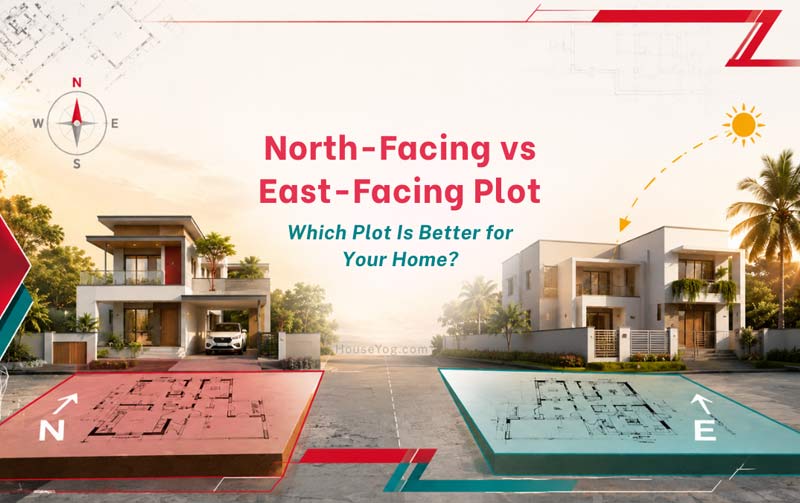

You’ve finally found two plots that fit your budget. One is north-facing. The other is east-facing.
Then the confusion begins.
Your parents recommend an east-facing plot because it’s considered better according to Vastu. Your broker says north-facing plots have higher demand and better resale value. A friend tells you that east-facing houses receive better sunlight.
Suddenly, choosing a plot becomes much more complicated than you expected.
The good news? You don’t have to rely on myths, opinions, or WhatsApp advice.
The truth is that both north-facing and east-facing plots can be excellent choices. The right option depends on your climate, plot size, family requirements, future plans, and, most importantly, the quality of the house design.
As architects, we’ve designed comfortable, functional homes on both. We’ve also seen poorly designed houses on both.
In this guide, we’ll compare north-facing and east-facing plots from three practical perspectives:
- Architecture
- House planning and functionality
- Vastu principles
Let’s begin.
North-Facing vs East-Facing Plot: Quick Summary
| If your priority is… | Choose |
| Morning sunlight | East-facing |
| Better daylight distribution | North-facing |
| Family living | East-facing |
| Future commercial use | North-facing |
| Vastu | Both |
| Resale value | Both |
| Duplex construction | Either |
Architect’s recommendation: There is no universally better option. Choose the plot that best suits your family’s needs, climate, and architectural requirements.
What Is a North-Facing Plot?
A north-facing plot is a plot where the main access road is located on the northern side, and the entrance to the house usually faces north.
In simple terms, when you stand inside the plot and look toward the road, you face north.
How does sunlight move around a north-facing plot?
In India, the sun rises in the east, moves across the southern sky, and sets in the west.
As a result:
- The eastern side receives morning sunlight.
- The southern side receives the maximum amount of sunlight during the day.
- The western side receives the harsh afternoon sun.
- The northern side receives softer and more indirect daylight.
This movement of the sun significantly influences room placement, window design, ventilation, and thermal comfort.
Advantages of a north-facing plot
A north-facing plot offers several practical advantages that go far beyond Vastu beliefs. From better daylight distribution to greater design flexibility, there are several reasons why architects often enjoy working with this orientation.
Better daylight without excessive heat
North-facing houses typically receive softer, more uniform daylight throughout the day. This makes the interiors feel bright without becoming excessively hot.
Greater design flexibility
Architects often prefer north-facing plots because they allow more flexibility in placing windows, living areas, home offices, and open spaces.
Excellent for mixed-use properties
If you’re planning to combine residential and commercial spaces, a north-facing plot can be an excellent choice.
Small offices, clinics, retail spaces, and professional studios often perform well on north-facing properties.
Strong market demand
North-facing plots are highly popular in many Indian cities, which often translates into good resale value.
Disadvantages of a north-facing plot
Like any other plot orientation, a north-facing plot isn’t perfect. Depending on the layout, plot size, and surrounding structures, you may need to address a few design challenges during the planning stage.
Limited morning sunlight
If you enjoy bright morning sunlight in your living room or bedroom, a north-facing house may require more thoughtful planning.
Room placement becomes more important
The architect must carefully position the bedrooms, kitchen, courtyard, windows, and staircases to maximize natural light.
Without proper planning, some rooms may feel darker than expected.
What Is an East-Facing Plot?
An east-facing plot is a plot where the road is located on the eastern side, and the entrance of the house typically faces east.
When you stand inside the plot and face the road, you face east.
East-facing plots are among the most preferred plot orientations in India because they combine practical design benefits with strong cultural and Vastu appeal.
How does sunlight move around an east-facing plot?
The most significant advantage of an east-facing plot is direct access to morning sunlight.
This means:
- The front portion of the house receives sunlight early in the day.
- Living spaces can feel brighter.
- Bedrooms can receive healthier morning light.
- The house often feels naturally active and vibrant during the first half of the day.
Advantages of an east-facing plot
An east-facing plot is one of the most sought-after choices among Indian families, and for good reason. It combines practical design benefits with cultural and Vastu preferences, making it a popular option for residential construction.
Excellent morning sunlight
Morning sunlight is generally considered beneficial because it is less intense than afternoon sunlight.
Many families prefer waking up to naturally illuminated bedrooms and living areas.
Better natural lighting
If designed correctly, an east-facing house can remain bright throughout the day while reducing dependence on artificial lighting.
Strong Vastu preference
East-facing plots are traditionally associated with positive energy, health, and growth, making them extremely popular among Indian families.
Ideal for family homes
East-facing houses often work exceptionally well for nuclear families, especially when the design prioritizes living areas, balconies, gardens, and open spaces.
Disadvantages of an east-facing plot
While east-facing plots have several strengths, they aren’t automatically the right choice for every family. A few potential limitations should be considered before making your final decision.
Greater exposure to direct sunlight
Although morning sunlight is desirable, excessive glazing or poorly designed openings can sometimes increase indoor temperatures.
More planning is required on compact plots
On smaller plots, balancing daylight, parking, staircases, and room placement may require additional design adjustments.
North-Facing vs East-Facing Plot: An Architect’s Comparison
Both plot orientations can produce excellent homes. The difference lies in how the house is designed.
The following comparison should help you understand where each option performs better.
| Factor | North-Facing Plot | East-Facing Plot |
| Morning sunlight | Good | Excellent |
| Daylight quality | Excellent | Excellent |
| Summer heat | Moderate | Moderate |
| Vastu popularity | Very high | Very high |
| Family homes | Very good | Excellent |
| Commercial use | Excellent | Good |
| Resale value | Excellent | Excellent |
Natural lighting
If natural lighting is your top priority, an east-facing plot has a slight advantage.
Morning sunlight can illuminate the entrance, living room, and front-facing spaces more effectively.
However, don’t assume that a north-facing house will be dark.
A well-designed north-facing house with skylights, internal courtyards, large windows, and strategically placed openings can be brighter than a poorly designed east-facing house.
Ventilation
Ventilation depends more on window placement and building layout than plot orientation.
Cross-ventilation requires air to move through the house.
This means:
- Window positioning matters.
- Open spaces matter.
- Courtyards matter.
- Building setbacks matter.
A house with windows on opposite walls will almost always perform better than a house designed without considering airflow.
Summer heat
Neither north-facing nor east-facing plots automatically guarantee a cooler house.
The western side of any house usually receives the harshest afternoon heat.
That’s why architects often recommend:
- Heat-resistant walls
- Proper shading devices
- Verandas
- Vertical fins
- Double-glazed windows
- Landscape buffers
The quality of the building envelope matters far more than plot orientation.
Winter comfort
East-facing homes generally receive more direct sunlight during the morning, which can make them feel warmer during winter.
In colder regions, this can be a practical advantage.
However, in most Indian cities, the difference is relatively small.
Room planning
Room planning should always follow function rather than direction.
For example:
| Space | Recommended location |
| Living room | East or north |
| Bedrooms | East, north, or south |
| Kitchen | Depends on layout |
| Study room | North |
| Dining room | Near the kitchen |
| Staircase | Depends on circulation |
An architect should design the house according to your lifestyle instead of forcing rooms into predetermined positions.
Parking and entrance design
Parking often becomes a challenge on small urban plots.
An east-facing plot may offer a more attractive entrance design, while a north-facing plot can provide additional flexibility for driveway planning.
The ideal parking layout depends on:
- Car size
- Plot width
- Gate location
- Turning radius
- Building setbacks
Which plot works better for small plots like 20×30, 25×30, and 30×40?
On smaller plots, architectural planning becomes more important than orientation.
A 20×30 plot offers only 600 square feet of land.
After accounting for walls, staircases, parking, setbacks, and circulation space, the usable area becomes significantly smaller.
In such cases, focus on:
- Efficient circulation
- Multi-functional rooms
- Natural lighting
- Ventilation
- Storage
If you’re exploring different layout options, you can also browse our collection of house plans for common plot sizes such as 20×30, 25×30, and 30×40 plots to understand how orientation influences design options.
Which plot is better for a duplex house?
Both orientations work equally well for duplex homes.
A duplex house offers greater flexibility because spaces can be distributed across two floors.
For example:
- The ground floor can accommodate common areas.
- Bedrooms can be shifted upstairs.
- Balconies can be positioned for better daylight.
- Open terraces can improve ventilation.
The orientation of the plot becomes less important when vertical planning is available.
Which plot is better for commercial use?
A north-facing plot usually has a slight advantage for future commercial development.
If you plan to add:
- A shop
- A clinic
- An office
- A consulting space
- A rental unit
A north-facing property often provides greater design flexibility.
That said, location still matters more than direction.
A commercially active street will always outperform a perfectly oriented plot in a poor location.
What Does Vastu Say About North-Facing and East-Facing Plots?
According to Vastu, both north-facing and east-facing plots are considered auspicious.
However, they are associated with different symbolic qualities.
| Vastu aspect | North-facing plot | East-facing plot |
| Wealth | Strongly associated | Moderately associated |
| Health | Good | Strongly associated |
| Career | Excellent | Good |
| Family growth | Good | Excellent |
Wealth
North-facing plots are traditionally associated with prosperity and financial growth.
This belief contributes significantly to their popularity.
Health
East-facing plots are often associated with better health because they receive morning sunlight.
Interestingly, this belief also has a practical architectural basis.
Exposure to early morning sunlight can support healthier daily routines.
Career
Many people believe that north-facing homes support professional growth and business success.
A north-facing plot alone won’t guarantee business success, just as an east-facing plot won’t automatically improve family life. Good financial planning, thoughtful design, and smart long-term decisions have a much greater impact than the direction of your plot.
Family growth
East-facing plots are commonly associated with family well-being, positive energy, and harmonious living.
But it’s important to keep one thing in mind.
A well-designed house will always outperform a poorly designed house, regardless of Vastu.
If Vastu is important to you, the best approach is to integrate traditional principles with sound architectural planning rather than treating them as opposing philosophies.
You may also find it helpful to explore our detailed Vastu guides before finalizing your house design.
Which Plot Is Better for Different Families?
There is no single answer because every family has different priorities.
Use this quick guide to identify which option may suit your requirements.
| If you are… | Recommended choice |
| A first-time homeowner | East-facing |
| Building a family home | East-facing |
| Building a duplex | Either |
| Planning a home office | North-facing |
| Planning future commercial use | North-facing |
| Living in a hot climate | Either, with proper design |
If you’re planning to construct your first house, don’t select a plot based solely on direction.
Also evaluate:
- Your budget
- Construction costs
- Future expansion plans
- Parking requirements
- Family size
We’ve discussed many of these considerations in our house construction cost guides, which can help you estimate your total project budget more accurately.
Five Factors That Matter More Than Plot Direction
In our experience, families often spend weeks debating whether a plot should face north or east but spend only a few minutes evaluating the things that actually determine how comfortable their home will be for the next 30 or 40 years.
This is where many buyers make a costly mistake.
They spend weeks comparing north-facing and east-facing plots while completely ignoring factors that will affect the house for decades.
1. Plot dimensions
A well-proportioned rectangular plot is usually easier to design than an irregularly shaped plot.
The shape of the land directly affects:
- Room layout
- Circulation
- Structural design
- Parking
- Future expansion
2. Road width
A 30-foot-wide road often provides significantly better access than a 12-foot-wide road.
Road width affects:
- Vehicle movement
- Parking
- Accessibility
- Property value
- Future development potential
3. Soil quality
Never purchase a plot without understanding the soil conditions.
Poor soil can increase foundation costs considerably.
A basic soil investigation can prevent expensive surprises during construction.
4. Surrounding buildings
A neighboring four-story building can block light and ventilation, regardless of your plot orientation.
Before buying a plot, examine:
- Adjacent buildings
- Future development
- Shadows
- Setbacks
- Open spaces
5. Architectural planning
This is the most important factor.
An experienced architect can transform an average plot into a comfortable, energy-efficient, and beautiful home.
Good design can compensate for many site limitations.
Poor design cannot.
If you’re still deciding whether to buy a plot, it may also be helpful to understand the actual cost of building a house before making your final decision. Our detailed house construction cost guides can help you estimate your budget more accurately.
Frequently Asked Questions
No. Both are considered favorable. The better choice depends on your family’s needs, climate, plot size, future plans, and house design.
An east-facing plot receives more direct morning sunlight, while a north-facing plot typically receives softer and more consistent indirect daylight.
Both are considered auspicious. Traditionally, north-facing plots are associated with prosperity, while east-facing plots are associated with health and growth.
Both usually have strong resale demand. In most cases, location, road width, neighborhood, plot size, and nearby infrastructure have a much greater impact on resale value.
Final Thoughts: Choose the Plot That Fits Your Family, Not the Myth
If you’re choosing between a north-facing and an east-facing plot, don’t assume that one is automatically superior.
Instead, ask yourself these questions:
- How large is your family?
- Will you build a duplex?
- Do you need parking?
- Will you add a home office?
- Do you plan to use part of the property commercially?
- Is natural light a priority?
The answers to these questions matter far more than the direction of the plot.
At Houseyog, we believe that every plot has potential. The goal isn’t to find the “perfect” direction. The goal is to design a house that works for your family, your budget, and your lifestyle.
If you’re planning to build a house and need professional guidance, our architectural team can help you with house planning, custom floor plans, 3D elevation design, structural drawings, and complete construction consulting.