Choosing the right plot size is the single most important decision when planning a marriage hall in India.
Whether you’re targeting 300, 500, or 800 guests, the land required for a marriage hall depends not just on the hall size, but also on dining arrangements, parking demand, service areas, and peak-hour crowd movement.
Many marriage hall projects struggle later, because the plot was never feasible for the intended guest capacity in the first place.
This guide explains the ideal plot size for a marriage hall in India, using practical capacity-based ranges for 300-guest, 500-guest, and 800-guest venues. The focus is on land feasibility before design, so owners and investors can evaluate plots correctly before committing to drawings, approvals, or construction
Why guest capacity matters more than built-up area for marriage halls
Two marriage halls can have the same built-up area and still function very differently on event days.
This is because guest capacity is not only about seating inside the hall, but also about how people move, dine, queue, and park during peak wedding hours.
Some of these factors directly affect how much land a marriage hall actually needs to operate smoothly:
Peak crowd load (when baraat arrives, or dinner peak starts)
Floating guests + seated guests (common in Indian weddings)
Dining + service aisles (buffet + circulation)
Back-of-house (kitchen, store, staff movement)
Parking and queue management (the #1 approval and neighbour-conflict trigger)
A practical planning reality:
Indian building guidelines treat marriage halls as “assembly spaces,” where space needs change depending on how people actually use the area. A tightly packed seating arrangement needs less space per person, while dining areas, buffet movement, and standing crowds need much more.
This is why two marriage halls with the same built-up area can perform very differently during peak wedding hours. And why plot size decisions should always factor in dining style and crowd movement, not just hall seating.
A simple way to estimate plot size (before design)
There is no single “correct” plot size for a marriage hall. A realistic estimate always falls within a range, depending on how the hall will be used on event days.
Before getting into drawings or approvals, plot feasibility can be assessed using three practical factors:
Peak guest capacity (300 / 500 / 800)
Event style (seated dining vs buffet + floating)
Parking (how many cars + two-wheelers in peak hours on event day)
Typical space blocks to account for
To apply this capacity-based logic, it helps to break the land requirement into clear space blocks, such as:
Main hall + stage buffer
Dining / pre-function / queue space (often the “hidden” area)
Kitchen + store + wash
Toilets + handwash
Circulation + exits + service corridor
Parking + driveway turning + entry queue
With this framework in mind, let’s translate it into realistic plot size ranges, starting with smaller and mid-sized marriage halls.
Ideal plot size for a 300-guest marriage hall
A 300-guest marriage hall is often the first practical target for owners evaluating land feasibility. At this scale, it is possible to balance hall size, dining space, and parking without requiring very large plots or complex vertical planning.
This capacity typically works well for:
Tier-2/tier-3 towns
Smaller city edges
Multi-event use (wedding + birthday + community programs)
Feasibility estimate (plot area range)
A realistic starting plot size range for a 300-guest marriage hall, including functional parking, is:
~10,000 to 18,000 sq ft plot area (approx. 0.23 to 0.41 acre)
Why is it shown as a range?
Lower end works when parking demand is low, and you use compact planning.
Upper end applies when you want comfortable parking + drop-off + less neighbour impact.
Quick block estimate (example)
(Illustrative feasibility numbers; final design and local rules will refine these)
Block
Typical allowance (sq ft)
Hall seating + stage buffer
2,400–4,200
Dining/buffet / queue
1,500–3,000
Kitchen + store + wash
700–1,200
Toilets + handwash
400–700
Circulation + exits + utilities
800–1,500
Parking + driveway + turning
4,000–8,000
Indicative plot range
10,000–18,000
Plot shapes that commonly work
Wider-front plots reduce entry congestion and help parking movement.
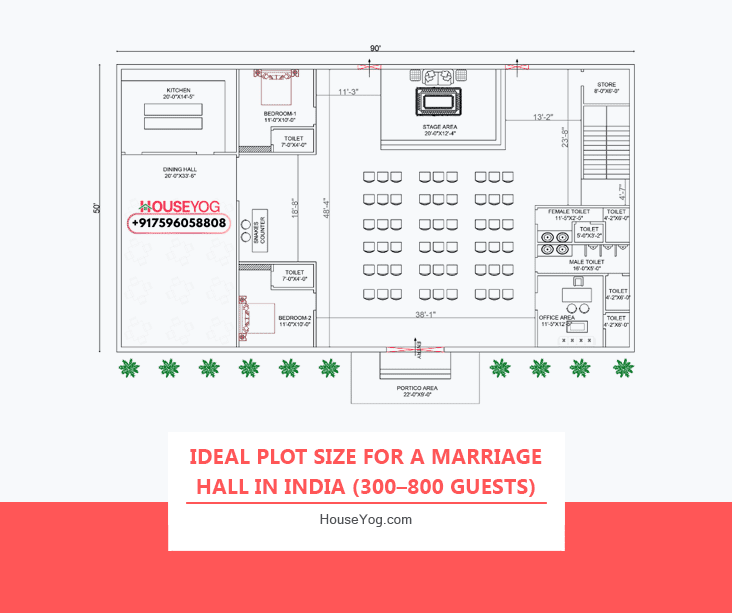
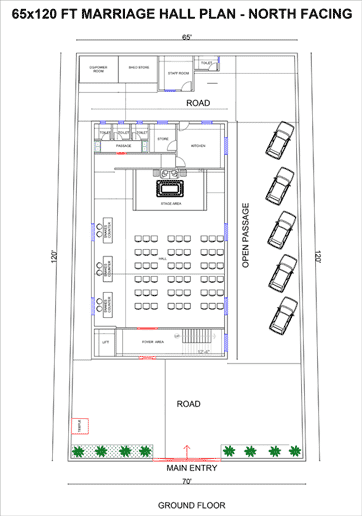
Examples: 80×125, 90×120, 100×120 (dimensions vary by site and setbacks).
As guest capacity increases, land requirements grow faster than most owners expect, especially due to dining logistics and parking demand.
Ideal plot size for a 500-guest marriage hall
A 500-guest marriage hall is the most common target for owners planning a commercially viable venue in India. At this capacity, land feasibility becomes more demanding, as dining space, parking volume, and service circulation start to dominate plot size decisions.
This capacity is widely chosen because it supports:
Wedding + reception scale
Corporate/community events
Multiple pricing tiers (weekday vs weekend)
Feasibility estimate (plot area range)
For a 500-guest marriage hall, a practical plot size range is:
~18,000 to 35,000 sq ft plot area (approx. 0.41 to 0.80 acre)
At this capacity, plot size requirements increase quickly due to:
Dining peak load
Parking + entry queue
Larger kitchen/service needs
Quick block estimate (example)
Block
Typical allowance (sq ft)
Hall seating + stage buffer
4,000–7,000
Dining/buffet / pre-function
3,000–6,000
Kitchen + store + wash
1,200–2,000
Toilets + handwash
700–1,200
Circulation + exits + utilities
1,500–3,000
Parking + driveway + turning
7,000–16,000
Indicative plot range
18,000–35,000
Approval and operations reality (why many 500-guest halls get stuck)
Many 500-guest projects run into delays because owners:
Focus only on the hall and dining built-up area,
But underestimate parking requirements and vehicle turning space, which is often checked during local approvals and later becomes a neighbourhood issue.
Parking requirements are not uniform across India; cities and states publish their own development/building rules and norms, and they often specify parking based on built-up/covered area with “ECS” (Equivalent Car Space) definitions.
Practical feasibility rule: If your plot cannot handle parking + entry queue, your hall will face friction even if the building fits on paper.
Beyond this scale, feasibility challenges multiply, and land planning becomes just as important as the building itself.
Ideal plot size for an 800-guest marriage hall (large venue)
An 800-guest marriage hall falls into the large-venue category, where land feasibility becomes a critical constraint rather than a design preference. At this scale, crowd density, dining logistics, service movement, and parking demand place significant pressure on plot size and access planning.
Projects at this capacity typically involve:
bigger dining logistics
higher peak crowd density
heavier vendor/staff movement
stronger parking and road-width sensitivity
Feasibility estimate (plot area range)
For an 800-guest marriage hall, a realistic plot size range is:
~35,000 to 70,000 sq ft plot area (approx. 0.80 to 1.60 acre)
At this scale, many projects require one of the following planning approaches:
Vertical stacking (G+1 / G+2 with strong circulation planning), or
Event-lawn + banquet hybrid with controlled zoning.
Quick block estimate (example for feasibility planning)
Block
Typical allowance (sq ft)
Hall seating + stage buffer
6,500–12,000
Dining/buffet / pre-function
6,000–12,000
Kitchen + store + wash
2,000–3,500
Toilets + handwash
1,200–2,000
Circulation + exits + utilities
3,000–6,000
Parking + driveway + turning
16,000–35,000
Indicative plot range
35,000–70,000
Parking needs: what works on paper vs on event day
Parking is one of the most common reasons marriage halls face operational stress and approval challenges in India. On paper, a project may meet minimum parking norms, but on event days, real vehicle volumes often exceed what the site can comfortably handle.
At a standards level, marriage halls are classified as assembly buildings in Indian planning guidelines, where concepts like crowd safety, circulation width, and parking are considered. However, these are model guidelines, and local municipal or development authorities enforce actual parking requirements.
This is why there is no single national parking number that works everywhere, and why parking feasibility must always be assessed locally.
Instead of relying on a single national parking number, a more reliable approach is to assess parking demand in two simple steps:
Step 1: Estimate peak vehicles based on local reality
For Indian weddings, the vehicle mix typically includes:
cars (family groups)
two-wheelers (local guests)
1–2 buses or mini-buses (sometimes)
vendor vehicles + DG service access
Step 2: Convert vehicle count into land demand (rough planning)
A single car parking space is not only the car footprint; it includes circulation/aisles in most layouts. Many Indian parking norms define ECS (Equivalent Car Space) using different area assumptions for open, stilt, and basement parking.
Feasibility tip: If you can’t allocate meaningful on-site parking, you will end up with:
road congestion on event days,
neighbour complaints,
and weak approval defensibility.
Why does the same guest capacity need different land in different cities
Even for the same guest capacity, the amount of land required for a marriage hall can vary significantly depending on location. Local driving patterns, road widths, parking behaviour, and enforcement practices all influence how much plot area is needed for smooth operations.
In practice, a 500-guest hall that works well in one town may struggle on a similar-sized plot in a denser urban area.
In urban areas
Higher car ownership and arrival density
Tighter setbacks and narrower approach roads
Stricter enforcement and greater neighbour sensitivity
On-site parking becomes non-negotiable
In semi-urban or highway-edge areas
Easier entry and exit planning
Deeper plots with more layout flexibility
Parking can be more open and scalable
Banquet + lawn combinations become feasible at a lower cost
Common plot-selection mistakes marriage hall owners make
Many marriage hall projects face avoidable delays, redesigns, or operational issues, not because of poor design, but because of early plot-selection mistakes. These issues are often expensive to fix once construction or approvals have begun.
Buying a plot before freezing guest capacity
Ignoring the approach road width and vehicle turning radius
Assuming parking can be “managed outside” the site
Underestimating dining and buffet queue space
No dedicated service entry for kitchen and vendor movement
No buffer for future expansion (rooms, lawn, stilt parking, generator, storage)
If a marriage hall is meant to operate as a long-term commercial venue—not a one-season facility- the plot must support daily operations, not just building construction.
Can a smaller plot still work? (smart feasibility options)
A smaller plot does not automatically rule out a successful marriage hall—but it does reduce the margin for error. At limited plot sizes, feasibility depends less on raw area and more on how carefully space, circulation, and operations are planned.
In such cases, smaller plots can still be workable by adopting one or more of the following strategies:
Vertical stacking: Hall on one floor and dining on another, with carefully planned circulation
Time-sliced parking: Controlled entry, valet use, drop-off zones, and staging space
Multi-purpose positioning: Community hall plus events with different peak usage patterns
Tighter guest control: Invitation scale and event operations (effective in select markets)
This is where an architect-led feasibility check makes a big difference: It’s not only about whether the building fits on the plot, but whether the venue can operate smoothly on peak event days.
What owners can decide themselves and where architects add value
Before engaging an architect, marriage hall owners can usually clarify a few high-level decisions on their own. These inputs help frame feasibility but do not replace professional planning.
Owners can typically decide:
Target guest capacity (300 / 500 / 800)
Event type (banquet-only vs banquet + lawn)
Business positioning (budget / mid-range / premium)
Local parking reality and neighbourhood context
However, once these basics are defined, an architect’s role becomes critical, especially to avoid costly redesigns or approval issues later.
An architect should be involved early for:
Feasibility zoning and circulation concepts
Parking layout and entry/exit strategy
Identifying constraints from local building by-laws
Planning for future scalability and upgrades
What comes after plot feasibility?
Once you’ve confirmed that your land can realistically support the intended guest capacity, with adequate parking, access, and service movement, the focus shifts from whether the plot works to how the venue should be planned.
This next stage includes zoning the site, designing the hall and dining areas, managing guest and service circulation, aligning layouts with Vastu where required, and ensuring compliance with local fire and building norms.
We’ve covered this complete planning process in detail in our main guide on marriage hall design in India, including layout principles, parking logic, guest flow planning, and Vastu considerations
Once land feasibility is clear, approvals become the next critical checkpoint.
Approvals come after feasibility
Once land feasibility is established, statutory approvals become the next critical checkpoint. Marriage halls in India require multiple permissions depending on location and scale, including local building plan sanction, fire safety NOC, and, in some cases, traffic or pollution-related clearances.
Importantly, these approvals are evaluated after basic feasibility, such as parking provision, access, and circulation, is confirmed.
While plot size sets the foundation, many projects fail due to planning oversights. This guide on common marriage hall design mistakes explains how layout, parking, and circulation errors impact real-world operations.
FAQs on Marriage Hall Land Requirements
What is the minimum plot size for a marriage hall in India?
There is no fixed minimum plot size across India. The land required for a marriage hall depends on guest capacity, parking provision, access conditions, and local building by-laws. Smaller plots may work for lower capacities if circulation and parking are carefully planned.
How much land is required for a 500-guest marriage hall with parking?
For a 500-guest marriage hall, a practical feasibility range is ~18,000 to 35,000 sq ft. The exact requirement depends on on-site parking availability, dining layout, and how entry and exit are managed during peak event hours.
Can I build a marriage hall on a 10,000 sq ft plot?
A 10,000 sq ft plot can be feasible for a 200–300 guest marriage hall if parking and access are manageable. For 500 guests or more, this plot size usually becomes restrictive once dining, service areas, and parking are fully accounted for.
Does the plot size requirement change by city?
Yes. Plot size requirements vary by city and state due to differences in parking norms, road widths, and enforcement practices. Local authorities often evaluate parking provision based on built-up or covered area during approvals.
Why do marriage halls feel crowded even when the hall is big?
Crowding is usually caused by dining queues, buffet placement, circulation bottlenecks, and parking or entry congestion, not just by the size of the main hall.
Over to You
If you’re evaluating a plot, or already own land, and want to confirm whether it can realistically support your target guest capacity with adequate parking and future expansion, a feasibility-based assessment can prevent costly changes later.
Houseyog works with marriage hall owners from the feasibility stage to complete architectural delivery. This includes land feasibility assessment, layout planning, statutory drawings, structural design, 3D exterior elevation, and interior planning, so projects move forward with clarity, compliance, and long-term operational success.