
Arranging a bedroom sounds simple—until you actually try to fit a bed, a wardrobe, side tables, and maybe a TV into one space.
Suddenly, the room feels cramped, movement becomes awkward, and basic things like opening a wardrobe or walking around the bed become frustrating.
If you’ve ever struggled with bedroom furniture layout, you’re not alone.
This guide will help you understand:
- How to arrange bedroom furniture efficiently
- The minimum space required around each element
- Practical layout rules based on Indian bedroom sizes
- Real layout ideas for 10×10, 10×12, and 12×14 rooms
Whether you’re designing a new home or rearranging furniture in an existing room, this guide will help you create a functional and comfortable bedroom layout.
Bedroom Furniture Layout: Quick Guidelines
If you’re short on time, here are the most important bedroom furniture layout rules:
- Maintain 2–2.5 ft (600–750 mm) space around the bed
- Keep wardrobe clearance of 2.5–3 ft (750–900 mm)
- Ensure a clear walking path from the door to the bed
- Place the bed on a solid wall, not directly facing the door
- Use sliding wardrobes in small bedrooms to save space
These basic rules will help you create a comfortable and functional bedroom layout in most Indian homes.
Now that the basics are clear, let’s dive deeper.
Why Bedroom Furniture Layout Matters
A well-planned bedroom furniture layout is not just about making your room look good. It directly affects how comfortable, functional, and relaxing your space feels daily.
Many homeowners focus only on furniture selection, but the real difference comes from how that furniture is arranged. A poorly planned layout can make even a large bedroom feel cramped, while a smart layout can make a small room feel spacious and efficient.
Here’s why getting your bedroom layout right is so important:
1. Space Efficiency
One of the biggest advantages of a good bedroom layout plan is efficient use of available space.
When furniture like the bed, wardrobe, and side tables are placed thoughtfully, you avoid dead corners and wasted areas. This is especially important in Indian homes, where bedroom sizes like 10×10 or 10×12 are common.
Even a compact room can feel open and usable if the layout is planned with proper spacing and proportions.
2. Comfort and Movement
A functional layout ensures smooth movement within the room, which is often referred to as bedroom circulation space.
If there isn’t enough space around the bed or wardrobe, everyday activities, like getting ready, opening shutters, or simply walking, can become inconvenient.
Maintaining an ideal bedroom walking space (typically 2–2.5 feet or 600–750 mm) ensures that the room feels comfortable and easy to use, not restrictive.
3. Better Sleep Quality
Your bedroom should feel calm and clutter-free, and layout plays a big role in that.
A poorly arranged room, with blocked pathways, bulky furniture, or awkward positioning, can create visual and mental clutter. This directly impacts how relaxed you feel before sleep.
A clean and well-organised layout promotes a sense of order, which can improve sleep quality and overall well-being.
A well-organised layout can improve sleep quality and relaxation.
You can explore this in detail in our guide on bedroom design for better sleep.
4. Visual Balance and Aesthetics
A good bedroom furniture arrangement also improves how your room looks and feels visually.
When elements are properly aligned, like a centered bed with balanced side tables or a well-positioned wardrobe, the room feels more harmonious.
This sense of visual balance makes the bedroom feel more inviting, organised, and thoughtfully designed.
Standard Bedroom Layout Principles (Core Rules)
Before you start deciding where to place your bed or wardrobe, it’s important to understand a few fundamental layout rules.
These principles form the foundation of any good bedroom furniture layout, whether you’re designing a compact 10×10 room or a spacious master bedroom.
If you get these basics right, your room will feel comfortable, functional, and easy to move around in. If you ignore them, even a large bedroom can feel cramped and poorly planned.
Let’s break down the key rules you should always follow:
Minimum Space Around Bed
The minimum space around a bed should be at least 1.5 ft (450 mm), while 2–2.5 ft (600–750 mm) is ideal for comfortable movement.
One of the most common mistakes in bedroom planning is not leaving enough space around the bed.
For a comfortable and functional layout:
- Ideal space: 2 to 2.5 feet (600–750 mm)
- Minimum space: 1.5 feet (450 mm)
This clearance acts as your ideal bedroom walking space, allowing you to move freely, access both sides of the bed, and make the bed comfortably.
If you’re wondering how much space is needed around a bed, aim for at least 2 feet (600 mm) wherever possible. Anything less can make the room feel tight and restrictive.
In smaller bedrooms, you may reduce space on one side, but ensure at least one side remains comfortably accessible.
Wardrobe Clearance Space
The minimum space around a bed should be at least 1.5 ft (450 mm), while 2–2.5 ft (600–750 mm) is ideal for comfortable movement.
Wardrobe planning is not just about size; it’s also about how much space you leave in front of it for accessibility.
For smooth usage:
- Recommended clearance: 2.5 to 3 feet (750–900 mm)
This ensures:
- Wardrobe shutters can open fully
- You have enough standing and dressing space
- Movement is not blocked
When planning wardrobe clearance space in India, also consider the type of shutters:
- Hinged shutters: Need full clearance to open
- Sliding wardrobes: Ideal for compact rooms with limited space
If you’re working with a small bedroom furniture layout, sliding wardrobes can significantly improve usability without compromising storage.
To plan better based on room dimensions, refer to our detailed guide on standard bedroom size in India.
Circulation Path Planning
A good bedroom layout should always have a clear, uninterrupted walking path from the door to the bed. It should feel easy to move through—not like an obstacle course.
This is where bedroom circulation space becomes critical.
A good bedroom layout plan should:
- Maintain a clear walking path from the entrance to the bed
- Avoid placing furniture directly in the entry line
- Reduce unnecessary turns or zig-zag movement
Think of movement inside your bedroom as a straight, uninterrupted flow.
The easier it is to walk through your room, the more spacious and comfortable it will feel, even if the actual size is small.
Bed Placement Guide
The bed is the most important element in any bedroom furniture layout. Its position not only defines the overall layout but also affects circulation, comfort, and even how spacious the room feels.
Before placing other furniture like wardrobes or side tables, it’s essential to decide the right position for your bed.
Against Wall vs Centered Bed Placement
One of the first decisions in any bedroom layout plan is whether to place the bed against a wall or keep it centred.
- Centered bed (ideal for medium to large rooms):
Placing the bed in the center of a wall creates a balanced and symmetrical layout. It allows circulation on both sides (ideally 2–2.5 ft / 600–750 mm), making the room feel more open and comfortable. - Against the wall (best for small bedrooms):
In compact spaces like a 10×10 bedroom, placing the bed against one wall helps save space and improves movement. This is a practical approach for a small bedroom furniture layout.
Tip: If placing against a wall, ensure at least one side has comfortable access.
Avoid Direct Door Alignment
Try to avoid placing the bed directly in line with the bedroom door.
When the bed is immediately visible from the entrance:
- It reduces privacy
- Creates a slightly uncomfortable visual alignment
- Disrupts the sense of relaxation
A better approach is to position the bed slightly offset from the door while still maintaining a clear bedroom circulation space.
Window Considerations
Windows play a key role in ventilation and natural light, so bed placement should respect that.
- Avoid placing the bed in a way that blocks window openings
- Do not completely cover light sources with bulky headboards
- Ensure easy access to windows for ventilation
In smaller rooms, placing the bed adjacent to a window (instead of directly in front) is often a smart compromise.
Vastu Bedroom Layout (Optional)
For those of you who prefer Vastu-compliant planning:
- Keep the bed head towards the south or east
- Avoid placing the bed directly under beams
- Try to maintain symmetry and balance around the bed
While not mandatory, these guidelines are commonly followed in Indian homes.
Wardrobe Placement & Size Guide
After the bed, the wardrobe is the most space-consuming element in a bedroom. Its placement has a major impact on movement, storage efficiency, and overall layout balance.
Standard Wardrobe Size
Understanding standard dimensions helps in planning a practical wardrobe placement in bedroom layouts:
- Depth: 2 feet (600 mm)
- Height: 7–8 feet (2100–2400 mm)
This size is suitable for most Indian homes and provides adequate storage without occupying excessive floor space.
Wall Selection Logic
Choosing the right wall for the wardrobe is just as important as its size.
- Place the wardrobe along a full-length wall for maximum efficiency
- Avoid positioning it in front of windows
- Keep it away from the main entry path to maintain smooth circulation
A well-placed wardrobe improves both usability and visual balance in your bedroom furniture arrangement.
Corner Wardrobes
Corner wardrobes can be a smart solution in:
- Irregularly shaped rooms
- Compact bedroom layouts
They help utilise otherwise unused space and can improve storage without affecting movement.
Sliding Wardrobes for Small Rooms
In smaller bedrooms, wardrobe design plays a big role in usability.
Sliding wardrobes are ideal for:
- Small bedroom layout with a wardrobe and a bed
- Rooms with tight clearance space
- Situations where hinged shutters may block movement
They eliminate the need for shutter clearance, making them perfect for space-constrained layouts.
Side Tables, Dressing & TV Placement
Once the bed and wardrobe are placed, the remaining elements should be arranged to enhance convenience without overcrowding the space.
Side Tables
Side tables add functionality but must be used wisely.
- Ideal spacing: 1.5–2 feet (450–600 mm) width per side
- Keep proportionate to bed size
In very compact rooms, it’s perfectly fine to:
- Use only one side table
- Or skip them altogether to improve circulation
Dressing Table Placement
A dressing table should be placed where it is both functional and comfortable to use.
- Near the wardrobe for easy access while getting ready
- Near a window for natural lighting
Proper dressing table placement improves daily usability without disrupting the layout.
TV Placement
If you’re planning to include a TV, placement should ensure comfortable viewing without affecting the layout flow.
If you’re wondering where to place a TV in the bedroom, follow these guidelines:
- Place the TV opposite the bed for direct viewing
- Maintain a viewing distance of 6–8 feet (1800–2400 mm)
Avoid placing the TV too close, as it can strain the eyes and clutter the space.
Bedroom Layout Examples (Practical Plans)
Understanding layout principles is important—but seeing how they apply in real room sizes makes things much clearer.
Below are practical bedroom furniture layout examples based on common Indian room sizes. These layouts will help you visualise how to arrange your bed, wardrobe, and other furniture while maintaining proper circulation space.
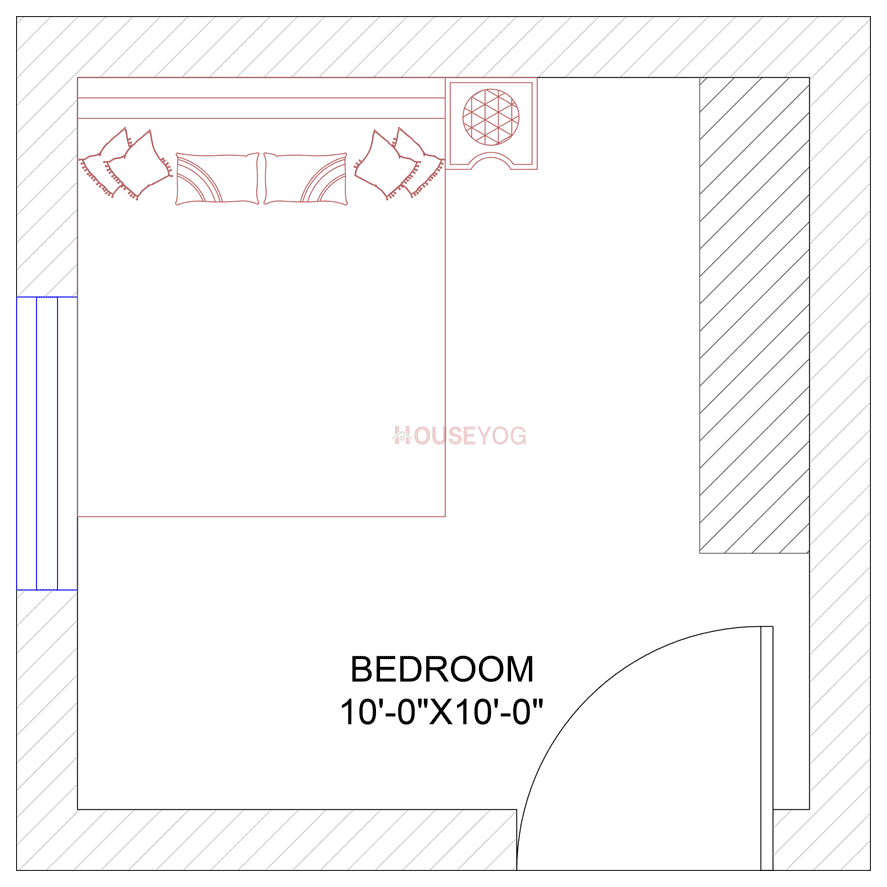
Bedroom Furniture Layout for 10×10 Room
This layout is ideal for those searching for “bedroom furniture layout for 10×10 room” or planning compact spaces. A 10×10 bedroom is compact, so the focus should be on maximising usable space while maintaining basic comfort.
Recommended layout:
- Place the bed against one wall to free up movement space
- Position the wardrobe on an adjacent wall
- Maintain a single-sided circulation space of around 2 ft (600 mm)
- Use either one small side table or skip side tables entirely
This type of small bedroom furniture layout works best when you prioritise function over symmetry.
What to expect:
- Limited walking space
- Minimal furniture flexibility
- Efficient but compact usability
Best suited for: Guest bedrooms, budget homes, or compact urban apartments
Bedroom Layout for 10×12 Room
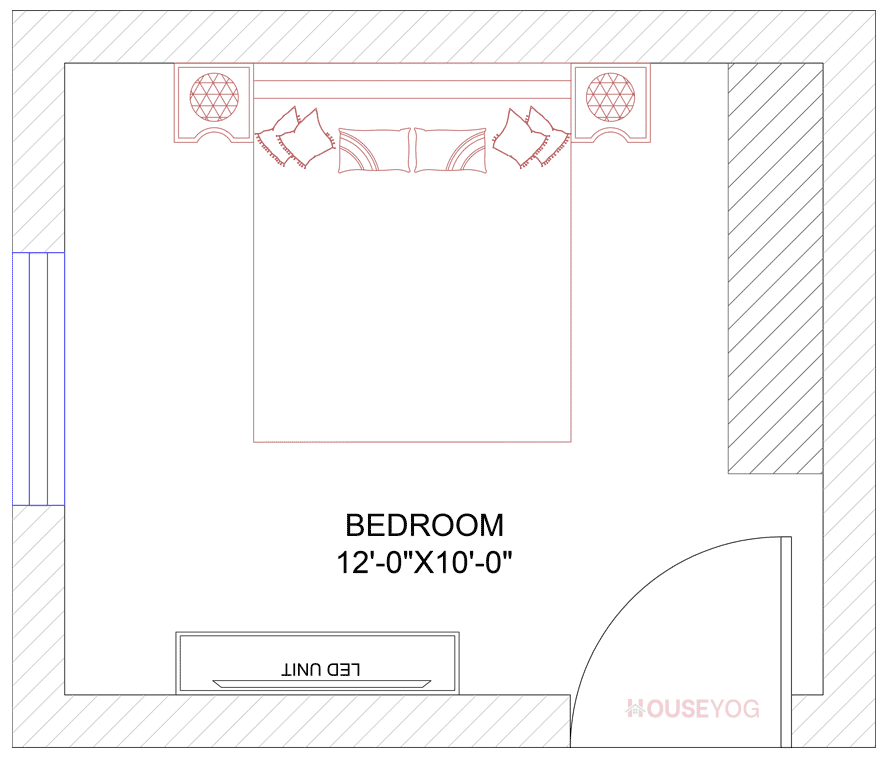
This is one of the most practical bedroom layout plans for mid-sized Indian homes. A 10×12 bedroom offers better flexibility and allows for a more balanced layout.
Recommended layout:
- Place the bed in a centred position with access from both sides
- Keep at least 2 ft (600 mm) circulation space on either side
- Position the wardrobe along one longer wall
- Add two compact side tables if space allows
- Optional: Place a TV unit opposite the bed
This is one of the most practical and commonly used bedroom layout plans in Indian homes.
What to expect:
- Comfortable movement
- Better visual balance
- Space for essential furniture without overcrowding
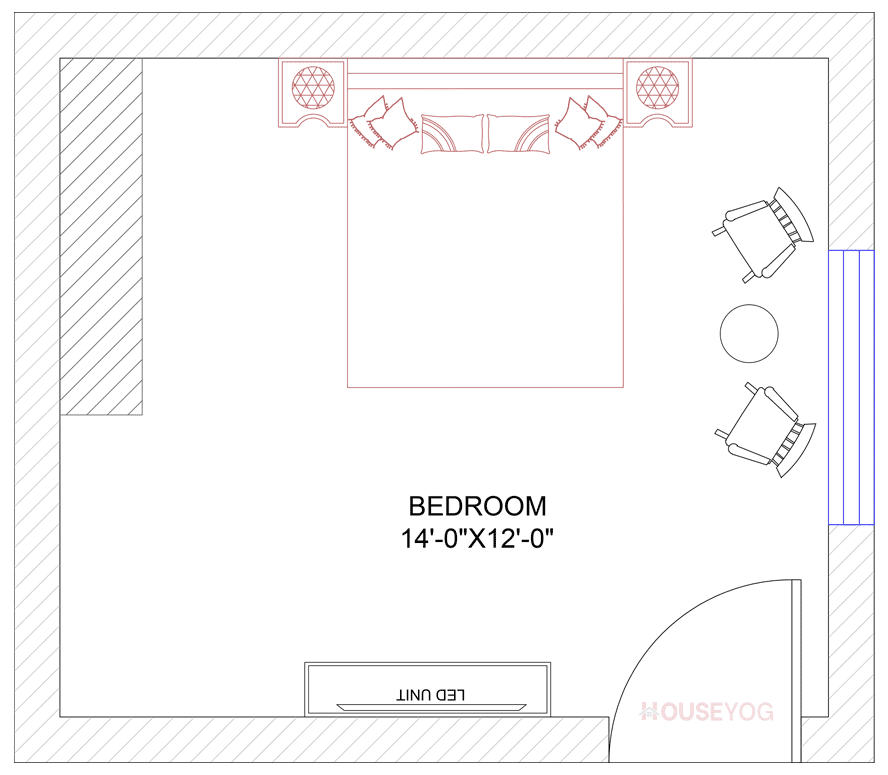
Master Bedroom Layout Plan for 12×14 Room
This layout suits users looking for a complete master bedroom furniture arrangement plan. A 12×14 room gives you the flexibility to create a complete and comfortable master bedroom.
Recommended layout:
- Place a king-size bed in the centre of the room
- Maintain 2–2.5 ft (600–750 mm) circulation space on all accessible sides
- Add side tables on both sides of the bed
- Install a full-length wardrobe along one wall
- Include a dressing table and a TV unit
This is an ideal master bedroom furniture arrangement plan with both functionality and comfort.
What to expect:
- Spacious movement
- Proper zoning of furniture
- Balanced and premium feel
Common Bedroom Layout Mistakes
Even with the right furniture, a poor layout can make your bedroom uncomfortable. Here are some common mistakes to avoid:
- Ignoring circulation space: Not leaving enough walking space around the bed can make daily movement difficult
- Using oversized furniture: Large beds or wardrobes in small rooms can quickly make the space feel cramped
- Blocking windows with wardrobes: This reduces natural light and ventilation
- Pushing the bed into a tight corner: This limits accessibility and disrupts layout balance
Avoiding these mistakes can significantly improve your overall bedroom furniture layout.
Pro Tips from Architects
Here are some practical bedroom furniture arrangement tips used by our architects and interior designer team at houseyog:
- Use sliding wardrobes in compact rooms to save clearance space
- Choose multi-functional furniture like storage beds
- Plan electrical points (switches, TV, lighting) before finalizing layout
- Keep some flexibility in layout for future changes
These small decisions can make a big difference in long-term usability.
When to Hire a Designer
If you’re unsure about how to arrange your space or want to make the most of your room size, consulting a professional interior designer can be a smart decision.
An interior designer can help you with:
- Space optimisation based on your room dimensions
- Furniture planning and placement
- Detailed 2D and 3D layout designs
Bedroom Furniture Layout Tips for Small Rooms
If you’re working with a compact bedroom, here are a few quick tips:
- Place the bed against one wall to maximise space
- Use sliding wardrobes instead of hinged shutters
- Avoid bulky side tables
- Keep furniture minimal and functional
- Maintain at least one clear walking path
These tips are especially useful for small bedroom furniture layout planning.
FAQs
The ideal space around a bed is 2 to 2.5 feet (600–750 mm) for comfortable movement.
In smaller bedrooms, a minimum of 1.5 feet (450 mm) is acceptable.
The wardrobe should be placed along a full wall that does not block windows or circulation paths. Maintain at least 2.5–3 feet (750–900 mm) clearance in front.
A 10×10 room can accommodate basic furniture, but a 10×12 or larger room is more comfortable for proper circulation and additional elements.
Yes, placing a TV opposite the bed is ideal. Maintain a viewing distance of at least 6–8 feet (1800–2400 mm).
Use wall-mounted or sliding furniture, avoid side tables, and maintain at least one clear walking path.
Standard wardrobe clearance is 2.5–3 feet (750–900 mm), depending on shutter type.
Final Thoughts
A well-planned bedroom furniture layout can completely transform how your room feels and functions.
By following the right spacing rules, choosing appropriate furniture sizes, and planning layouts based on your room dimensions, you can create a bedroom that is both comfortable and practical.
Need Help Designing Your Bedroom Layout?
If you want a perfectly planned bedroom tailored to your space and lifestyle, our experts can help.
At Houseyog, we offer:
- Personalised bedroom furniture layout plans
- Space optimisation based on your room size
- Complete 2D and 3D interior design solutions
Get started here: Interior Design
Popular on Houseyog Right Now!: