
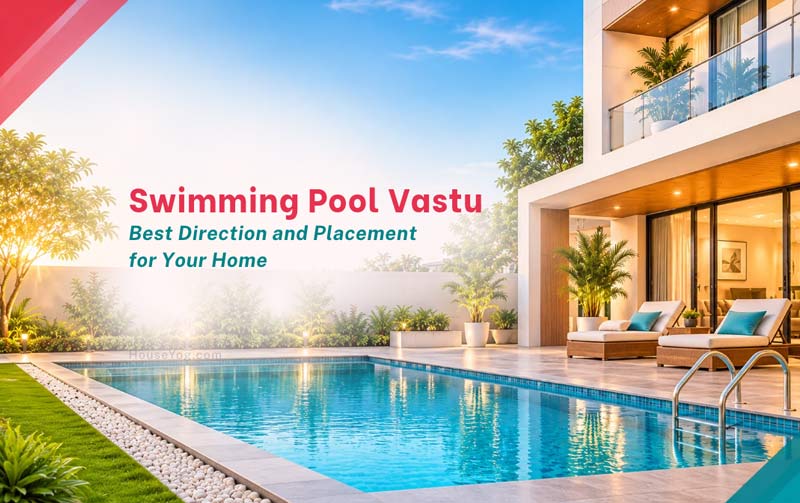

According to commonly followed Vastu principles, the northeast direction (Ishan corner) is considered the most favourable location for a swimming pool. North and east are generally preferred alternatives, while southwest and southeast are commonly avoided for large water bodies.
If you are planning a swimming pool at home, its direction and placement may be important to you from a Vastu perspective. But finding the right location involves more than choosing a compass direction. The available space, house layout, sunlight, structural conditions and drainage arrangements also need attention.
Here is what you should know about swimming pool Vastu, including the preferred directions, placement options and practical considerations before finalising your pool location.
Which Direction Is Best for a Swimming Pool According to Vastu?
The northeast (Ishan) corner is generally considered the best direction for a swimming pool according to traditional Vastu principles. North and east are also commonly recommended when the northeast is not available.
The following table summarises the commonly followed directional recommendations.
| Direction | Common Vastu recommendation |
| Northeast (Ishan) | Most preferred |
| North | Generally favourable |
| East | Generally favourable |
| West | Usually not preferred |
| South | Generally avoided |
| Southeast | Generally avoided |
| Southwest | Strongly discouraged |
| Centre (Brahmasthan) | Generally avoided |
These recommendations are based on traditional Vastu interpretations of the five elements and directional associations. Different Vastu schools and consultants may interpret some placements differently, so the table should be treated as general guidance rather than a universal rule.
1. Northeast (Ishan Corner): The Preferred Direction
The northeast corner is traditionally associated with water and is considered an auspicious zone for water bodies such as wells, ponds and swimming pools.
If your plot has sufficient open space in the northeast, you can consider placing the swimming pool in this area. It is particularly suitable when the pool can be integrated with the garden or outdoor recreational space without affecting the house layout.
Keep the area reasonably open and avoid crowding it with heavy structures or unnecessary storage.
2. North Direction: A Suitable Alternative
North is another commonly preferred direction for a swimming pool.
If the northeast is occupied by the house, driveway or another essential feature, the northern side may be a suitable alternative, provided there is enough space for the pool and its surrounding circulation area.
3. East Direction: Another Favourable Option
East is generally considered a favourable direction for water bodies in Vastu. It may also offer a practical advantage if the pool’s position allows it to receive morning sunlight.
For example, if your plot has an open eastern garden, placing the swimming pool here may provide a comfortable outdoor setting for morning use.
4. Directions Generally Avoided for Swimming Pools
Southwest, southeast and south are commonly considered unsuitable for swimming pools under traditional Vastu principles.
The southwest is associated with stability and the earth element, while the southeast is associated with fire. Placing a large water body in these zones is generally discouraged in conventional Vastu interpretations.
The centre of the plot, known as Brahmasthan, is also traditionally recommended to remain relatively open and free from major obstructions.
If your existing property layout leaves no practical alternative, do not assume that the pool must be relocated. Consider the complete site layout and consult a qualified Vastu professional before making any major changes.
Why Is Northeast Considered the Best Direction for a Swimming Pool?
In traditional Vastu interpretations, the northeast or Ishan corner is associated with water and is considered a favourable zone for water bodies such as wells and ponds. These principles are commonly extended to modern residential swimming pools.
An open northeast area can also work well as an outdoor recreational space if the site layout provides sufficient sunlight, ventilation and access.
Still, a preferred Vastu direction does not automatically make a location suitable for construction. The site’s soil conditions, structural requirements, drainage and relationship with the house must also be assessed.
Swimming Pool Vastu for Different Locations
A swimming pool can be built in the backyard, along the side of the house, in a courtyard or even on the rooftop. From a Vastu perspective, what matters is its actual compass direction within the property, not simply whether it is called a front-yard or backyard pool.
If you are still comparing different locations, our guide on where to build a swimming pool at home explains the practical advantages of backyard, side-yard, front-yard and rooftop placements.
Let’s look at the common arrangements.
Swimming Pool in the Backyard
A backyard swimming pool is a popular choice because it offers privacy and can be connected to a garden, patio or outdoor seating area.
If the backyard falls in the northeast, north or east, it may align with commonly followed Vastu preferences. But if the backyard is in the southwest, its position alone does not make it favourable under traditional Vastu recommendations.
Swimming Pool Along the Side of the House
A side-yard pool can be a good option for narrow plots where the rear garden has limited space.
Check the compass direction of that side before finalising the location. Also ensure there is enough clearance around the pool for safe movement, maintenance access and servicing.
Swimming Pool in the Front Yard
A front-yard pool can work when the plot has adequate open space and the arrangement does not interfere with vehicle access, the entrance or everyday privacy.
From a Vastu perspective, check whether the proposed pool falls in the north, east or northeast zone. Its position should also be assessed against the overall house layout.
Swimming Pool in the Courtyard
A swimming pool in an open-to-sky courtyard can work well in larger homes, particularly when it is planned as part of the house layout.
However, the courtyard’s actual direction within the plot matters. You should also consider waterproofing, rainwater disposal, ventilation and the effect of humidity on adjoining rooms.
Rooftop Swimming Pool: Vastu and Structural Considerations
Rooftop swimming pools require special attention. While the same compass directions are relevant when assessing the property, Vastu interpretations for pools on upper floors may vary.
More importantly, a rooftop pool places a substantial load on the building. The roof slab, supporting beams, columns and foundation must be checked by a structural engineer to ensure they can safely carry the pool’s water load, along with the pool structure and associated equipment.
Waterproofing, overflow drainage and access for maintenance also need to be planned carefully.
Swimming Pool Shape, Depth and Water Flow: Vastu and Practical Considerations
Many contemporary Vastu recommendations favour regular swimming pool shapes, such as rectangular and square designs. Oval pools are also accepted by some consultants, while irregular shapes may be discouraged. From a design perspective, rectangular pools are often practical because they use available space efficiently and are relatively straightforward to construct.
A rectangular pool is also practical for most residential properties because it uses space efficiently and is relatively straightforward to design and construct.
Pool depth should be decided according to its intended use, users’ age groups and safety requirements. There is no reason to compromise swimming safety or structural design to follow a generalised Vastu recommendation about depth.
Water circulation and drainage deserve equal attention. The filtration system, inlet and return arrangements, overflow points and drainage connections should follow proper pool engineering practices. Do not change these technical arrangements based solely on unverified directional prescriptions.
If you are still deciding on the pool’s dimensions and configuration, our guide on how to design a swimming pool for your home explains the design and planning aspects in more detail.
What If You Cannot Build a Swimming Pool in the Northeast?
Not every plot has enough open space in the northeast. The house may already occupy that portion, or the available garden may be on another side.
If the northeast is unavailable, north and east are commonly considered alternative locations under traditional Vastu recommendations. If neither direction is feasible, assess the complete property rather than making a decision based on one isolated rule.
For an existing house, shifting a swimming pool can involve excavation, demolition, waterproofing and considerable expense. It may also affect underground utilities, retaining structures and the surrounding landscape.
A Vastu consultant can review the property and suggest suitable adjustments based on its layout. Avoid expensive structural modifications based on generic online advice.
Can You Correct Vastu Defects in an Existing Swimming Pool?
If your swimming pool is already built in a direction considered unfavourable in Vastu, there is no need to panic.
Some Vastu consultants may suggest adjustments involving landscaping, the surrounding open space or other features of the property. The recommendations will depend on the overall layout and the particular Vastu interpretation being followed.
Claims that a particular colour, plant, mirror or decorative object can automatically correct every swimming pool Vastu defect should be treated with caution.
Most importantly, do not undertake major excavation or relocation work without evaluating the structural and financial implications.
Vastu vs Practical Planning: What Should You Prioritise?
Vastu can be one of the considerations when choosing a swimming pool location, but it should not override essential architectural and engineering requirements.
Before finalising the position, check the following:
- Structural safety: The pool must have a properly designed base, retaining structure and waterproofing system. Rooftop pools need specific structural load calculations.
- Sunlight and ventilation: Adequate sunlight helps make the pool area more comfortable. Good ventilation is particularly useful in enclosed or semi-covered pool spaces.
- Drainage: Pool overflow, filter backwash water and rainwater from the surrounding deck must have suitable drainage arrangements.
- Privacy and access: The pool should be accessible without disrupting the privacy and regular use of the house.
- Maintenance: Keep adequate space for pumps, filters, pipes and servicing.
If you are still at the planning stage, it is worth understanding the technical requirements before finalising the location. Our guide on things to know before building a swimming pool at home covers several of these considerations.
Frequently Asked Questions
Northeast (Ishan corner) is generally considered the best direction for a swimming pool according to traditional Vastu principles. North and east are commonly recommended alternatives.
Southwest is generally considered unfavourable for swimming pools because this direction is traditionally associated with stability and the earth element. However, an existing pool should not be relocated without assessing the entire property.
Traditional Vastu recommendations generally discourage swimming pools in the southeast because this direction is associated with the fire element. Consider other available locations where practical.
A backyard swimming pool can be suitable if it falls in a preferred direction such as northeast, north or east. The backyard’s compass direction matters more than its position behind the house.
A rooftop swimming pool can be assessed using the property’s compass directions, although Vastu interpretations may vary. More importantly, the building must be structurally capable of carrying the pool’s water load. A structural engineer should verify the slab, supporting structure and waterproofing before construction.
Traditional Vastu principles generally recommend keeping the centre of the plot, known as Brahmasthan, open and free from major structures. A swimming pool is therefore usually not preferred in this location.
Final Thoughts
If you follow Vastu while planning your home, the northeast is generally the preferred direction for a swimming pool, with north and east as common alternatives.
But a good swimming pool design must also work with your plot dimensions, house layout, structural system and everyday requirements. Rather than following directional recommendations in isolation, consider them alongside proper architectural and engineering planning.
At Houseyog, we approach swimming pool planning as part of the overall house design. The location, pool structure, drainage and surrounding outdoor space all need to work together. Vastu preferences can be considered along the way, but the final design must also be safe, practical and suitable for your property.