
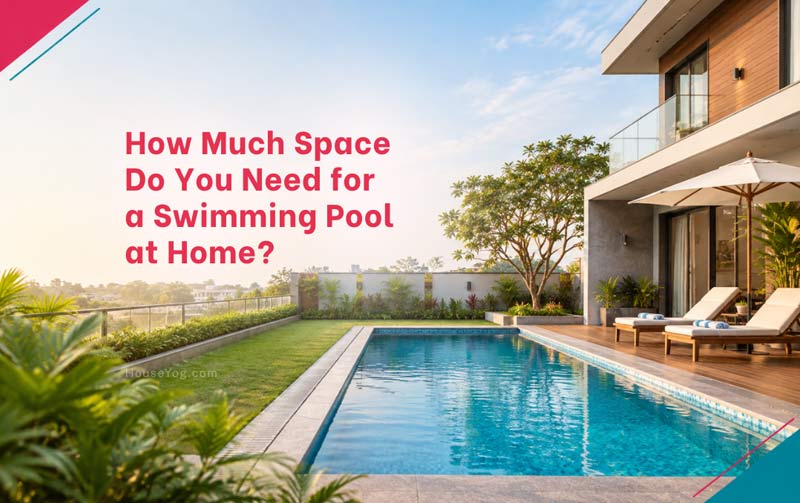

Planning a swimming pool for your home can get tricky when space is limited. A pool that looks perfectly manageable on paper can take up much more of the outdoor area once you allow for circulation, space around the pool, access and services.
The good news is that you don’t always need a large backyard for a pool. A compact pool can work surprisingly well when its size, shape and location are planned around the space you actually have.
So, before choosing pool dimensions, it helps to understand what really determines the space a swimming pool needs.
What Determines How Much Space You Need for a Pool?
There is no single minimum area that works for every residential swimming pool. The space you need depends on the pool’s dimensions, how you intend to use it and what else needs to fit around it.
A compact plunge pool may work in a relatively small outdoor area, while a larger family pool with comfortable seating and landscaping needs considerably more space.
It helps to think about the pool area in three parts:
| Space | What it includes |
| Pool water area | The actual length and width of the pool |
| Pool surround | Walking space, pool deck, entry and exit areas |
| Supporting space | Equipment, service access, drainage, landscaping and seating |
The pool dimensions are only one part of the space you need to consider. A 12 x 24 ft pool has a water surface of 288 sq ft, but the total area you need to plan will be larger.
What Is the Standard Size of a Swimming Pool?
There is no universal standard size for a residential swimming pool. In Indian homes, pool dimensions vary considerably depending on the plot size, setbacks, outdoor layout and how the pool will be used.
Common pool dimensions are useful starting points, but they should not be treated as fixed standards or minimum requirements. The right size is the one that fits the available space while still leaving enough room for circulation, access and other outdoor needs.
For planning purposes, you may come across residential pools in roughly these ranges:
| Pool type | Example dimensions | Suitable for |
| Compact / plunge pool | 10 x 15 ft | Relaxation and smaller spaces |
| Small residential pool | 12 x 20 ft | Compact family use |
| Medium residential pool | 12 x 24 ft | General recreation and swimming |
| Larger residential pool | 15 x 30 ft | Larger plots and entertaining |
| Long / lap-oriented pool | Site dependent | Regular swimming or narrow spaces |
These are common planning examples, not prescribed standards or minimum requirements.
You should not choose a 12 x 24 ft pool simply because it is a commonly seen dimension. For one property, a 10 x 20 ft pool may feel generous. On another, even a 12 x 24 ft pool could make the outdoor space feel cramped.
The property should determine the pool—not the other way around.
How Much Space Should You Leave Around a Swimming Pool?
The space around a swimming pool is just as important as the pool itself.
You need enough room to move safely around the pool, get in and out comfortably, access the pool for cleaning and maintenance, and use the surrounding area without feeling squeezed.
The exact amount will depend on the layout, but you should consider space for:
- Circulation around the pool
- Steps or pool entry
- A deck or paved surface
- Outdoor seating, if required
- Access from the house
- Cleaning and maintenance
- Drainage
- Landscaping
A common mistake is to measure the available backyard, fit the largest possible pool into it and leave only a narrow strip around the edges.
Technically, the pool may fit. Functionally, the outdoor space may not work very well.
A slightly smaller pool with a comfortable surround is often a better design than a large pool that consumes the entire backyard.
How Do You Calculate Whether Your Space Can Fit a Pool?
Start with the usable open space, not the total plot area.
For example, imagine you have a 30 x 50 ft plot. That gives you 1,500 sq ft of plot area, but you cannot assume all 1,500 sq ft is available for a swimming pool.
Part of the plot may already be occupied by:
- The house
- Setbacks
- Driveway or parking
- Entrance and circulation
- Garden areas
- Utility spaces
- Other outdoor requirements
Once spaces for these amenities are accounted for, what remains is the usable pool zone—not necessarily all of the remaining open space.
Then work backwards.
The sequence is very simple: start with usable outdoor space, define the pool zone, allow for the surrounding space, and only then decide the actual pool dimensions.
This is a much more reliable way to decide the pool size for your home.
Can You Build a Swimming Pool in a Small Backyard or Open Space?
Yes, a small backyard can sometimes accommodate a swimming pool, but the solution usually needs to be more carefully planned.
A compact or plunge pool may be more appropriate than trying to fit a conventional large pool into a limited space.
The shape can also make a significant difference. A narrow, elongated outdoor space may work well with a long rectangular pool, while a compact square area may suit a smaller plunge pool.
If ground-level space is particularly limited, you could also consider alternatives such as a side pool, courtyard pool or rooftop pool, depending on the property and technical feasibility.
The key is to look at the shape and usability of the available space, not just its total area.
How Much Space Does a Pool Really Take Up?
The dimensions of the pool give you its water surface area, but they don’t tell you how much of your outdoor space the complete pool area will occupy.
The larger the pool, the more carefully you need to plan the surrounding space.
Consider these examples as planning illustrations rather than fixed requirements:
A 10 x 20 ft pool
The water area is 200 sq ft. It can work well where the priority is having a compact pool without sacrificing the entire outdoor area.
A 12 x 24 ft pool
At 288 sq ft, this provides a more comfortable recreational pool while still being manageable on many residential properties.
A 15 x 30 ft pool
With 450 sq ft of water surface, this is a substantial pool. You should think about the pool deck, circulation, seating and landscaping before deciding that the available backyard is large enough.
The difference becomes even more obvious when you draw the complete pool zone, rather than just the rectangle representing the water.
What Pool Size Is Right for Your Needs?
Your intended use should influence the dimensions as much as the available space.
If you mainly want a place to relax and cool off, you may not need a large swimming pool.
If the pool will be used regularly by the family, you may want more comfortable dimensions and easier access.
If you want to swim for exercise, length becomes particularly important. A narrower but longer pool may be more useful than a wide recreational pool.
And if you regularly entertain guests, remember that the pool is only one part of the outdoor living area. You may also want seating, a deck, landscape and a connection to the house.
What do I actually want the pool to do?
The answer can change the ideal dimensions considerably.
Plan for Pool Equipment and Service Spaces
Pool planning also needs room for the systems that keep the pool running.
Depending on the design, you may need space for filtration equipment, pumps, plumbing connections and electrical systems, along with reasonable access for servicing them.
These spaces are easy to overlook because they disappear from view once the pool is finished.
Planning them early is much better than trying to find a corner for equipment after the pool layout has already been finalised.
How Does Plot Shape Affect Pool Size?
Two properties with the same amount of usable outdoor space can accommodate very different pools.
Imagine two outdoor areas with roughly the same area:
20 x 30 ft and 15 x 40 ft.
The first may allow a more compact, wider pool. The second may be better suited to a longer and narrower pool.
This is why dimensions matter as much as area.
A long side setback, for example, may not be wide enough for a conventional pool but could work surprisingly well for a narrow linear pool.
The best pool layout responds to the actual geometry of your property.
Three Simple Pool Space-Planning Examples
1. Compact backyard
A smaller pool may leave enough room for a practical deck and circulation, instead of turning the entire outdoor area into a pool surround.
2. Long side space
A narrow side space may work better with a linear pool than a wider rectangular pool, particularly when the pool connects directly to the house.
3. Larger backyard
With more room available, you can plan the pool alongside seating, landscaping and outdoor living instead of treating the pool as an isolated feature.
In all three cases, the principle is the same:
Plan the complete outdoor space first, then decide how much of it the pool should occupy.
What If You Don’t Have Enough Space for a Conventional Pool?
You may still have options.
A plunge pool, compact pool or narrow pool can provide the experience of having a pool without requiring the footprint of a large family pool.
Depending on your property, a courtyard, side or rooftop location may also be worth exploring.
However, these are not automatic solutions. Rooftop pools, in particular, require careful consideration of structural capacity, waterproofing, drainage, access and services.
If you are still deciding where the pool should go, see our guide to Where Should You Build a Swimming Pool at Home.
A Simple Way to Decide Your Pool Size
Before settling on dimensions, work through these questions:
- How much usable outdoor space do I actually have?
- Where can the pool be located without disrupting the rest of the property?
- How will the pool be used?
- How much space should remain around it for circulation and access?
- Where will the equipment and services go?
- Do I need seating, landscaping or other outdoor areas?
- Does the final layout still work as a whole?
Only after answering these questions should you finalise the pool dimensions.
And if you are starting from scratch, it is worth looking at the larger picture in our guide to How to Design a Swimming Pool for Your Home.
FAQs About Home Swimming Pool Size
There is no single standard residential pool size. Common home pool dimensions vary depending on available space, intended use and the overall site layout.
There is no universal minimum space for every home pool. A compact plunge pool can fit into a much smaller area than a conventional family pool, but the total space must also allow for access, circulation and supporting requirements.
Sometimes. A compact, plunge or narrow pool may be possible where a larger conventional pool is not. The feasibility depends on the usable dimensions of the site and what else needs to fit around the pool.
It can be a practical residential size for general recreation, but it is not automatically the right choice for every property. The surrounding space and intended use should be considered before finalising the dimensions.
You need enough surrounding space for comfortable circulation, entry and exit, maintenance and any deck or outdoor living areas you plan to include. The exact requirement depends on the layout rather than one universal number.
Final Thoughts
The right swimming pool size is not the biggest pool that your property can physically accommodate.
It is the size that gives you a usable pool while leaving the rest of your outdoor space comfortable, accessible and functional.
Start with your available space. Understand how you want to use the pool. Plan the surrounding area, services and circulation. Then choose the dimensions.
That approach may result in a smaller pool than you initially imagined—but often, it results in a much better home.