

You’re about to buy a plot, and the broker points to a particular piece of land and says, “Sir, this is a premium corner plot. It has two roads, better ventilation, and higher resale value.”
At first glance, it sounds like an obvious choice.
After all, who wouldn’t want better access, more sunlight, and a house that stands out from the rest?
But here’s the question most buyers never ask:
Is paying extra for a corner plot always worth it?
Not necessarily.
In our experience, many people buy a corner plot because they’ve heard it’s more valuable, only to discover later that local building rules, setbacks, traffic, privacy concerns, and additional construction costs significantly affect their plans.
Sometimes, a regular plot can actually be the better option.
If you’re still deciding, you may also want to read our guide on North-facing vs East-facing plots, because the direction of the plot can influence your design almost as much as the plot type itself.
In this guide, we’ll compare corner plots and regular plots from an architect’s perspective and help you answer one simple question:
Should you pay the premium for a corner plot, or should you choose a regular plot instead?
Quick Answer: Should You Buy a Corner Plot?
A corner plot offers better ventilation, more design flexibility, easier parking, and stronger architectural appeal. However, it may also increase construction costs, reduce the buildable area because of setback requirements, and create privacy concerns. The right choice depends on your budget, local regulations, and house design requirements.
Let’s dig deeper and find out what’s right for you.
What Is a Corner Plot?
A corner plot is a piece of land located at the intersection of two roads, giving it road access on two sides instead of one.
Unlike a regular plot, which usually faces a single road, a corner plot has two open frontages. This additional exposure affects everything from house planning and ventilation to parking, privacy, setbacks, and construction costs.
Before comparing the pros and cons, let’s quickly understand what actually makes a plot a “corner plot.”
A simple representation looks like this:
| Plot Type | Layout |
| Regular plot | Plot connected to one road |
| Corner plot | Plot connected to two intersecting roads |
Imagine a 30×40 plot.
In a regular plot, the road might be on the eastern side only.
In a corner plot, the same 30×40 plot could have roads on both the eastern and northern sides.
That single difference can completely change the architectural design.
An architect suddenly has more flexibility when deciding where to place:
- The entrance
- Parking
- Staircases
- Balconies
- Windows
- Gardens
- Service areas
However, that flexibility also comes with certain limitations, which we’ll discuss shortly.
Corner Plot vs Regular Plot: What’s the Difference?
The biggest difference between a corner plot and a regular plot is that a corner plot offers two road-facing sides, while a regular plot typically has only one.
That affects much more than just accessibility.
| Feature | Corner Plot | Regular Plot |
| Road access | Two sides | One side |
| Ventilation | Better | Average |
| Natural light | Better | Average |
| Privacy | Lower | Higher |
| Construction cost | Higher | Lower |
| Setback impact | Higher | Lower |
| Resale value | Usually higher | Depends |
The comparison table tells only part of the story.
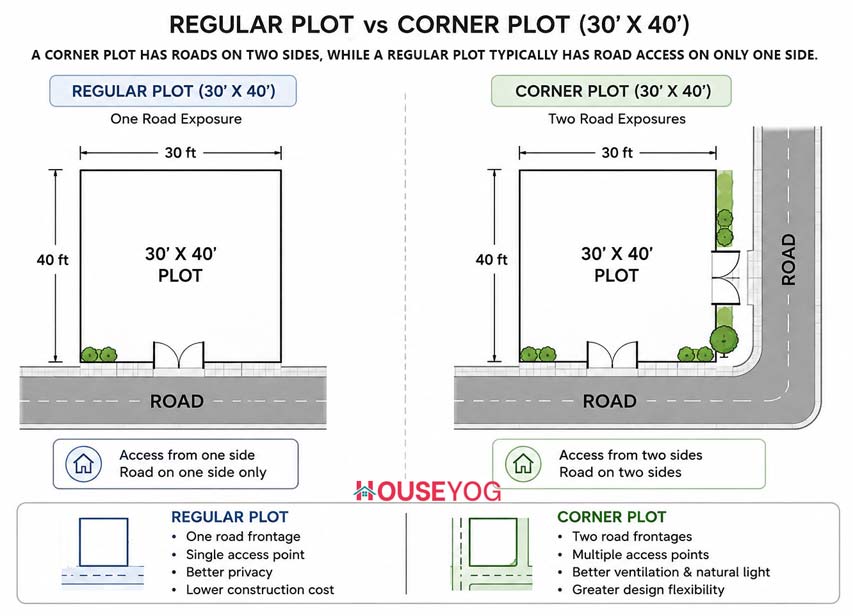
A corner plot often offers greater design flexibility, better ventilation, and stronger architectural appeal.
At the same time, it may also reduce the actual buildable area and increase your overall project cost.
That’s why you shouldn’t evaluate a plot based only on its location. You should evaluate it based on how well it supports the kind of house you want to build.
Top 5 Advantages of Buying a Corner Plot
A corner plot is often considered a premium property, and for good reason. The additional road frontage creates opportunities that are difficult to achieve in a regular plot. From better ventilation and natural light to greater design flexibility and easier parking, a well-planned corner plot can offer several practical advantages. However, not all benefits apply equally to every property, which is why it’s important to understand exactly where a corner plot can work in your favour.
Better Natural Light and Ventilation
Corner plots usually receive better sunlight and cross-ventilation because they have two open sides.
This is probably the most commonly discussed advantage, but it’s also one of the most practical.
More open sides create more opportunities for placing:
- Windows
- Balconies
- Ventilators
- Courtyards
- Open terraces
Good ventilation doesn’t just make your home feel comfortable.
It can also reduce dependence on artificial lighting and improve indoor air circulation throughout the year.
This becomes particularly important in Indian cities, where neighbouring buildings are often constructed very close to one another.
A well-designed corner house can remain bright and airy even in densely populated neighbourhoods.
More Design Flexibility
A corner plot gives architects more freedom to plan the layout.
With access from two roads, you’re no longer restricted to a single entry point.
This opens up several possibilities.
You can create:
- Separate pedestrian and vehicle entrances
- Independent access for a duplex
- A dedicated service entrance
- Better zoning between public and private spaces
Let’s say you’re building a G+1 duplex.
Instead of bringing every visitor through the main gate, you can create separate access for family members, tenants, guests, or service staff.
These design possibilities are much more difficult to achieve in a conventional plot.
Better Elevation Opportunities
This is an important advantage that most real-estate articles completely overlook.
Two visible facades create better architectural opportunities.
In a regular plot, only one side of the house usually receives architectural attention.
In a corner plot, two elevations remain visible from the road.
That means you can incorporate:
- Larger balconies
- Corner windows
- Glass elements
- Feature walls
- Landscaping
- Modern facade treatments
The result is often a more attractive and premium-looking house.
If aesthetics matter to you, a corner plot offers far more design possibilities.
Easier Parking Access
Parking is often easier to plan in a corner plot.
In urban areas, this can be a major advantage.
Instead of aligning your garage with a single entrance, you can approach the property from two directions.
This gives you greater flexibility when planning:
- Car parking
- Visitor parking
- Garage access
- Turning radius
- Vehicle movement
This advantage becomes even more significant for larger houses, duplex homes, or properties with multiple vehicles.
Potentially Better Resale Value
Corner plots often command a higher resale value, but they are not automatically better investments.
Location matters much more.
A corner plot in a poorly connected neighbourhood may appreciate more slowly than a regular plot in a well-developed area.
Several factors influence resale value, including:
- Road width
- Connectivity
- Infrastructure
- Neighborhood development
- Commercial activity
- Future growth potential
Don’t buy a corner plot simply because someone says it’s a premium property.
Always evaluate the surrounding area before paying an additional premium.
5 Hidden Challenges of a Corner Plot
This is where things become interesting.
Most buyers focus only on the benefits.
Architects, however, look at the constraints first.
And that’s where many corner plots become complicated.
Setback Rules Can Reduce the Buildable Area
A corner plot may provide less usable construction space than a regular plot of the same size.
This is probably the most important point in this entire article.
Most municipal authorities require mandatory setbacks between the building and the road.
Because a corner plot faces two roads, setback requirements may apply on both sides.
Let’s take a simple example.
Suppose you purchase two 1,500-square-foot plots.
One is a regular plot.
The other is a corner plot.
If the local building authority requires setbacks on both road-facing sides, the actual area available for construction may become significantly smaller in the corner plot.
Before buying any plot, ask these questions:
- What are the minimum setback requirements?
- What is the maximum permissible ground coverage?
- What is the actual buildable area?
This is also one reason why site development decisions such as basement construction versus sand filling should always be evaluated after understanding the usable footprint of the plot.
You May Have to Leave Space for Road Widening or Corner Cuts
Many buyers have never heard of a corner cut until they begin the approval process.
A corner cut, sometimes called a splay, is an angled portion of land left open near a road intersection to improve traffic visibility.
Depending on local municipal regulations, you may be required to leave a portion of the corner undeveloped.
In some areas, future road widening plans can further reduce the usable plot area.
This is particularly common in developing urban neighbourhoods.
Before purchasing a corner plot, verify:
- The approved layout plan
- The master plan
- Municipal road proposals
- Road widening notifications
Never assume that the dimensions mentioned in the sale deed represent the actual buildable area.
Construction Costs Are Usually Higher
Corner plots often cost more to develop.
The additional expenses may not seem significant initially, but they can add up quickly.
Some common additional costs include:
| Additional Component | Why It Costs More |
| Compound wall | Two exposed sides |
| Gates | Multiple access points |
| Paving | Larger frontage |
| Landscaping | More visible open areas |
| Exterior finishing | Two visible facades |
Many homeowners spend extra money simply because they want both road-facing sides to look equally attractive.
As a result, the overall project budget increases.
If you’re planning your finances, don’t forget to estimate the complete construction budget, including site development, exterior work, and landscaping.
Privacy May Actually Become Worse
This surprises many people.
A corner plot doesn’t always provide better privacy.
In fact, the opposite can be true.
Two roads mean:
- More passing vehicles
- More pedestrians
- More visual exposure
- More noise
Your living room, bedrooms, balconies, and windows may become visible from multiple directions.
Good architectural design can certainly improve privacy.
An architect may use:
- Landscape buffers
- Higher compound walls
- Window placement strategies
- Pergolas
- Screens
- Green barriers
However, these solutions often require additional planning and investment.
Security Requires More Planning
More exposure usually means more security considerations.
A regular plot has fewer entry points and a smaller boundary to manage.
A corner plot typically requires a more comprehensive security strategy.
You may need to consider:
- Additional lighting
- CCTV cameras
- Secure gate placement
- Boundary wall design
- Window positioning
This doesn’t mean corner plots are unsafe.
It simply means that security planning should be integrated into the design from the beginning.
Before You Buy a Corner Plot, Check These 7 Things
Before making the final payment, verify these seven points.
Think of this as your pre-purchase checklist.
- Check the sanctioned layout plan.
- Verify local municipal setback requirements.
- Confirm future road widening proposals.
- Measure the actual buildable area.
- Check the location of utility poles, drains, and service lines.
- Visit the plot during peak traffic hours.
- Ask an architect to evaluate the site.
That final point is probably the most important.
A 30-minute professional review can help you avoid costly mistakes later.
You should also estimate your total project budget using a house construction cost guide before making a purchase decision.
Who Should Buy a Corner Plot?
A corner plot may be the right choice if design flexibility is more important than cost.
You should seriously consider a corner plot if:
- You want a premium-looking house.
- Natural light and ventilation are priorities.
- You’re planning a duplex.
- Parking is important.
- You value architectural aesthetics.
- You’re comfortable paying a premium.
Corner plots work particularly well for:
- Duplex homes
- Larger independent houses
- Multi-generational homes
- Properties with multiple vehicles
Who Should Choose a Regular Plot?
By now, you may be wondering whether all these additional benefits justify the higher cost. In many cases, the answer is no. A regular plot can actually be the smarter choice.
A regular plot may be a smarter option if you want to maximise usable space and keep construction costs under control.
A regular plot may be a better choice if:
- Your budget is limited.
- Privacy is important.
- You want to maximise the built-up area.
- You want lower construction costs.
- You don’t need multiple access points.
Remember, a well-designed house on a regular plot will always outperform a poorly designed house on a premium corner plot.
Good design matters more than plot type.
Final Verdict: Is a Corner Plot Worth It?
Yes, a corner plot can be an excellent investment, but only if it aligns with your construction goals, budget, and local building regulations.
Our recommendation is simple:
Don’t buy a corner plot because it’s a corner plot.
Buy it because the:
- Design possibilities make sense
- Setback requirements are manageable
- Road width supports your plans
- Municipal regulations are favourable
- Privacy concerns can be addressed
- Construction costs fit your budget
That’s how architects evaluate a plot.
And that’s exactly how you should evaluate it, too.
If you’re still unsure, consider getting the plot reviewed before you finalise the purchase. A professional assessment can help you understand the actual buildable area, identify design opportunities, and avoid expensive surprises later.
After all, choosing the right plot is the first and perhaps the most important decision you’ll make in your home-building journey.
FAQs About Corner Plot Vs Regular Plot
A corner plot offers better ventilation and design flexibility, but a regular plot may provide better privacy and lower construction costs.
Usually, yes. However, location, infrastructure, and neighbourhood development have a greater impact on resale value.
Yes. Additional costs may include larger compound walls, multiple gates, landscaping, and enhanced exterior finishes.
In many municipalities, setback requirements apply to both road-facing sides, reducing the buildable area.
It depends on the orientation of the roads, the location of the entrance, and the overall site layout. Vastu should be evaluated on a case-by-case basis.