
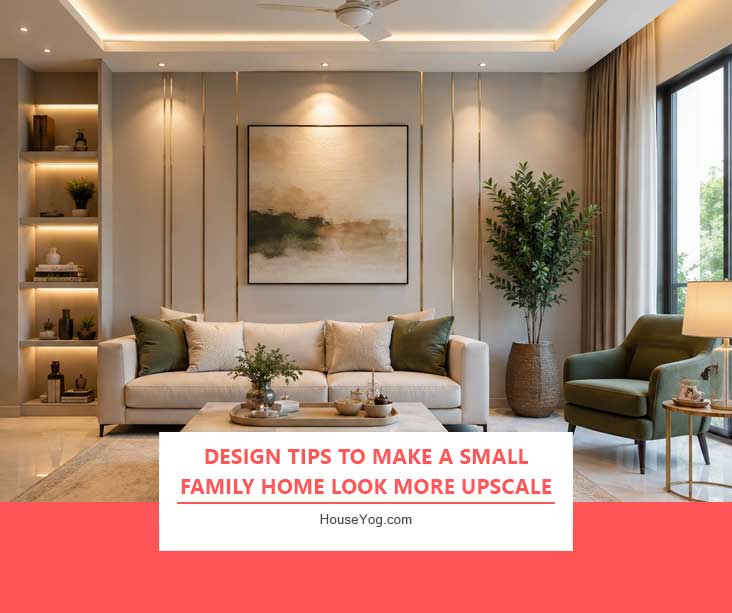

A beautiful home isn’t defined by its size. Some of the most elegant homes we’ve designed have been compact apartments and modest family houses where every square foot was planned thoughtfully.
The biggest misconception is that creating a luxurious home requires expensive furniture, imported finishes, or a larger floor plan. In reality, what makes a home feel premium is good design—well-planned layouts, balanced proportions, natural light, quality materials, and attention to detail.
Whether you live in a compact apartment, a 2BHK flat, or a small independent home, the right design choices can make your interiors feel noticeably bigger, brighter, and more refined without increasing the built-up area.
In this guide, we’ll share practical design tips that interior designers frequently use to create elegant homes that are comfortable for everyday family life.
Design Changes That Deliver the Biggest Impact
Here are a few design changes that can elevate the aesthetic of your home easily.
| Design Upgrade | Impact |
| Open layouts | Makes rooms feel larger |
| Layered lighting | Adds warmth and depth |
| Neutral colour palette | Creates visual continuity |
| Large mirrors | Reflects light and expands space |
| Hidden storage | Keeps rooms clutter-free |
| Solid wood furniture | Adds warmth and character |
| Larger rugs | Makes rooms feel better proportioned |
| Full-length curtains | Creates the illusion of taller ceilings |
Start with a Layout That Works for Your Family
A well-planned layout improves comfort, circulation, and storage, making even a compact home feel larger than it actually is.
Before choosing furniture or decorative accessories, think about how your family actually uses the home.
Do children need space to study?
Do you often entertain guests?
Do you work from home?
The answers should influence your layout from the beginning.
If you’re building a new home instead of renovating an existing one, working with an experienced custom home builder allows you to optimise room sizes, storage, natural lighting, and circulation before construction begins. A thoughtfully planned layout often delivers a greater feeling of luxury than simply adding extra square footage.
During our design projects, we’ve found that homes designed around daily routines remain functional for years, while layouts created purely for appearance often become frustrating to live in.
Open Up the Living Spaces Wherever Possible
Removing unnecessary visual barriers makes compact homes feel brighter, more spacious, and easier to move through.
Small homes often feel cramped because every activity happens inside separate enclosed rooms.
Where structural conditions permit, opening the connection between the living room, dining space, and kitchen creates better sightlines and allows natural light to travel further into the house.
You don’t always need to remove walls completely. Wider openings, glass partitions, open shelving, or partial dividers can improve the sense of openness while still maintaining functional separation.
For apartments where structural changes aren’t possible, arranging furniture carefully and avoiding oversized pieces can achieve a surprisingly similar effect.
Create a Calm Colour Palette Throughout the Home
Using a consistent colour palette helps your eyes move naturally from one room to another, making the entire home feel larger.
One of the easiest ways to make a small home appear busy is by giving every room a completely different colour scheme.
Instead, choose two or three complementary colours and repeat them throughout the house.
Soft whites, warm greys, beige, sage green, muted blues, and earthy tones create a timeless backdrop that works with almost every decorating style.
Accent colours can still be introduced through cushions, artwork, rugs, and decorative accessories without overwhelming the space.
If you’re unsure where to begin, our guide on how to choose the right colour scheme for your home explains how different colours influence the mood and appearance of each room.
Consistency doesn’t mean everything should look identical. It simply creates visual harmony.
Add Architectural Details That Never Go Out of Style
Simple architectural features add character and make even modest homes feel more refined.
Luxury isn’t always about expensive materials.
Often, it’s the subtle details that elevate a room.
Wall mouldings, ceiling trims, wooden panelling, feature walls, recessed niches, decorative skirting boards, and elegant door architraves all contribute to a richer interior without dominating the space.
Rather than adding decorative elements everywhere, focus on one or two key areas such as the living room, entrance foyer, or master bedroom.
Quality almost always looks better than quantity.
If you enjoy classic interiors that remain stylish for decades, you’ll also find inspiration in our guide to timeless interior design ideas, where we explore design choices that continue to look elegant long after trends have faded.
Invest in Fewer, Better Furniture Pieces
Well-made furniture creates a more premium appearance than filling a room with numerous inexpensive pieces.
Furniture occupies most of the visual space in a room.
Choosing quality over quantity instantly changes how an interior feels.
Solid wood furniture can introduce natural warmth, texture and character to a room.
That doesn’t mean every piece must match perfectly.
Combining contemporary furniture with handcrafted wooden pieces often creates more personality than buying an entire matching furniture set.
One mistake we frequently notice is selecting furniture that’s too large for the room.
Leave enough breathing space around each piece so the room feels open rather than crowded.
Get the Proportions Right
A room can have expensive furniture and still look ordinary if the proportions are wrong.
Choose furniture that fits the room rather than simply buying the largest or most impressive pieces. Make sure rugs are large enough to anchor the furniture, artwork is appropriately scaled to the wall, and there is enough space for comfortable movement around each piece.
Avoid both extremes: oversized furniture that overwhelms a small room and undersized pieces that make the space feel disconnected.
Good proportions create balance and visual harmony—the polished appearance people often associate with well-designed, upscale interiors.
Keep Everyday Clutter Out of Sight
Hidden storage helps small homes look organised while making daily life easier for the entire family.
Family homes naturally accumulate belongings.
School bags.
Shoes.
Toys.
Chargers.
Books.
If everything remains visible, even beautifully designed rooms begin to feel cluttered.
Built-in wardrobes, under-bed storage, storage benches, wall-mounted cabinets, and multifunctional furniture help keep frequently used items organised without reducing usable floor space.
Where possible, use storage that blends into the wall rather than standing out as another bulky furniture piece.
The less visual clutter your home has, the larger and calmer it will feel.
Use Floating Shelves Thoughtfully
Floating shelves display meaningful décor without taking up valuable floor space.
Floating shelves work particularly well in compact homes because they make use of vertical wall space instead of consuming precious floor area.
Instead of filling every shelf, style them with intention.
A few books.
One indoor plant.
A ceramic vase.
Framed family photographs.
Leave enough empty space around each item.
Negative space is an important part of good interior design. It allows each object to stand out instead of competing for attention.
Think of your shelves as carefully curated displays rather than extra storage.
Use Lighting to Highlight the Design
Good lighting does more than brighten a room—it helps highlight the details that make an interior feel refined.
Instead of relying entirely on a single overhead light, combine different light sources to create depth and atmosphere. Use general lighting for everyday illumination, task lighting where specific activities take place, and accent lighting to draw attention to artwork, wall details, furniture or architectural features.
In a small home, lighting can also help define different areas without adding physical partitions. A pendant over the dining table, wall lights beside a sofa, or subtle LED lighting in a display unit can give each zone its own character.
The goal isn’t to make the room brighter at all times. It’s to make the right elements stand out while creating a warm, balanced atmosphere.
Hang Curtains Higher to Create Taller Rooms
Mounting curtain rods close to the ceiling makes windows appear larger, and ceilings look higher.
It’s a simple trick, yet one that designers use repeatedly.
Instead of fixing curtain rods directly above the window frame, install them closer to the ceiling and use full-length curtains that extend almost to the floor.
This draws the eye upward, creating the illusion of greater height.
Choose light, breathable fabrics that allow daylight to filter through during the day while heavier curtains can provide privacy when needed.
Avoid curtains that stop midway down the wall—they visually shorten the room.
Choose Rugs That Anchor the Furniture
A well-sized rug can make a room look more polished by visually connecting the furniture into one cohesive arrangement.
Instead of choosing a very small rug simply because the room is compact, select one that is large enough for at least the front legs of the main seating pieces to rest on it. This creates a stronger relationship between the sofa, chairs and coffee table.
The same principle applies in bedrooms. A rug that extends beyond the sides and foot of the bed creates a more balanced and finished appearance.
The goal isn’t simply to fill floor space. A properly proportioned rug helps define the room, anchor the furniture and make the entire arrangement feel intentional.
Make a Statement with One Large Artwork
Keep decorative pieces selective. A few meaningful objects usually create a more sophisticated look than filling every available surface.
When decorating walls, many people gradually fill every available space with photographs, souvenirs, and small frames.
The result often feels cluttered.
Instead, choose one larger artwork that complements your colour palette and becomes the room’s focal point.
Landscape paintings, abstract artwork, black-and-white photography, or even a large family portrait can work beautifully when scaled appropriately.
Also, give the artwork some breathing space to make a statement
A single impactful piece almost always creates a more sophisticated impression than a crowded gallery of unrelated items.
Use Mirrors as Decorative Features
Mirrors can do more than make a small room appear larger. A thoughtfully chosen mirror can also become an elegant decorative element.
Instead of covering a wall with several small mirrors, consider one substantial piece with a frame that complements the room’s furniture and finishes. Position it where it can reflect natural light, an attractive view, artwork or another architectural feature.
The frame matters too. A simple, well-proportioned frame can contribute to the overall character of the room, while an overly decorative mirror may compete with other elements.
In an upscale interior, every feature should feel intentional—including the mirror.
Appeal to More Than Just the Eyes
A thoughtfully chosen home fragrance completes the overall experience and leaves a lasting impression.
Great interiors engage more than just sight.
The way a home smells also influences how welcoming it feels.
Choose one fragrance that reflects the atmosphere you want to create.
Warm notes like vanilla, sandalwood, cedar, or cinnamon create a cosy environment, while citrus or floral fragrances feel fresh and uplifting.
Use candles, reed diffusers, or essential oil diffusers sparingly.
The goal isn’t to overwhelm visitors but to create a subtle signature scent that quietly enhances the overall experience.
Common Mistakes That Make Small Homes Look Smaller
Even well-furnished homes can lose their charm because of a few avoidable design mistakes.
| Common Mistake | Better Approach |
| Using only one ceiling light | Layer ambient, task and accent lighting |
| Choosing oversized furniture | Scale furniture to the room |
| Hanging curtains too low | Install rods close to the ceiling |
| Using tiny rugs | Choose rugs that anchor the furniture |
| Decorating every wall | Create one or two focal points |
| Displaying too many accessories | Keep décor simple and intentional |
| Ignoring storage | Hide everyday clutter with smart storage |
Small improvements across multiple areas usually create a greater visual impact than one expensive upgrade.
Frequently Asked Questions
Focus on design rather than expensive décor. Layer your lighting, choose a consistent colour palette, use larger rugs, invest in quality furniture, keep clutter hidden, and add a few well-chosen decorative pieces. Thoughtful planning usually has a bigger impact than increasing your budget.
Light neutrals such as white, beige, warm grey, soft green, and muted blue reflect more light and create visual continuity. Using the same colour palette throughout the house also helps rooms feel larger and more connected.
Yes. Layered lighting reduces dark corners, improves depth, and creates a brighter, more open feel. Combining ceiling lights with table lamps, floor lamps, or wall sconces produces a more balanced and inviting interior.
Choose furniture that’s proportional to the room and offers built-in storage where possible. Solid, well-crafted pieces with clean lines generally work better than bulky furniture or oversized sectional sofas.
Yes. Large mirrors reflect natural light and create the illusion of additional depth. Placing a mirror opposite a window is one of the simplest ways to make a compact room feel brighter and more spacious.
The most common mistake is overcrowding the space with too much furniture and décor. Keeping layouts simple, leaving enough circulation space, and reducing visual clutter instantly makes a home feel larger and more comfortable.
Final Thoughts
A luxurious home isn’t measured by its square footage—it’s measured by how thoughtfully it has been designed.
When natural light flows freely, furniture is well-proportioned, colours feel harmonious, and every item has a purpose, even a compact family home can feel elegant and inviting.
You don’t need to implement every idea at once. Start with the improvements that offer the greatest impact, such as better lighting, a calmer colour palette, smarter storage, or full-length curtains. As your home evolves over time, these thoughtful changes will create a space that not only looks more refined but also works better for your family’s everyday life.
Great design isn’t about spending more. It’s about making better choices.