

The main door is more than just the entrance to your home—it creates the first impression, enhances security, and adds to your home’s overall appearance. Whether you’re building a new house or replacing an existing entrance door, choosing the right one involves balancing aesthetics, durability, security and budget.
So, how much does a main door cost in India?
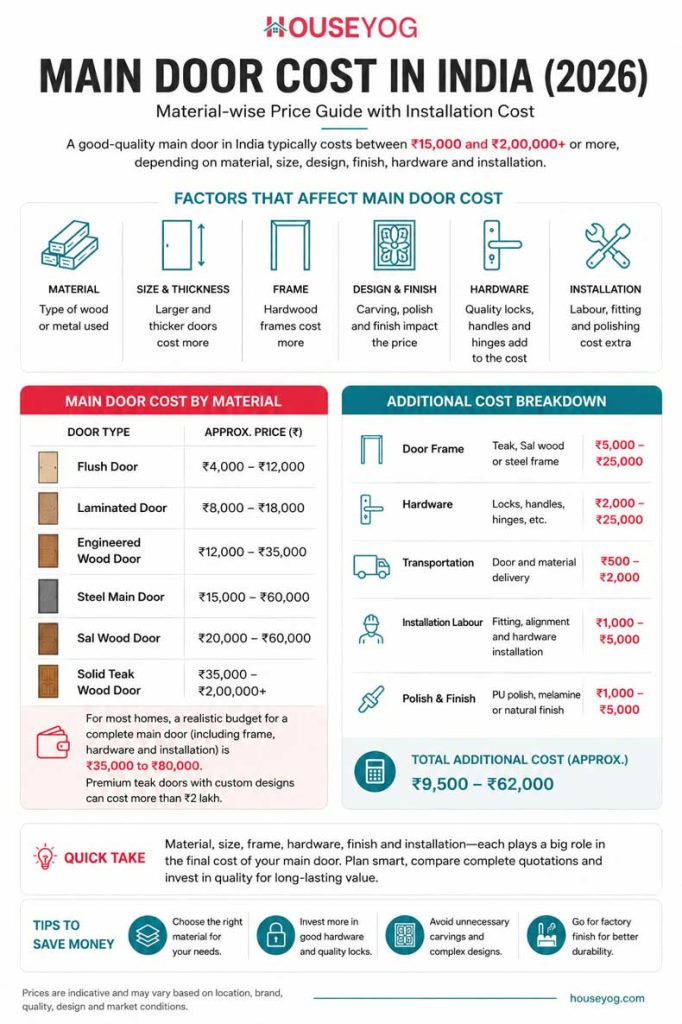
A good-quality main door in India typically costs between ₹15,000 and ₹2,00,000 or more, depending on the material, size, wood species, design, finish, hardware and installation. A basic flush or laminated entrance door can cost well under ₹15,000, while a handcrafted solid teak wood door with premium hardware can easily cost over ₹2 lakh.
However, the door shutter is only one part of the total expense. You’ll also need to budget for the door frame, locks, handles, hinges, polishing, transportation and installation. These additional costs can significantly increase the final amount.
If you’re planning a new home, understanding these costs in advance can help you make better decisions and avoid unexpected expenses later. This guide explains the latest main door prices in India, compares different materials, breaks down installation and hardware costs, and shares practical tips to help you choose the best entrance door for your budget.
Quick Navigation
- Main Door Cost at a Glance
- Budget Guide
- Cost by Material
- Cost by Size
- Frame Cost
- Hardware Cost
- Installation Cost
- Best Value
- FAQs
Main Door Cost in India at a Glance
Popular brands like Century Doors, Greenply, Tata Pravesh and Godrej offer main entrance doors across different budgets.
The table below gives a quick overview of the approximate price range for different types of residential main doors in India.
| Door Type | Approximate Price |
| Flush Door | ₹4,000–₹12,000 |
| Laminated Door | ₹8,000–₹18,000 |
| Engineered Wood Door | ₹12,000–₹35,000 |
| Steel Main Door | ₹15,000–₹60,000 |
| Sal Wood Door | ₹20,000–₹60,000 |
| Solid Teak Wood Door | ₹35,000–₹2,00,000+ |
Prices are indicative for standard residential entrance doors and may vary depending on the city, timber quality, size, design, brand, hardware and finishing requirements.
Quick Take: For most new homes in India, a realistic budget for a good-quality main entrance door—including the frame, hardware and installation—is between ₹35,000 and ₹80,000. Premium homes with custom teak wood doors and designer hardware may require a substantially higher budget.
How Much Should You Budget for a Main Door?
For most residential projects, setting aside around ₹35,000 to ₹80,000 for the complete main door package is a practical starting point. This typically covers the door shutter, frame, essential hardware and installation. If you’re opting for premium hardwood, intricate designs or smart locking systems, your budget may need to be significantly higher.
One of the most common mistakes we see during home construction is budgeting only for the door itself. A beautiful entrance door can quickly become much more expensive once you add a hardwood frame, premium locks, decorative handles, polishing and installation.
As a general guideline, the main entrance door often accounts for around 2–4% of the total construction budget (excluding land cost) for a typical independent house. While this isn’t a fixed rule, it provides a useful benchmark when planning your overall construction budget.
The table below shows a practical budgeting guide for different house budgets.
| Approximate House Construction Budget* | Suggested Main Door Budget |
| ₹20–40 lakh | ₹20,000–₹35,000 |
| ₹40–70 lakh | ₹35,000–₹60,000 |
| ₹70 lakh–₹1 crore | ₹60,000–₹1,00,000 |
| Above ₹1 crore | ₹1,00,000–₹2,00,000+ |
*Construction budget excludes land cost and interior furnishings.
Of course, these figures aren’t rigid. A minimalist modern home may feature a sleek engineered wood or steel entrance door, while a traditionally designed house may justify investing in a handcrafted teak wood door with decorative carving. The right budget depends on your priorities, architectural style and long-term expectations.
Factors That Affect Main Door Cost
The biggest factors that determine the price of a main door are its material, size, thickness, frame, design, finish, hardware and installation. Two doors that appear similar from a distance can differ in price by several times because of differences in timber quality, craftsmanship or accessories.
Understanding what influences the cost will help you compare quotations more confidently and avoid paying for features you may not actually need.
1. Door Material
The material has the greatest influence on the overall price.
Solid teak wood doors are among the most expensive because of the high cost of quality timber and the craftsmanship involved. Sal wood offers excellent strength at a comparatively lower price, making it a popular choice for many Indian homes. Engineered wood provides a modern appearance with better dimensional stability, while steel doors are valued for their durability, security and low maintenance.
Choosing the right material should be based not only on cost but also on your climate, maintenance expectations and the architectural style of your home.
2. Door Size
Larger entrance doors naturally require more material, stronger frames and heavier-duty hardware.
A standard single-leaf entrance door generally costs much less than a double-door or oversized pivot door. If you’re planning a grand entrance with wider openings or greater height, expect the overall project cost to increase accordingly.
Standard Main Door Size in India
| Door | Standard Size |
| Single door | 3′ x 7′ |
| Premium door | 4′ x 8′ |
| Double door | 5′ x 7′ |
3. Door Thickness
Thickness plays an important role in both durability and perceived quality.
A thicker door usually provides better strength, improved sound insulation and a more premium feel. However, it also requires stronger hinges and can increase both manufacturing and installation costs.
4. Door Frame
Many homeowners focus only on the door shutter and forget to include the frame in their budget.
A well-made frame is essential for the long-term performance of the entrance door. Hardwood frames, particularly teak, can significantly increase the total cost but also offer excellent durability and stability. Steel frames provide another reliable option for certain applications.
5. Design and Craftsmanship
The complexity of the design has a major impact on pricing.
Simple contemporary doors with clean lines are generally more affordable than handcrafted designs featuring decorative carving, CNC patterns, glass inserts or custom detailing. The more labour-intensive the design, the higher the cost.
6. Surface Finish
The finish protects the door while enhancing its appearance.
Melamine, PU coating, natural polish, veneer and laminate finishes all differ in cost and maintenance requirements. Premium finishes generally provide better durability, colour retention and weather resistance, especially for doors exposed to sunlight and rain.
7. Hardware and Accessories
The hardware can account for a surprisingly large share of the total budget.
Items such as mortise locks, pull handles, hinges, tower bolts, door closers and digital locks vary widely in quality and price. Investing in reliable hardware often provides better long-term value than spending excessively on decorative features.
8. Installation and Finishing
Installation costs vary depending on the door’s size, weight and site conditions.
Labour charges may include transportation, frame fixing, alignment, polishing, fitting hardware and final adjustments. Heavier hardwood doors typically require more time and skilled labour to install properly.
9. Brand and Manufacturing Quality
Established manufacturers often charge more than local fabricators, but they may also offer better seasoning, precision manufacturing, factory finishing and warranty support.
Rather than choosing solely based on price, compare the overall quality of the timber, workmanship, hardware compatibility and after-sales service.
Before Comparing Door Prices…
Once you understand the factors that influence cost, the next step is choosing the right material. This is where the price differences become much clearer.
In the next section, we’ll compare the cost, advantages, limitations and ideal use cases of the most popular main door materials in India—including solid teak wood, sal wood, engineered wood, flush doors, steel and uPVC—to help you decide which one offers the best value for your home.
Main Door Cost by Material
The material you choose has the biggest impact on the cost, appearance, durability and maintenance of your main entrance door. In India, wooden doors remain the most popular choice for independent houses, while steel and engineered wood doors are becoming increasingly common due to their lower maintenance and modern designs.
There is no single “best” material for every home. A handcrafted teak wood door may be ideal for a premium bungalow, whereas a steel or engineered wood door could be a more practical choice for a contemporary urban home.
The table below provides a quick comparison before we discuss each material in detail.
| Material | Approximate Price | Durability | Maintenance | Best For |
| Flush Door | ₹4,000–₹12,000 | Moderate | Low | Budget homes |
| Engineered Wood | ₹12,000–₹35,000 | Good | Low | Modern homes |
| Steel | ₹15,000–₹60,000 | Excellent | Very Low | Security-focused homes |
| Sal Wood | ₹20,000–₹60,000 | Very Good | Moderate | Mid-range homes |
| Solid Teak Wood | ₹35,000–₹2,00,000+ | Excellent | Low to Moderate | Premium homes |
| uPVC | ₹12,000–₹30,000 | Good | Very Low | Utility & secondary entrances |
Let’s look at each option in more detail.
Solid Teak Wood Main Door Price
Approximate Cost: ₹35,000 to ₹2,00,000+
If there’s one material that has remained the benchmark for premium entrance doors in India, it’s solid teak wood. Known for its rich grain, natural oils and exceptional durability, teak has been the preferred choice for traditional homes, villas and luxury residences for decades.
Unlike many other hardwoods, teak naturally resists termites, decay and moisture, making it particularly suitable for India’s diverse climatic conditions. A well-seasoned teak door, properly maintained, can last for several decades while developing an attractive natural patina over time.
The price, however, varies considerably depending on factors such as the timber’s origin, thickness, seasoning, design complexity and workmanship. For example, a simple machine-made teak door costs significantly less than a handcrafted door featuring intricate carvings or decorative glass panels.
Advantages
- Exceptional durability and longevity
- Naturally resistant to termites and moisture
- Elegant appearance with distinctive wood grain
- Adds premium value to the property
- Suitable for traditional and contemporary homes
Considerations
- Highest initial investment
- Quality varies significantly depending on the source of teak
- Premium designs require skilled craftsmanship
Best for: Premium independent houses, villas and homeowners looking for a long-term investment.
Architect’s Tip: If you’re investing in a teak main door, choose seasoned timber from a reputable manufacturer. A well-made simple teak door often performs better than an elaborately carved door made from inferior-quality wood.
Sal Wood Main Door Price
Typical Price: ₹20,000 to ₹60,000
For many homeowners, Sal wood offers one of the best balances between cost, durability and strength. It is widely used across eastern and northern India and is particularly popular for residential construction because of its robust nature and relatively lower cost compared to teak.
Sal is a dense hardwood capable of withstanding regular wear and tear, making it a dependable choice for main entrance doors. While it doesn’t have the distinctive grain patterns associated with teak, it can still achieve an attractive appearance with proper polishing or painting.
One important consideration is seasoning. Since Sal is naturally dense, poorly seasoned timber may develop minor warping or shrinkage over time. Buying from a trusted supplier is therefore essential.
Advantages
- Excellent structural strength
- More affordable than teak
- Durable for long-term residential use
- Readily available across many parts of India
Considerations
- Requires proper seasoning
- Slightly heavier than many other woods
- Grain is less decorative than teak
Best for: Mid-range homes where durability is a higher priority than decorative appearance.
Engineered Wood Main Door Price
Price Range: ₹12,000 to ₹35,000
Engineered wood doors have become increasingly popular over the past decade, particularly in modern apartments and contemporary homes.
Instead of using a single piece of solid timber, these doors are manufactured using engineered wood products combined with veneers, laminates or decorative finishes. This controlled manufacturing process improves dimensional stability and reduces the chances of warping or cracking caused by changes in temperature or humidity.
Factory-finished engineered doors are also available in a wide range of colours, textures and wood-like finishes, allowing homeowners to achieve a premium appearance without the higher cost of solid hardwood.
However, not all engineered doors are made to the same standard. Core material, manufacturing quality and moisture resistance can vary considerably between manufacturers.
Advantages
- Attractive modern finishes
- Better dimensional stability
- Lower maintenance
- Wide variety of designs
- More affordable than premium hardwood
Considerations
- Quality depends heavily on the manufacturer
- Lower-end products may not perform well in harsh weather
- Limited repairability compared to solid wood
Best for: Contemporary homes, apartments and homeowners looking for modern aesthetics with minimal maintenance.
Flush Door Price
Typical Price: ₹4,000 to ₹12,000
Flush doors are among the most economical options available in the Indian market. They consist of a solid or hollow core covered with plywood, MDF or similar facing materials, resulting in a clean, minimalist appearance.
Although flush doors are commonly used for bedrooms and internal spaces, they can also serve as main entrance doors in budget-conscious homes when combined with a quality laminate, sturdy frame and reliable locking system.
That said, a standard flush door may not provide the same visual appeal or long-term durability as hardwood or premium engineered doors.
Advantages
- Lowest purchase cost
- Simple, clean appearance
- Easy availability
- Suitable for economical projects
Considerations
- Limited design options
- Lower perceived premium value
- Quality varies with core construction
Best for: Budget homes, rental properties and cost-sensitive projects.
Steel Main Door Price
Approximate Price: ₹15,000 to ₹60,000
Steel entrance doors have evolved significantly in recent years. Modern designs no longer resemble plain industrial doors; many now feature wood-grain finishes, decorative panels and premium hardware that closely mimic the appearance of natural timber.
Their biggest advantage is security. Steel doors offer excellent resistance to forced entry, require minimal maintenance and are unaffected by termites. They also perform well in humid or coastal environments where wooden doors may require additional care.
However, some homeowners still prefer the warmth and natural character of real wood, particularly for traditional architectural styles.
Advantages
- Excellent security
- Very low maintenance
- Termite-proof
- Moisture resistant
- Long service life
Considerations
- Less natural appearance than solid wood
- Scratches may require touch-up
- Limited customisation options compared to handcrafted wooden doors
Best for: Urban homes, apartments, and coastal regions.
Many premium steel doors now feature realistic wood-finish coatings, offering the appearance of timber with the durability of steel.
uPVC Main Door Price
Typical Market Price: ₹12,000 to ₹30,000
uPVC doors are widely used for balconies, utility rooms, bathrooms and service entrances because they are lightweight, weather-resistant and virtually maintenance-free.
While they are excellent for these applications, they are generally not the preferred choice for the primary entrance of an independent house. Compared to solid wood or steel, they offer a less premium appearance and may not provide the same level of security expected from a main entrance door.
Advantages
- Low maintenance
- Resistant to moisture
- Lightweight
- Affordable
- Weather resistant
Considerations
- Less premium appearance
- Lower structural strength than wood or steel
- Limited suitability for grand entrance designs
Best for: Utility entrances, secondary doors and budget residential applications.
If you’re still deciding between these two popular options, our detailed guide on Wood vs Steel Doors in India compares their cost, durability, maintenance and security to help you choose the right entrance door for your home.
Which Main Door Material Offers the Best Value?
There isn’t a single material that’s best for every home. The right choice depends on your budget, maintenance expectations, architectural style and long-term priorities.
If you’re looking for the lowest upfront cost, a flush door remains the most economical option. For homeowners seeking durability without spending on premium hardwood, Sal wood offers excellent value. Engineered wood suits modern homes that prioritise clean aesthetics and low maintenance, while steel doors are an ideal choice for those who place security above everything else.
Solid teak continues to be the premium benchmark. Although it requires a higher initial investment, its longevity, natural beauty and ability to enhance the overall character of a home make it a worthwhile choice for many homeowners planning a long-term residence.
The following table summarises our recommendations.
| Your Priority | Recommended Material |
| Lowest Budget | Flush Door |
| Best Value for Money | Sal Wood |
| Modern Appearance | Engineered Wood |
| Maximum Security | Steel Door |
| Premium Finish & Longevity | Solid Teak Wood |
| Lowest Maintenance | Steel or uPVC |
As with any major building material, quality matters just as much as the material itself. A well-manufactured Sal or engineered wood door from a reputable supplier will often outperform a poorly made teak door. Before making your final decision, compare the quality of the timber, seasoning, frame, hardware and workmanship—not just the quoted price.
Main Door Cost by Size
The size of your main door directly affects its price because larger doors require more material, stronger frames, heavier hardware and additional labour during installation. While most Indian homes use a standard single-leaf entrance door, larger homes often opt for double doors or oversized entrance doors to create a grander appearance.
If you’re designing a new home, choose the door size based on your architectural style and functional needs rather than appearance alone. An oversized entrance door can look impressive, but it also increases the overall project cost.
The table below provides a general idea of how door size influences pricing.
| Door Size | Suitable For | Approximate Price* |
| 3′ x 7′ (900 x 2100 mm) | Standard residential entrance | ₹15,000–₹60,000 |
| 4′ x 7′ (1200 x 2100 mm) | Wider single entrance | ₹25,000–₹90,000 |
| 5′ x 8′ Double Door | Villas and premium homes | ₹60,000–₹2,00,000+ |
| Oversized Designer Door | Luxury residences | ₹80,000–₹2,50,000+ |
| Pivot Door | Contemporary luxury homes | ₹1,00,000–₹3,00,000+ |
*Prices depend on the material, thickness, design, frame and hardware.
Standard Single Door (3′ x 7′)
This remains the most common main entrance door size for independent houses in India. It offers an ideal balance between functionality, cost and ease of installation. Since it requires less material and standard hardware, it is also the most economical option.
Wider Entrance Doors
Many modern homes now feature wider entrance doors that create a more spacious and welcoming entry. Although visually appealing, they require heavier frames, stronger hinges and premium hardware, which increases the total cost.
Double Doors
Double doors are often chosen for large independent houses, duplexes and villas. Besides using almost twice the material, they also require more complex joinery, additional hardware and precise installation, making them significantly more expensive than standard doors.
Pivot Doors
Pivot doors have become increasingly popular in luxury contemporary homes. Instead of traditional side hinges, these doors rotate on pivot hardware installed at the top and bottom.
While they create a striking architectural statement, pivot doors are among the most expensive options because of specialised hardware, thicker door panels and skilled installation.
Architect’s Advice: Unless your entrance is unusually large or your design specifically calls for it, a well-designed 3′ x 7′ or 4′ x 7′ main door usually offers the best balance between aesthetics, functionality and cost.
Main Door Frame Cost
The door frame is one of the most overlooked components when budgeting for a new main entrance door. Yet it plays a crucial role in supporting the weight of the door, ensuring smooth operation and maintaining structural stability for decades.
Many homeowners compare only the price of the door shutter and later discover that the frame adds a significant amount to the total project cost.
Approximate Door Frame Prices
| Frame Material | Approximate Cost |
| Sal Wood Frame | ₹6,000–₹15,000 |
| Teak Wood Frame | ₹12,000–₹35,000 |
| Steel Frame | ₹8,000–₹20,000 |
The right frame depends on the material and weight of the door.
Teak Wood Frame
Teak remains the premium choice because of its natural resistance to termites, moisture and decay. It is particularly suitable for heavy hardwood entrance doors and offers excellent durability over the long term.
Although more expensive, a teak frame often requires less maintenance and can last for several decades.
Sal Wood Frame
Sal wood frames provide excellent structural strength at a lower price. They are widely used in residential construction, particularly in eastern and northern India, where Sal timber is readily available.
Proper seasoning is essential to minimise the risk of shrinkage or distortion.
Steel Frame
Steel frames are increasingly used with steel doors and some engineered wood doors. They provide excellent strength, dimensional stability and resistance to termites.
They are particularly useful in regions with high humidity or where minimal maintenance is preferred.
Expert Tip: Don’t compromise on the quality of the door frame. Even the best-quality entrance door may develop alignment issues if it is installed on a poorly constructed or inadequately seasoned frame.
Main Door Hardware Cost
Hardware is often the most underestimated part of the budget. A premium entrance door fitted with poor-quality locks or hinges can compromise both security and user experience.
Good hardware not only improves safety but also makes the door operate smoothly for years.
Approximate Hardware Cost
| Hardware Item | Approximate Price |
| Mortise Lock | ₹2,000–₹15,000 |
| Main Door Handle | ₹1,000–₹8,000 |
| Hinges (Set) | ₹500–₹2,500 |
| Tower Bolt | ₹300–₹1,200 |
| Door Closer | ₹1,500–₹6,000 |
| Door Stopper | ₹300–₹1,000 |
| Door Viewer | ₹300–₹1,000 |
| Digital Door Lock | ₹8,000–₹35,000+ |
Let’s briefly look at each component.
Lock
A good-quality mortise lock is one of the best investments you can make for your home’s security. Prices vary depending on the brand, security rating and number of locking points.
Handles
From simple stainless steel handles to designer brass pull handles, the choice of handle can significantly influence both the appearance and cost of the entrance door.
Hinges
Heavy wooden doors require stronger, high-quality hinges capable of supporting substantial weight without sagging over time.
Door Closer
Although commonly associated with commercial buildings, door closers are increasingly used in premium residences to ensure smooth and controlled closing.
Digital Locks
Smart locks are becoming increasingly popular in Indian homes. Features such as fingerprint recognition, PIN access, RFID cards, mobile app control and remote unlocking can substantially increase the overall hardware budget.
Houseyog Tip: If you have to prioritise your spending, invest in a high-quality lock and hinges before choosing expensive decorative handles. Security and long-term reliability should always come first.
Main Door Installation Cost
Installation is more than simply fixing the door in place. Proper installation ensures that the door opens smoothly, seals correctly, remains aligned over time and performs reliably for years.
Poor installation can lead to sagging, gaps, difficulty in locking and premature wear, even if the door itself is of excellent quality.
Typical Installation Charges
| Installation Component | Approximate Cost |
| Door Installation Labour | ₹2,000–₹8,000 |
| Transportation | ₹500–₹5,000 |
| Frame Fixing | ₹1,000–₹3,000 |
| Hardware Installation | ₹500–₹2,000 |
| PU Polish / Final Finish | ₹3,000–₹12,000 |
| Alignment & Final Adjustments | ₹500–₹2,000 |
The final labour cost depends on several factors:
- Weight of the door
- Type of frame
- Installation complexity
- Site accessibility
- City-wise labour rates
- Whether polishing is included
A handcrafted teak door weighing over 100 kg naturally requires more manpower and installation time than a lightweight engineered wood door.
What Is the Total Cost of Installing a Main Door (Material + Fittings + Installation)?
When all the components are considered together, the actual project cost is usually much higher than the price of the door shutter alone.
Here’s a realistic example for a mid-range Sal wood entrance door.
| Item | Approximate Cost |
| Sal Wood Door | ₹38,000 |
| Sal Wood Frame | ₹10,000 |
| Lock & Hardware | ₹9,000 |
| Installation & Labour | ₹6,000 |
| Transportation & Finishing | ₹5,000 |
| Estimated Total | ₹68,000 |
Likewise, a premium teak wood entrance door with decorative carving, a teak frame, premium hardware and a digital lock can easily cost ₹1.5 lakh to ₹2.5 lakh or more.
This is why comparing quotations based only on the price of the door shutter can be misleading.
Readymade vs Custom Main Doors
If you’re buying a new entrance door, one of the first decisions you’ll need to make is whether to choose a readymade door or have one custom-built. Both options have their advantages, and the right choice depends on your budget, timeline and design preferences.
If you’re renovating an existing home instead of installing a brand-new entrance door, these Front Door Makeover Ideas can help you refresh your home’s entrance without a complete replacement.
| Readymade Door | Custom Door |
| Lower upfront cost | Higher cost |
| Faster availability | Longer manufacturing time |
| Standard sizes | Made to exact dimensions |
| Limited design options | Unlimited customisation |
| Factory quality control | Handcrafted detailing possible |
Choose a Readymade Door If…
- You’re working within a fixed budget.
- Your wall opening follows standard dimensions.
- You need quicker delivery.
- You prefer modern factory-finished designs.
Choose a Custom Door If…
- Your entrance has non-standard dimensions.
- You want traditional carvings or unique designs.
- You’re building a premium home.
- You want complete control over the timber, finish and hardware.
Architect’s Recommendation: For most homeowners, a high-quality factory-manufactured door from a reputed brand offers excellent value. Opt for a custom-built entrance door when your home’s architecture or design truly calls for it—not simply because it’s perceived as more premium.
How to Save Money on Your Main Door Without Compromising Quality
A good main door doesn’t have to be the most expensive one. The smartest way to save money is to spend on the features that matter—such as material quality, frame and hardware—while avoiding unnecessary decorative upgrades.
Over the years, we’ve found that many homeowners either overspend on aesthetics or underestimate essential components like the frame and locking system. A balanced approach usually delivers better long-term value.
Here are a few practical ways to keep your costs under control.
1. Choose the Right Wood for Your Budget
If solid teak stretches your budget, consider a well-seasoned Sal wood door. It offers excellent strength and durability at a significantly lower price, making it one of the best value-for-money choices for many Indian homes.
2. Keep the Design Simple
Intricate carvings, decorative mouldings and custom CNC patterns can substantially increase manufacturing costs. A clean, well-proportioned design often looks more elegant and timeless while being easier to maintain.
3. Invest in Quality Hardware
It’s tempting to spend more on the door’s appearance and less on locks or hinges, but that approach can compromise both security and durability.
A high-quality lock, sturdy hinges and reliable handles are worth every rupee because they’re used every single day.
4. Compare Complete Quotations
When comparing suppliers, make sure the quotation clearly mentions:
- Door shutter
- Door frame
- Hardware
- Polish or finish
- Transportation
- Installation
- GST (where applicable)
A lower initial quote may exclude several of these items, making the final cost much higher.
5. Buy from Reputed Manufacturers or Supplier
Well-seasoned timber, better workmanship and proper quality control usually justify paying slightly more to a trusted supplier. Poor-quality timber can warp, crack or develop alignment issues within a few years, resulting in expensive repairs or replacement.
Houseyog Tip: If your budget is limited, choose a simpler design made from better-quality material rather than an elaborate design built with inferior timber.
Which Main Door Offers the Best Value?
The best main door isn’t necessarily the most expensive – it’s the one that suits your budget, lifestyle and long-term expectations.
Here’s our recommendation based on different budget ranges.
| Your Budget | Recommended Door |
| Up to ₹20,000 | Flush Door or Basic Steel Door |
| ₹20,000–₹40,000 | Sal Wood Door |
| ₹40,000–₹80,000 | Premium Sal or Engineered Wood Door |
| ₹80,000–₹1.5 Lakh | High-Quality Solid Teak Door |
| Above ₹1.5 Lakh | Custom Teak or Designer Entrance Door |
For most independent homes in India, a well-made Sal wood door with a quality frame and premium hardware offers the best balance of cost, durability and appearance.
If your home is designed as a premium residence and you’re planning to stay there for decades, investing in a solid teak wood entrance door can be worthwhile. Its durability, timeless appearance and ability to enhance the home’s value often justify the higher upfront cost.
Meanwhile, steel doors are an excellent option for homeowners who prioritise security and minimal maintenance, particularly in apartments or coastal regions.
Ultimately, the right choice depends on your priorities rather than the price tag alone.
Common Mistakes to Avoid When Buying a Main Door
Buying a main door is usually a once-in-a-generation decision for many homeowners. Avoiding a few common mistakes can save both money and future headaches.
Choosing Only on Price
The cheapest door isn’t always the most economical in the long run. Inferior timber or poor workmanship can lead to warping, cracks and frequent repairs.
Ignoring the Door Frame
A premium door installed on a weak or poorly seasoned frame is likely to develop alignment problems over time. Always evaluate the door and frame together.
Compromising on Hardware
Locks, hinges and handles directly affect security and everyday usability. These components should never be treated as an afterthought.
Buying Without Checking Timber Quality
Not all teak or Sal wood is of the same quality. Ask about seasoning, moisture content and the source of the timber before making a purchase.
Overlooking Maintenance Requirements
Natural wood requires periodic care to retain its appearance and weather resistance. If you’re looking for minimal maintenance, engineered wood or steel may be a better fit.
Choosing Oversized Doors Without Planning
Larger entrance doors require stronger frames, specialised hardware and additional structural support. Ensure your architect has planned for these requirements before finalising the design.
Planning a new home? Don’t budget only for the door. Always include the frame, hardware, polishing and installation to avoid surprises during construction.
Frequently Asked Questions
A wooden main door typically costs between ₹20,000 and ₹2,00,000 or more, depending on the type of wood, size, design, finish and hardware. Sal wood doors are generally more affordable, while solid teak wood doors command a premium price.
Yes, if you’re looking for long-term durability, natural beauty and excellent resistance to termites and moisture. Although teak has a higher upfront cost, a well-made teak door can last for decades with proper maintenance.
Among commonly used hardwoods, Sal wood offers one of the best combinations of affordability, strength and durability. Flush doors are cheaper overall but are generally better suited to budget projects.
Installation charges typically range from ₹2,000 to ₹8,000, depending on the size and weight of the door, labour rates, frame installation, polishing and site conditions.
Not always. Basic steel doors can cost less than premium wooden doors, but high-end designer steel doors with advanced locking systems may cost as much as—or even more than—some hardwood doors.
Yes, provided the frame is structurally sound, properly aligned and compatible with the new door. However, replacing the frame is often recommended if it shows signs of damage, decay or termite infestation.
Online platforms are useful for comparing designs and prices, but it’s advisable to inspect the build quality, finish, timber and hardware before purchasing. If buying online, choose established brands or trusted sellers with clear warranty and return policies.
Steel and high-quality engineered wood doors generally require less maintenance than natural wood. However, if aesthetics and long-term value are your priorities, a well-maintained teak wood door remains one of the finest choices.
Final Thoughts
Your main door is one of the first investments visitors notice and one of the few building components you’ll use every day for years to come. While it’s easy to focus on the initial purchase price, the true cost includes the frame, hardware, finishing and installation.
For most homeowners building an independent house in India, a realistic budget of ₹35,000 to ₹80,000 is sufficient for a durable, attractive and secure main entrance door. Premium homes, larger entrances and handcrafted teak wood doors may require a significantly higher investment.
Rather than simply choosing the cheapest or most expensive option, focus on finding the right balance between quality, security, durability and long-term value. A well-built entrance door not only enhances your home’s appearance but also provides reliable performance for decades.
If you’re choosing a wooden entrance door, regular care can significantly extend its lifespan. Read our Wooden Door Maintenance Tips to learn how to protect wooden doors from moisture, sunlight and everyday wear.
If you’re still unsure which material or budget is right for your project, consulting an architect before finalising your purchase can help you avoid costly mistakes and choose a door that complements both your home and your lifestyle.