
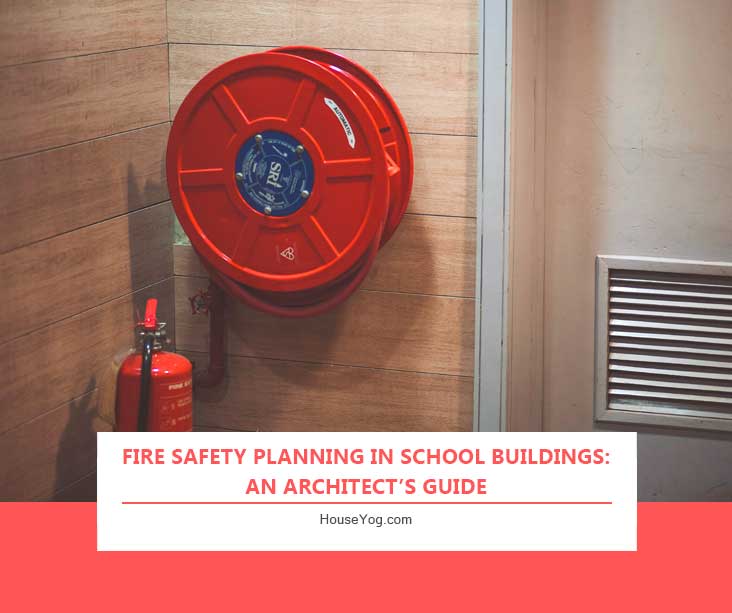

Fire safety planning is one of the most critical and often misunderstood aspects of school building design. Unlike residential or commercial buildings, schools accommodate large numbers of children who may panic, move slowly, or require guidance during emergencies.
Effective fire safety in school buildings is not achieved by adding exits at the end of the design process. It must be planned architecturally from day one, integrating classrooms, corridors, staircases, and open spaces into a clear, intuitive evacuation system.
This guide explains how architects plan fire exits, evacuation routes, and classroom–corridor–stair integration in school buildings, based on Indian fire norms and real-world school planning experience.
Why Fire Safety Planning Is Critical in Schools
School buildings function very differently from offices or apartments:
- Occupants are primarily children
- Movement happens in groups, not individually
- Evacuation must be simple, visible, and intuitive
- Teachers play a key role in guiding students
A well-designed fire safety system ensures:
- Fast, panic-free evacuation
- Clear escape paths without confusion
- Minimal dependence on signage or instructions
- Compliance with Indian fire norms and education board requirements
Poor planning, on the other hand, leads to bottlenecks, dead ends, and dangerous congestion, especially during peak hours.
Understanding Fire Safety in School Buildings
Fire safety in Indian schools is governed by:
- National Building Code (NBC) fire provisions
- State fire department regulations
- Education board infrastructure requirements (CBSE, ICSE, State Boards)
While codes define minimum standards, architectural planning determines whether those standards actually work during an emergency.
Key architectural objectives:
- Short travel distances
- Multiple, well-distributed exits
- Direct and visible evacuation paths
- Seamless connection between classrooms, corridors, and stairs
Fire Exits in School Buildings: Planning Principles
Fire exits form the backbone of fire safety in school buildings. Unlike other building types, schools must evacuate large groups of children quickly and safely, without confusion or panic. This section explains how architects plan the number, width, and location of fire exits so that everyday circulation paths naturally double as safe evacuation routes.
Fire exits should never feel like “special doors.” In well-designed schools, regular circulation paths double as evacuation routes.
Number of Fire Exits
- Each floor should have at least two remote exits
- Exit placement must ensure that no classroom depends on a single escape path
- Larger schools and multi-wing layouts require additional exits
Exit Width & Capacity
- Exit width must account for student density, not just floor area
- Wider staircases and corridors reduce panic and pushing
- Exit sizing should consider simultaneous evacuation, not staggered movement
Exit Location Strategy
Exits should be:
- Clearly visible from corridors
- Located at logical ends of circulation paths
- Free from sharp turns or visual obstructions
Dead-end corridors are among the most common and dangerous design mistakes in school buildings.
Evacuation Routes: Designing Clear & Intuitive Escape Paths
Evacuation routes determine how safely and quickly students can exit a school building during an emergency. In school design, evacuation paths must be simple, visible, and intuitive, allowing children to move in groups under teacher supervision. This section outlines the architectural principles used to design clear evacuation routes that function reliably under stress conditions.
A school evacuation plan should work even if lights fail or signage is ignored.
Key Characteristics of Good Evacuation Routes
- Straight, continuous movement paths
- Minimal direction changes
- Natural visibility toward stairs or exits
- No crossing of hazardous zones (labs, kitchens, storage)
Travel Distance Control
Classrooms should be planned so that exit access travel distances remain short and direct, allowing students to reach a protected corridor or staircase quickly during an emergency. From a fire safety perspective, compact classroom blocks consistently perform better than long, linear corridors, as they reduce travel distance, confusion, and evacuation time.
Avoiding Bottlenecks
Evacuation routes must be designed to prevent congestion at critical points. Sudden corridor narrowing near exits should be avoided, as it creates choke points during high-density movement. Doors should never swing into circulation paths, and stair entry zones must remain completely obstruction-free at all times to allow smooth and uninterrupted evacuation flow.
Classroom-Level Fire Safety Planning
Fire safety planning in schools begins inside the classroom itself. If exit access, door placement, and circulation paths are poorly planned at the classroom level, even well-designed corridors and staircases can fail during emergencies. This section explains how classroom layout directly influences evacuation speed and safety.
Since evacuation speed and exit access are directly influenced by classroom layout and seating density, it’s important to plan classroom dimensions carefully. You may find our guide on ideal classroom size for 35–40 students helpful for understanding how space planning affects safety and movement.
Door Placement & Swing Direction
Classroom doors should open outward, toward escape, and be placed toward the rear or side of the room rather than near the teaching wall. This placement reduces distractions during lessons and, more importantly, prevents crowding at exits during emergencies, allowing students to evacuate faster and more safely.
Classroom Exit Access
A clear circulation aisle, typically around 3 ft wide, should connect student seating directly to the classroom door. Furniture placement must never block this movement path, and items such as bags, shelves, or temporary storage should not intrude into exit routes. Unobstructed exit access inside the classroom significantly improves evacuation speed and reduces panic.
Visibility to Corridors
Vision panels or glazed strips in doors improve:
- Safety during evacuation
- Awareness of corridor conditions
- Day-to-day supervision
Corridor Design & Fire Safety Integration
Corridors act as the primary evacuation arteries in school buildings. Their width, continuity, and zoning directly affect how smoothly students can move from classrooms to staircases and exits. This section explains how corridor design integrates with fire safety planning to prevent congestion and confusion during evacuations.
Corridor Width & Continuity
Corridors in school buildings should maintain a consistent width throughout their length to support smooth and predictable movement during emergencies. Sudden reductions in width near staircases or exits create dangerous choke points and slow down evacuation. For effective fire safety planning, corridors must lead directly to staircases or exits, without passing through intermediate rooms or shared spaces that can confuse high-stress situations.
Corridor Zoning
Effective corridor zoning prevents congestion during both daily use and emergency evacuation. Classroom exits, washroom queues, and storage areas should not overlap within the same narrow corridor stretch. Separating these functions reduces crowding, confusion, and movement conflicts during peak occupancy and emergencies.
Staircase Planning for Safe Evacuation
Staircases are the most critical vertical evacuation elements in multi-storey school buildings. Their location, width, and design must support safe group movement by children during emergencies. This section covers key architectural principles for staircase planning in school fire safety design.
Staircase Location
Stairs should be:
- Clearly visible from corridors
- Located at logical ends or junctions
- Easy to reach without confusion
Hidden or poorly located staircases delay evacuation and increase panic.
Staircase Design Principles
- Adequate width for group movement
- Comfortable riser and tread proportions for children
- Continuous handrails on both sides
- No storage, services, or obstructions under stairs
Protected Staircases
Fire-rated staircase enclosures help prevent smoke spread and maintain safe evacuation paths during emergencies. Staircases should discharge directly to open ground level or clearly defined safe assembly areas, without forcing evacuees to pass through enclosed or hazardous zones.
Integration with the School Evacuation Plan
A school evacuation plan succeeds only when architectural design and operational procedures work together. Classroom layouts, corridors, staircases, and open spaces must support predictable and supervised movement during emergencies. This section explains how architects align building design with practical evacuation planning.
Fire safety planning must align with overall campus zoning, circulation networks, and building configuration. For a broader perspective on academic block planning, safety norms, and infrastructure layout, refer to our complete guide on planning a school building in India.
A good school evacuation plan depends on:
- Predictable classroom exit routes
- Simple teacher-led movement
- Direct access to open spaces or assembly areas
Architects must ensure that:
- Assembly areas are sized adequately
- Evacuation paths do not cross vehicle zones
- Routes remain usable even during peak occupancy
Fire drills succeed when the building layout supports natural movement, not when staff compensate for design flaws.
Common Fire Safety Planning Mistakes in Schools
From architectural reviews, these issues appear frequently:
- Long dead-end corridors
- Single-staircase academic blocks
- Narrow corridor sections near exits
- Classroom doors open inward
- Poor coordination between the classroom layout and the exit paths
Most of these problems are planning-stage errors and are expensive or impossible to fix later.
Fire Safety Is a Planning Decision, Not a Drawing Checklist
Fire safety in school buildings cannot be “added” after layouts are frozen. It must be embedded into classroom planning, corridor design, staircase positioning, and campus zoning.
Schools that perform well during safety audits usually share one trait:
Fire safety was considered from the first sketch, not at the approval stage.
Early fire safety planning also prevents costly design revisions later in the project. To understand how planning decisions influence overall budgets, you may also explore our guide on school construction cost in India, especially during feasibility and budgeting stages.
Fire Safety Starts at the Planning Stage
Effective fire safety planning protects lives, supports regulatory compliance, and builds long-term trust with parents, authorities, and education boards. In school buildings, safety outcomes are shaped far more by architectural planning decisions than by checklists added later.
If you are planning a new school or expanding an existing campus, integrating fire safety at the planning stage ensures that safety, usability, and learning environments work together.
For schools that require architectural planning, fire-compliant layouts, or end-to-end school design support, Houseyog works with promoters across India—from feasibility and zoning to detailed drawings and approvals.
If you found this guide useful, consider sharing it.