
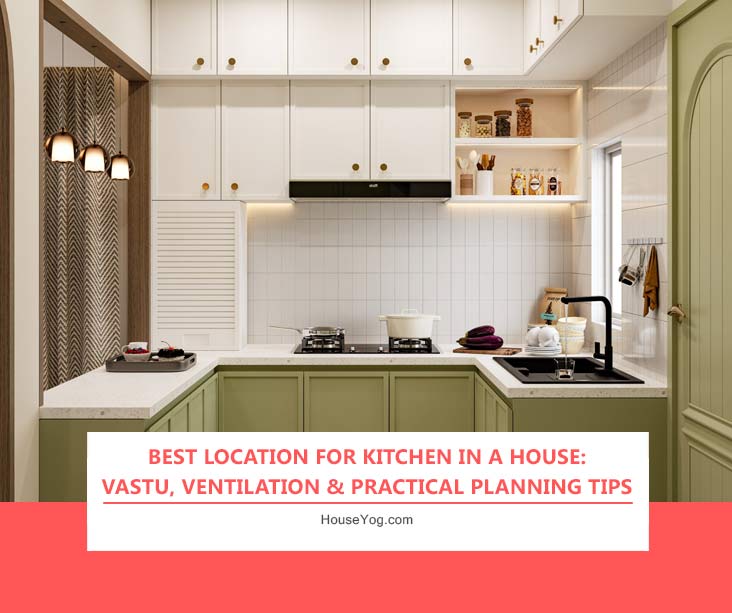

When you start planning your house, the kitchen is usually one of the most important spaces to get right. It is not just a cooking area anymore. The location of the kitchen affects daily movement, ventilation, hygiene, storage planning, family interaction, and even the overall comfort of the house.
That is why the location of your kitchen matters much more than you may initially realise. At the same time, kitchen placement is also closely connected with Vastu in India. Many families specifically look for a southeast kitchen (the Agni Kon), while others worry whether a north-west kitchen is acceptable or whether a kitchen in the north-east can create problems.
The challenge is that most online advice focuses only on directions and ignores practical planning. But in a real house, your kitchen location should work both functionally and contextually. Ventilation, plumbing lines, natural light, access to the dining area, and overall floor plan efficiency are equally important.
If you are planning your house and wondering about the best kitchen position in your house, then we have you covered. Today in this guide, we are discussing everything worth knowing about the best location for the kitchen, including:
- The best kitchen location according to Vastu
- How architects decide kitchen placement
- Kitchen planning mistakes to avoid
- The best kitchen position for different house facings
- What to do if the “ideal” kitchen direction is not possible
Whether you are planning a small house, apartment, duplex, or independent home, this guide will help you make a more informed decision.
Why Kitchen Location Matters in House Planning
The kitchen is one of the most utility-intensive spaces in your house. Unlike bedrooms or living rooms, it involves heat, smoke, water supply, drainage, appliances, and regular movement throughout the day.
A poorly located kitchen can create long-term issues such as:
- Poor ventilation
- Excessive heat buildup
- Inefficient movement
- Plumbing complications
- Dark interiors
- Smoke circulation into living spaces
On the other hand, a well-planned kitchen improves both functionality and comfort.
For example, when your kitchen is placed along an external wall, it becomes easier to provide windows, exhaust systems, and natural ventilation. Similarly, placing the kitchen close to the dining area improves daily usability and reduces unnecessary circulation.
When we design house plans, our architects at Houseyog also consider:
- Utility balcony access
- Gas pipeline routing
- Plumbing shaft alignment
- Natural daylight
- Movement between the kitchen and the dining room
- Privacy from the main entrance
So while Vastu may influence direction preference, practical planning plays an equally important role in deciding the best location for your kitchen.
Which is the Best Direction for the Kitchen as per Vastu?
According to traditional Vastu principles, the south-east corner is generally considered the best location for a kitchen. This zone is associated with the fire element, which aligns symbolically with cooking activities.
However, modern house planning should not depend on direction alone. A kitchen should also function efficiently in terms of ventilation, safety, workflow, and usability.
Let us understand the common kitchen directions in a more practical way.
South-East Kitchen (Most Preferred)
A kitchen in the south-east is widely considered ideal in Vastu. In many Indian house plans, this location also works practically because it allows better separation between private and service spaces.
Benefits of a south-east kitchen:
- Considered ideal in Vastu
- Works well for heat-generating activities
- Often easier to integrate with utility spaces
- Can reduce smoke movement into living areas if ventilated properly
If your plot orientation and floor plan allow it, the south-east zone is usually a safe and balanced option.
North-West Kitchen (Second Preferred Option)
If a south-east kitchen is not possible, the north-west direction is commonly considered the next suitable option.
This location is especially common in:
- Apartments
- Compact urban plots
- Duplex floor plans
- West-facing homes
A well-designed north-west kitchen can function perfectly if:
- Ventilation is properly planned
- Chimney placement is correct
- Natural light is available
- The layout remains efficient
In practical architecture, a well-ventilated north-west kitchen is often far better than a poorly planned south-east kitchen.
Is North-East Kitchen Good?
Traditionally, the north-east corner is usually avoided for kitchens in Vastu because it is associated with calmness, openness, and spiritual activities.
From a practical planning perspective, this area often works better for:
- Puja rooms
- Living spaces
- Open sit-outs
- Gardens or courtyards
However, many apartments and urban homes may not offer ideal directional flexibility. In such cases, proper ventilation, lighting, and planning become more important than blindly following directional rules.
Should You Avoid the Kitchen in the Centre of the House?
Yes, in most cases, the centre of the house is not an ideal location for a kitchen.
A centrally placed kitchen often creates issues such as:
- Poor ventilation
- Heat accumulation
- Smoke circulation
- Lack of natural light
- difficult exhaust routing
Architecturally, kitchens perform best when they connect to an external wall for ventilation and utility access.
Best Kitchen Location Based on House Facing
One of the biggest questions people ask during house planning is:
“Where should the kitchen be located based on my house’s orientation?”
The answer depends on both Vastu preferences and floor plan practicality.
Best Kitchen Location for North-Facing House
In a north-facing house, the south-east corner is usually preferred for kitchen placement.
This arrangement often works well because:
- It aligns with common Vastu recommendations
- It keeps service spaces away from the main northern entry
- It improves zoning within the floor plan
If the south-east placement is not feasible, the north-west can also work with proper planning.
Best Kitchen Location for South-Facing House
For south-facing homes, the south-east or east side generally works well for kitchen planning.
The main goal is to:
- Maintain proper ventilation
- Avoid excessive afternoon heat
- Ensure convenient circulation to dining spaces
In compact plots, architects may adjust kitchen placement slightly to optimise layout efficiency.
Best Kitchen Location for East-Facing House
East-facing homes often allow good flexibility for kitchen planning.
The south-east corner usually remains the preferred option because it aligns naturally with the overall orientation of the house.
This can also improve:
- Morning light access
- Ventilation opportunities
- Functional zoning
Best Kitchen Location for West-Facing House
In west-facing homes, north-west kitchens are quite common and often work efficiently.
However, west-facing plots can experience stronger afternoon heat. So proper shading, ventilation, and chimney planning become especially important.
Architects may also use:
- Ventilated utility areas
- Wider windows
- Exhaust shafts
- Thermal insulation strategies
This will help improve kitchen comfort.
How Architects Decide Kitchen Placement
In many of the house design projects, perfect directional placement is not always possible due to plot limitations and floor plan constraints.
This is where practical planning becomes far more important than simply choosing a direction.
When architects plan a kitchen, they usually evaluate how the space will function every day for years — not just how it appears on paper.
Here are some of the key factors considered during kitchen placement.
Ventilation and Airflow
A kitchen generates heat, smoke, moisture, and cooking odours daily.
That is why proper ventilation is critical.
Architects generally prefer placing kitchens along external walls because this makes it easier to provide windows, exhaust systems, chimney outlets and natural cross ventilation.
A kitchen without proper airflow can quickly become uncomfortable, especially in Indian cooking conditions where frying, tadka, and heavy cooking are common.
Proximity to Dining Area
A kitchen should feel connected to the dining space without disturbing privacy.
If the kitchen is placed too far away:
- Movement becomes inefficient
- Serving food becomes inconvenient
- Circulation increases unnecessarily
Modern Indian homes increasingly prefer layouts where the kitchen and dining work as connected functional zones.
Plumbing and Utility Efficiency
Kitchen placement also affects water supply routing, drainage lines, sink positioning and utility balcony access.
Poor plumbing planning can increase construction complexity and future maintenance issues.
This becomes especially important in apartments and duplex homes.
Natural Lighting
A kitchen with good natural light feels cleaner, brighter, and more usable.
Architects usually try to maximise daylight near the counter, window placement near sink areas and visual openness.
Natural lighting also reduces dependence on artificial lighting during the daytime.
Functional Work Triangle
A good kitchen layout maintains efficient movement between:
- Stove
- Sink
- Refrigerator
This is commonly known as the kitchen work triangle.
Poor placement can make even a large kitchen feel uncomfortable and inefficient.
Kitchen Locations You Should Generally Avoid
Some kitchen placements create recurring practical problems regardless of direction.
Kitchen Beside Toilet
This is usually avoided because of:
- Hygiene concerns
- Plumbing complications
- Unpleasant odours
- Reduced comfort
Even where space is limited, proper separation should ideally be maintained.
Kitchen Under Staircase
Under-stair kitchens are common in small homes, but are often not ideal for daily usability.
Common issues include:
- Reduced headroom
- Poor ventilation
- Cramped movement
- Heat buildup
This layout should generally be avoided if better alternatives exist.
Kitchen Without External Ventilation
A kitchen without windows or proper exhaust planning can become uncomfortable very quickly.
This is especially problematic in Indian cooking conditions.
If your kitchen cannot connect to an external wall, proper mechanical ventilation becomes extremely important.
Open Kitchen vs Closed Kitchen: Which Works Better?
Open kitchens have become increasingly popular in modern Indian homes, especially in apartments and compact urban houses.
An open kitchen can:
- Improve visual spaciousness
- Enhance family interaction
- Make smaller homes feel larger
However, it also requires stronger ventilation, efficient chimney systems, and better cleanliness management.
Closed kitchens, on the other hand, provide:
- Better smoke containment
- More privacy
- Easier separation of utility activities
The right choice depends on your lifestyle, cooking habits, family preferences, and floor plan design.
If you’re still unsure, read our detailed guide on Open kitchen Vs Closed kitchen to make an informed decision.
What If the Ideal Kitchen Direction Is Not Possible?
One common mistake we often notice in Indian homes is prioritising kitchen direction while ignoring ventilation and usability completely.
This is extremely common in real projects.
Many plots and apartments simply do not allow perfect directional placement.
In such cases, functionality should take priority over rigid directional rules.
A practical kitchen with good ventilation, efficient layout, natural light, proper storage, and comfortable circulation will usually perform much better than a directionally ‘ideal’ kitchen with poor planning.
If your preferred kitchen direction is not possible, focus on:
- Strong exhaust systems
- Proper chimney placement
- Brighter interiors
- Effective workflow
- Practical utility planning
This creates a more comfortable and usable kitchen in the long run.
Common Kitchen Planning Mistakes to Avoid
Even a good kitchen location can fail because of poor detailed planning.
Some very common mistakes include:
Ignoring Ventilation
Many kitchens look attractive initially, but become uncomfortable because ventilation was treated as an afterthought. In many of the urban homes, ventilation problems become noticeable only after the family starts using the kitchen daily. So, never ignore ventilation.
Poor Counter Planning
Insufficient counter space creates long-term usability problems.
Always consider appliance placement, preparation area, sink spacing, and storage access.
Wrong Sink and Stove Positioning
Placing the sink and stove too close together often reduces efficiency and comfort.
Balanced spacing improves workflow significantly.
Dark Kitchen Interiors
Natural light matters more than many people realise.
A bright kitchen feels cleaner, more spacious, and easier to work in.
Oversized Kitchen With Poor Movement
Bigger is not always better.
An excessively spread-out kitchen can increase unnecessary movement and reduce efficiency.
Good kitchen planning is about smart functionality, not just size.
A Practical Approach to Kitchen Planning
In most modern homes, the best kitchen location is usually the one that balances ventilation, movement efficiency, natural light, utility access, and family preferences together.
Instead of focusing only on direction, homeowners should also evaluate how comfortably and efficiently the kitchen will function in everyday life.
A well-planned kitchen should improve usability, workflow, comfort, and long-term convenience — not just satisfy directional preferences.
FAQs About Kitchen Location in Your House
South-east is traditionally considered the best kitchen direction in Vastu because it is associated with the fire element.
Yes. A north-west kitchen can work well if ventilation, natural light, and layout planning are properly managed.
North-east kitchens are generally avoided in traditional Vastu, but proper ventilation and practical planning are often more important in modern homes.
Good ventilation helps reduce heat, smoke, moisture, and cooking odours while improving comfort and indoor air quality.
Yes. A kitchen positioned close to the dining area improves movement efficiency and daily usability.
Both can work well. Open kitchens improve spaciousness and interaction, while closed kitchens provide better smoke control and privacy.
Final Thoughts
The best location for your kitchen is the one that balances:
- Practical usability
- Ventilation and natural light
- Movement efficiency
- Plumbing logic
- Your family’s preferences
- Vastu considerations if important to you
While the south-east corner is traditionally considered ideal, real-life house planning often requires flexibility.
A thoughtfully planned kitchen with good ventilation, efficient workflow, and comfortable daily usability will always serve you better than blindly following directional rules without considering practicality.
If you are planning your house layout, it is always worth evaluating kitchen placement early in the floor planning stage itself. Small planning decisions at this stage can make a major difference in how comfortable and functional your home feels for years to come.