
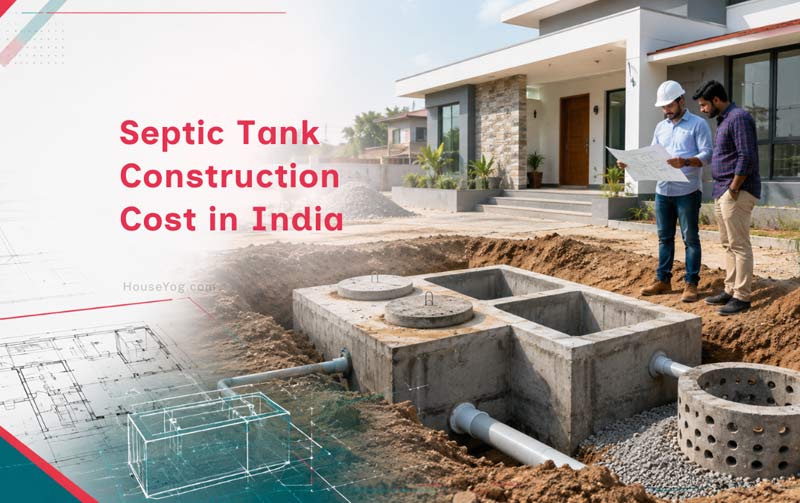

Planning a new home involves dozens of decisions, and one of the most overlooked is the septic tank. Since it’s built underground, many people don’t think much about it until construction begins. By then, questions start coming up: How much will it cost? What size do I need? Is a soak pit included?
Although many urban areas are now connected to municipal sewer networks, septic tanks remain the most common wastewater treatment solution for independent houses in many parts of India, especially in villages and small towns.
The good news is that estimating the cost isn’t complicated. For most residential houses, the budget mainly depends on the size of the septic tank, the number of people using it, soil conditions, and local construction costs.
In this guide, we’ll help you understand the typical septic tank construction cost in India, what’s generally included in the estimate, and how to budget realistically for your home.
If you’re planning the overall budget for your new home, you may also find our guide on house construction cost per sq ft in India helpful for estimating the total project cost before breaking it down into individual components.
How Much Does It Cost to Build a Septic Tank in India?
A residential RCC septic tank for an independent house in India typically costs between ₹50,000 and ₹1.40 lakh, including excavation, construction, labour, inlet and outlet pipes, vent pipe, covers, and a standard soak pit.
The final cost depends on the recommended tank capacity, site conditions, material prices, and local labour rates.
Recommended Septic Tank Size & Estimated Construction Cost
The recommended septic tank size and construction cost depend primarily on the number of occupants rather than the size of the house alone. The table below provides indicative tank capacities and estimated construction costs for common residential house types in India, helping you plan a realistic budget for your project.
| House Type | Typical Occupancy | Recommended Tank Capacity* | Estimated Construction Cost |
| 1 BHK | 2–4 persons | 4,000–5,000 litres | ₹50,000–₹70,000 |
| 2 BHK | 4–6 persons | 5,000–6,500 litres | ₹60,000–₹85,000 |
| 3 BHK | 5–8 persons | 6,500–8,000 litres | ₹75,000–₹1.10 lakh |
| Duplex / 4 BHK | 8–10 persons | 8,000–10,000 litres | ₹1.00–₹1.40 lakh |
The capacities mentioned here are indicative. Your architect or engineer should always size the septic tank according to the expected occupancy and applicable local regulations.
As a practical rule, it is always better to size the septic tank based on future occupancy rather than the current family size. A slightly larger tank generally performs better over the long term and reduces the frequency of cleaning.
What Does the Construction Cost Usually Include?
When contractors quote a septic tank construction cost, it usually covers the complete civil work required for a standard residential installation.
| Usually Included | Usually Excluded |
| Excavation | Long external sewer pipelines |
| RCC or brick masonry septic tank | Landscaping restoration |
| Internal plastering & waterproof finish | Pumping systems (if required) |
| Inlet & outlet pipes | Municipal approval charges (if applicable) |
| Vent pipe & covers | Future desludging and maintenance |
| Standard soak pit | Electrical work |
The exact scope may vary from one contractor to another. Before comparing quotations, always check whether the soak pit, vent pipe, covers, excavation, and backfilling are included. A cheaper quote may simply exclude some of these items.
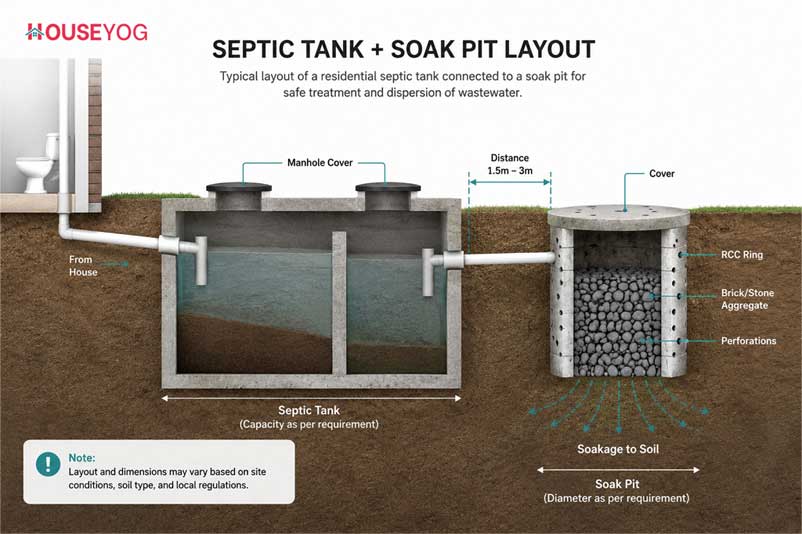
Typical Residential Septic Tank and Soak Pit Layout
Wastewater from the house first enters the septic tank, where solids settle and undergo partial treatment. The treated effluent then flows into the soak pit, allowing it to gradually percolate into the surrounding soil.
The actual layout and dimensions should always be designed based on occupancy, soil conditions, and local building regulations.
What Affects Septic Tank Construction Cost?
Although the average cost range is fairly predictable, every site is different. The following factors have the biggest influence on the final construction cost.
1. Tank Capacity
The size of the septic tank is the single biggest cost factor. Larger tanks require more excavation, concrete, steel, bricks, and labour. Instead of designing the tank only for your current family, consider future requirements if you plan to expand the house or expect more occupants over time.
2. Soil and Excavation Conditions
A plot with soft soil is generally easier and cheaper to excavate than one with rocky strata or a high groundwater table. If deeper excavation or additional safety measures are required, the overall cost increases.
3. RCC vs Brick Masonry Construction
Most modern homes prefer RCC septic tanks because they are stronger, more durable, and less prone to leakage. Brick masonry tanks can still be suitable in certain situations, but the right choice depends on soil conditions, structural requirements, and local construction practices.
4. Material Prices
The cost of cement, steel, bricks, sand, and aggregates varies across cities and even from one season to another. This is why septic tank construction costs in metropolitan cities are usually higher than in smaller towns.
5. Labour Charges
Labour rates differ significantly across India. Skilled masons, bar benders, shuttering carpenters, and helpers all contribute to the overall construction cost.
6. Site Accessibility
A site with limited working space, narrow access roads, or restricted equipment movement often takes more time to build, increasing labour costs.
How to Estimate the Right Budget for Your House
The easiest way to estimate your budget is to start with the recommended tank size rather than trying to calculate every material individually.
For example, suppose you’re building a 1,200 sq ft, 3 BHK house that will be occupied by a family of five or six. In most parts of India, you can generally budget ₹75,000 to ₹90,000 for a standard RCC septic tank with a soak pit under normal site conditions.
If your plot has hard rock, a high water table, or requires unusually deep excavation, keeping an additional 10–15% contingency is a sensible approach.
This method gives you a practical estimate without getting into unnecessary engineering calculations.
For a more detailed estimate of your overall project, including major materials and construction stages, you can also refer to our house construction material estimation guide.
Practical Tips to Save Money Without Compromising Quality
A septic tank is expected to last for decades. Saving a small amount during construction can sometimes lead to expensive repairs later. Instead, focus on making smart decisions from the beginning.
Choose the right size instead of the cheapest design. An undersized tank fills up quickly and requires more frequent cleaning.
Plan the septic tank location during the architectural planning stage. Relocating it after construction starts can increase both labour and plumbing costs.
Compare quotations based on the scope of work rather than the total price alone. Two contractors may quote different amounts simply because one includes the soak pit while the other doesn’t.
Finally, make sure the tank remains accessible for future desludging. Covering it permanently with landscaping or permanent structures can make maintenance difficult and costly.
Architect’s Recommendation
In our experience, the best septic tanks are not necessarily the most expensive ones. They are the ones that are properly sized, correctly located, and built using good construction practices.
Before finalising the layout, consider:
- The expected number of occupants over the next 15–20 years.
- Soil conditions and groundwater level.
- Adequate distance from the building foundation and drinking water sources.
- Easy access for periodic cleaning and maintenance.
A well-planned septic tank can serve your home reliably for decades with minimal maintenance.
Frequently Asked Questions
For most residential houses, the construction cost ranges from ₹50,000 to ₹1.40 lakh, depending on the tank capacity, site conditions, and local labour and material costs.
In many residential projects, yes. However, the scope varies between contractors, so always confirm whether the soak pit is included in the quotation.
RCC septic tanks are generally preferred for modern homes because they offer better strength, durability, and water-tightness. The final choice should depend on the site conditions and your engineer’s recommendation.
A family of five usually requires a septic tank with a capacity of around 5,000 to 6,500 litres, although the final design should be prepared by your architect or engineer.
Yes, provided it is properly designed and structurally capable of carrying the expected load. This should always be considered during the design stage.
A properly designed and well-constructed RCC septic tank can last 40–50 years or more with periodic inspection and regular desludging.
Final Thoughts
For most independent homes in India, budgeting ₹50,000 to ₹1.40 lakh is generally sufficient for a well-designed residential septic tank, depending on its capacity and site conditions.
Rather than focusing only on the lowest construction cost, pay attention to the tank size, construction quality, and proper placement. A well-built septic tank is a long-term investment that can provide decades of trouble-free service while reducing maintenance costs. Investing in the right septic tank during construction is far cheaper than correcting drainage or wastewater problems after the house is complete.
If you’re planning a new house and need professional help with architectural design, realistic cost estimation, or construction planning, Houseyog’s architects can help you plan every stage of your project. You can also explore our collection of free house plans with dimensions for design ideas and inspiration before starting construction.