
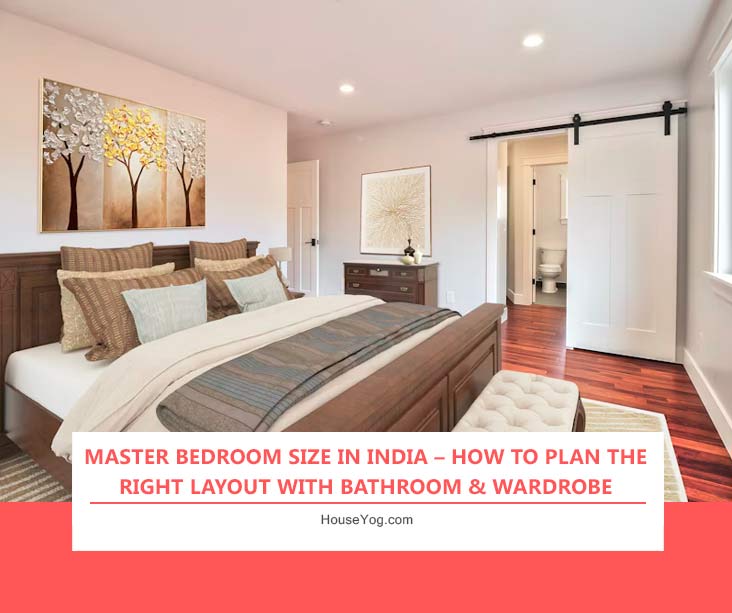

Why do some master bedrooms in India feel smaller than they actually are? In most cases, the issue is not the room size, it’s the bedroom layout.
In many Indian homes, the master bedroom looks fine on paper but feels uncomfortable in daily use.
You may have seen this in real homes:
- The bed fits, but movement feels tight
- The wardrobe is usable, but inconvenient to access
- The bathroom is attached, but it disrupts the layout
Interestingly, this problem is rarely about choosing a small room size. It usually comes from fixing the master bedroom size too early, based on assumptions rather than actual layout planning.
This is why understanding the ideal master bedroom size in India requires looking beyond standard dimensions and focusing on layout, furniture placement, and movement space.
A master bedroom is expected to do more than just accommodate a bed or a wardrobe. It combines sleeping, storage, dressing, and bathroom access in one space. Because of this, the ideal master bedroom size in India depends less on standard dimensions and more on how these elements are arranged together.
This guide focuses on that exact aspect, how to decide the right size based on layout, not assumptions.
If you’re unsure about general room dimensions, you can refer to our detailed guide on standard bedroom sizes in India.
What Actually Defines a Master Bedroom
A master bedroom is not simply a larger version of a regular bedroom. It is the most actively used private space in the house, and its layout, size and planning need to reflect that.
In practical terms, a master bedroom typically includes:
- A queen or king-size bed
- A wardrobe or dressing area
- An attached bathroom
What makes it different is not just the number of elements, but how frequently they are used together. This is where the master bedroom layout becomes critical. Even a reasonably sized bedroom can feel inefficient if movement between these elements is not planned properly.
So instead of asking ‘what is the standard master bedroom size’, a better question is: how should this space function every day?
Thinking in Layout First, Size Second
A more practical way to decide the master bedroom layout size is to start with what the room needs to accommodate, and then arrive at the size.
Here is a simplified reference:
| Layout Requirement | Practical Size Range |
| Bed + minimal movement | ~12 x 12 ft |
| Bed + wardrobe | ~12 x 14 ft |
| Bed + wardrobe + additional function | ~14 x 16 ft |
| Full master suite | ~16 x 18 ft or more |
These are not rigid rules, but they reflect how space expands as you add real-life usage.
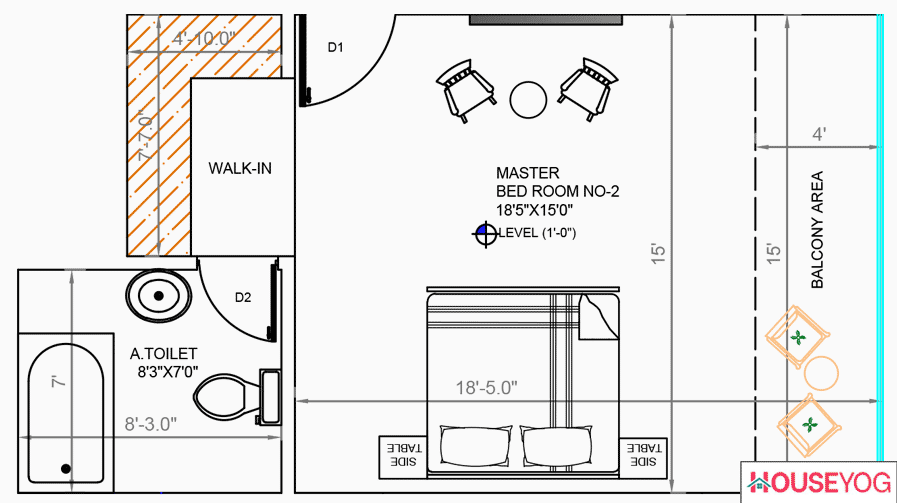
Where a 12×14 Bedroom Works—and Where It Starts Failing
A 12×14 ft room is often considered a safe choice for a master bedroom. In many cases, it works well. But in real use, its performance depends entirely on how the layout is planned. This is also the most common size where layout mistakes start showing up clearly.
When planned properly, this size can comfortably include:
- A bed
- A wall-mounted wardrobe
- Basic circulation space
However, problems start appearing when:
- The wardrobe blocks movement
- The bathroom cuts into usable wall space
- The door positions interfere with circulation
This is why two bedrooms with the same 12×14 dimensions can feel very different in practice.
The takeaway is simple: At this size, layout precision matters more than the size itself.
The Real Impact of an Attached Bathroom
Adding a bathroom is where the master bedroom layout often becomes complicated.
On paper, a bathroom may only take 30–50 sq ft. In reality, it influences:
- Wall availability for wardrobes
- Circulation paths within the room
- Visual privacy from the bed
A poorly placed bathroom can make the room feel smaller than it actually is.
For example:
- A front-facing bathroom door can disrupt the entire layout
- A centrally placed bathroom reduces the flexibility for furniture
- A side-entry bathroom usually allows better planning
This is why a master bedroom with an attached bathroom should always be planned as a single layout unit, not as two separate spaces.
Wardrobe Planning: The Most Underrated Factor
In most master bedrooms, the wardrobe is the largest continuous element. But it is often planned last.
This creates avoidable constraints.
The real challenge is not fitting the wardrobe, but ensuring it works comfortably:
- Can the shutters open fully?
- Is there enough standing space?
- Does it interfere with the bed or movement path?
Even the type of wardrobe changes how the room behaves:
- Sliding wardrobes are more space-efficient
- Hinged wardrobes need additional clearance
In smaller rooms, this difference becomes significant in practical use.
A well-planned wardrobe can make a room feel organised and open. A poorly planned one can make the same room feel tight and inconvenient.
Proper wardrobe planning is often what determines whether a bedroom feels spacious or cramped.
Wardrobe planning also plays a role in how comfortable and restful your bedroom feels, especially in terms of clutter and visual space.
How Room Size Changes the Experience
To understand this better, it helps to visualise how different sizes feel in real use.
A 12×14 ft bedroom is efficient and workable, but requires careful planning. It is best suited for compact homes where every inch needs to be optimised.
A 14×16 ft bedroom offers more flexibility. It allows additional functions like a study or a dresser without affecting movement. The room feels more comfortable, especially for daily use.
A 16×18 ft or larger bedroom moves into a different category. It allows spacing between elements, making the room feel relaxed rather than tightly arranged. This is where features like seating or walk-in wardrobes become viable.
The shift here is not just in size—it is in usability, comfort, and how the room feels on a daily basis.
Common Planning Mistakes That Reduce Usability
Most issues in master bedrooms do not come from a lack of space – they come from avoidable planning mistakes.
One of the biggest problems is ignoring circulation space. When there isn’t enough room to move around the bed or stand comfortably in front of the wardrobe, the room starts feeling restrictive, regardless of its size.
Another common mistake is choosing furniture before finalising the layout. Oversized beds, especially king-size beds in compact rooms, often reduce usable space more than expected.
Bathroom placement also creates issues when it is added as an afterthought. Poorly positioned doors can affect both privacy and furniture arrangement, making the room harder to use.
Wardrobes are another frequent problem area. When they are designed without considering door clearance and daily usage, they interfere with movement and reduce comfort.
Flats vs Independent Homes: Context Matters
The ideal master bedroom size also depends on the type of home you are planning.
In flats, space is usually limited, so sizes like 12×12 or 12×14 ft are common. Here, efficient layout planning becomes more important than increasing size.
In independent homes, there is more flexibility. Sizes like 14×16 ft or larger allow better comfort and additional features. The focus shifts from fitting everything in to creating a more relaxed and functional space.
So, What Size Should You Actually Choose?
If you’re deciding the ideal master bedroom size for your home, this simple framework can help:
- If your home is compact and space is limited, a 12×14 ft master bedroom is a reliable starting point, but only with careful layout planning
- If you want more flexibility and comfort, a 14×16 ft layout works better for most families
- If space allows, a 16×18 ft or larger room offers long-term comfort and adaptability
The key is to choose a size that supports your daily use, not just one that fits into a plan.
FAQs
For most homes, 12×14 ft to 14×16 ft works well, depending on layout, wardrobe, and bathroom planning.
It can work for basic use, but it becomes restrictive when adding wardrobes and an attached bathroom.
Typically, a 6–8 ft wide wardrobe is sufficient, but clearance space in front is equally important.
A master suite usually starts from 16×18 ft or larger, allowing for additional features like seating or walk-in wardrobes.
Final Thought
A master bedroom is one of the most used spaces in your home. Even small planning decisions—like wardrobe placement or bathroom entry- can affect how comfortable the room feels every day.
That’s why it’s important to think beyond just the room size and focus on how the space will actually function once you start using it.
Need Help Planning Your Layout?
At Houseyog, we offer end-to-end architectural design services, where our architects approach every house design project from a practical perspective, balancing size, layout, and usability.
If you’re planning your home, getting the layout right at the beginning can make a significant difference in how the space feels later.
Getting the layout right at the planning stage can prevent costly design compromises later.