
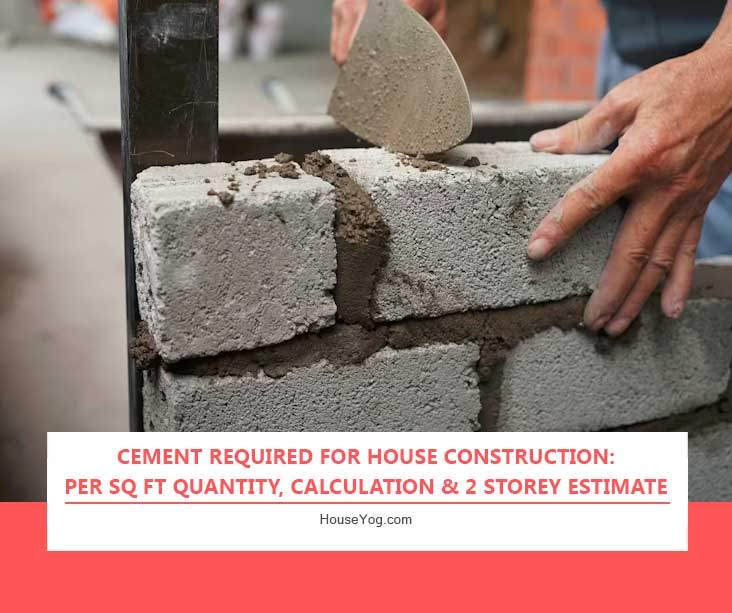

When you plan your house construction, one of the first material questions that affects your budget is how much cement will be required.
Cement is used in foundations, columns, slabs, brickwork, plastering and several other structural components. Yet, many homeowners receive only rough estimates from contractors such as “400–500 bags for 1000 sq ft,” without any explanation of how that number was derived. This creates confusion, budgeting errors, and sometimes material shortages or wastage during construction.
In this detailed guide, we will explain:
- Cement required per sq ft for residential construction
- Cement quantity calculation for a house using the proper method
- A 1000 sq ft worked example
- Cement required for 2 storey house with 2000 sq ft, example
- Component-wise breakdown (foundation, slab, brickwork, plaster)
This guide focuses on structural and masonry work in typical Indian RCC residential buildings. It does not include interior finishing materials such as tiles adhesive, putty, decorative plaster, or false ceiling work.
The goal is to help you understand cement consumption in residential buildings logically, so your India construction cost estimation is based on calculation, not guesswork.
Quick Answer: Cement Required for House Construction
For a typical RCC residential building in India:
- Single-storey house: 0.35–0.45 cement bags per sq ft
- Double-storey house: 0.40–0.50 cement bags per sq ft
- 1000 sq ft house: 400–500 bags
- 2000 sq ft (2 storey): 900–1000 bags
Actual quantity depends on structural design, soil condition, slab thickness and foundation depth.
How Much Cement Is Required Per Sq Ft?
For a typical RCC (Reinforced Cement Concrete) residential building in India, the cement required per sq ft generally falls within the following range:
| Type of Structure | Cement Bags per Sq Ft (50 kg bags) |
| Single Storey RCC House | 0.35 – 0.45 bags |
| Double Storey RCC House | 0.40 – 0.50 bags |
This means:
- A 1000 sq ft single-storey house may require 350–450 cement bags.
- A 1000 sq ft double-storey house may require 400–500 cement bags (considering total built-up area).
These numbers represent the total cement required for house construction, including foundation, columns, beams, slabs, brickwork and plastering.
Why Does Cement Requirement Vary?
The number of cement bags per sq ft is not fixed. It varies due to:
1. Soil Bearing Capacity (SBC)
Weak soil requires larger footings and deeper foundations, increasing cement consumption.
Wider column spacing means larger beam sizes. More load means more concrete volume.
3. Slab Thickness
Standard slab thickness is 4–5 inches. Thicker slabs increase the RCC slab cement quantity.
4. Structural Design
A structure designed for future expansion (G+1 provision) will consume more cement even if only the ground floor is built initially.
5. Foundation Depth
Black cotton soil or filled land increases foundation volume significantly.
Therefore, while thumb rules help in budgeting, accurate cement quantity calculation for a house must be based on drawings.
Cement Required for 1000 Sq Ft House
Let us calculate how much cement is required for a 1000 sq ft house using an average value.
Assume: Cement required per sq ft = 0.45 bags
Step 1: Calculate Total Bags
1000 sq ft × 0.45 bags per sq ft = 450 bags
Step 2: Convert Bags to Weight
Each bag = 50 kg
450 × 50 kg = 22,500 kg
= 22.5 metric tonnes
So, cement bags required ≈ 450 bags
Total cement weight ≈ 22.5 MT
This is a realistic estimate for an RCC-framed residential structure in India.
In practice, most residential projects use design-mix concrete for structural members. Therefore, the final cement quantity should always be verified from structural drawings and mix design specifications.
Built-up Area-Wise Cement Consumption Comparison
| Built-up Area | Avg Bags (0.45) | Avg Bags (0.45) |
| 1000 sq ft | 450 | 400–500 |
| 1200 sq ft | 540 | 480–600 |
| 1500 sq ft | 675 | 600–750 |
| 2000 sq ft | 900 | 800–1000 |
Why Actual Site Quantity May Differ
- Extra wastage due to improper storage
- Design changes during construction
- Thicker plaster application
- Additional structural strengthening
- Site mix vs RMC variation
For overall budgeting, you can also read our detailed guide on steel quantity for house construction to understand the combined material impact.
Cement Required for 2 Storey House (2000 Sq Ft Example)
Now, let us estimate the cement required for a 2-storey house with a total built-up area of 2000 sq ft (1000 sq ft per floor).
Assume average consumption: 0.45–0.50 bags per sq ft
Estimated Range
2000 × 0.45 = 900 bags
2000 × 0.50 = 1000 bags
So total cement requirement range: 900 – 1000 bags
You can also read our detailed guide on steel quantity for house construction to understand how cement and steel together affect structural material planning.
Approximate Distribution of Cement Consumption
| Component | Approx % of Total Cement |
| Foundation | 15–20% |
| Columns & Beams | 20–25% |
| Slabs | 25–30% |
| Brickwork | 15–20% |
| Plaster | 10–15% |
For 950 bags total (mid value):
- Foundation: ~160–180 bags
- RCC (columns + slabs): ~450–500 bags
- Brickwork + plaster: ~250–300 bags
This breakdown provides clarity on residential building material quantity planning.
To understand how cement impacts the overall construction cost in India, see our construction cost guide for India.
Cement Required for Different Components in a Residential Building
This section provides more technical clarity.
Cement for Foundation
Foundation typically consumes 15–20% of total cement.
It includes:
- PCC (Plain Cement Concrete)
- Footings
- Pedestals
If the total cement is 500 bags, the foundation may consume 75–100 bags, depending on soil conditions.
A deeper footing increases the cement required for the foundation significantly.
Cement for RCC Slab
For slab, M20 concrete is commonly used in residential construction.
Typical M20 concrete cement requirement:
Approx 8 bags per cubic meter (cum)
If slab volume = 20 cubic meters:
20 × 8 = 160 bags
RCC slab cement quantity depends on:
- Slab thickness
- Beam size
- Cantilever projections
- Staircase concrete
Cement for Brickwork
Brickwork usually uses a mortar ratio of 1:6 (cement: sand).
Approximate cement required per 1000 bricks:
6–8 bags (depending on joint thickness)
In a typical 1000 sq ft house with 9-inch external walls and 4.5-inch internal walls, brickwork may consume approximately 70–90 cement bags.
This forms a significant part of the cement for brickwork calculation.
Cement for Plastering
Cement for plastering depends on thickness and ratio (usually 1:4 or 1:6).
Typical cement consumption:
1.2–1.5 bags per 100 sq ft (12 mm plaster thickness)
If the total plaster area is 2500 sq ft:
Approx 30–40 bags required.
Plaster wastage is common if supervision is weak.
Cement Quantity Calculation Formula (Step-by-Step)
For accurate cement quantity calculation for a house, follow this method.
Step 1: Calculate Concrete Volume
For example, slab volume:
Length × Width × Thickness
Convert dimensions to meters.
Suppose: 10 m × 10 m × 0.125 m = 12.5 cubic meters
Step 2: Convert Wet Volume to Dry Volume
Dry Volume = Wet Volume × 1.54
12.5 × 1.54 = 19.25 cubic meters
The factor 1.54 accounts for voids and shrinkage.
Step 3: Apply Mix Ratio
For M20 nominal mix (1:1.5:3):
Total ratio = 1 + 1.5 + 3 = 5.5
Cement proportion = Cement ratio / Total ratio
= 1 / 5.5
Cement volume = 19.25 × (1/5.5)
= 3.5 cubic meters (approx)
Step 4: Convert to Bags
1 cubic meter of cement ≈ 28.8 bags
3.5 × 28.8 ≈ 100 bags
This is the scientific cement calculation formula method.
Thumb Rule for Quick Cement Estimation
For quick budgeting:
- 0.4–0.5 bags per sq ft for RCC house
- 400–500 bags per 1000 sq ft
These thumb rules for cement values are suitable for early-stage planning, not final procurement.
You can also use our construction cost calculator to estimate structural material budgets.
Why Cement Quantity Increases in a 2 Storey House?
A double-storey structure consumes more cement per sq ft due to:
1. Higher Column Size: Lower floor columns carry upper floor load, increasing concrete volume.
2. Larger Footing: The foundation must support the total structural load.
3. Staircase Concrete: Additional RCC for staircase slab and landings.
4. Parapet Walls: Extra masonry and plastering.
5. Additional Structural Reinforcement: More beams and tie elements for stability.
Therefore, the cement required for 2 storey house per sq ft is slightly higher than single-storey construction.
FAQs
For an RCC house, estimate 0.4–0.5 bags per sq ft.
1200 × 0.45 ≈ 540 bags.
Actual consumption depends on structural design and soil conditions.
Using 0.45 bags per sq ft:
1500 × 0.45 = 675 bags.
A two-storey structure may require slightly more due to additional load-bearing elements.
For M20 concrete, approximately 8 bags per cubic meter are required.
This may vary slightly depending on design mix and site conditions.
For a 4–5 inch thick RCC slab, cement consumption may range between 0.08–0.12 bags per sq ft. The exact quantity depends on slab thickness and beam depth.
Yes. Due to larger columns, stronger foundation, and additional structural components, cement consumption per sq ft increases slightly compared to single-storey houses.
Final Thoughts on Cement Estimation
Cement estimation should never be based purely on verbal contractor estimates. The cement required for house construction depends on structural drawings, soil condition, slab thickness and masonry volume.
Thumb rules, such as 400–500 bags per 1000 sq ft, are useful for early budgeting, but proper cement quantity calculation for a house must follow the volume-based method.
Before finalising procurement:
- Verify quantities from structural drawings
- Check the mix design and concrete grade
- Plan storage to avoid moisture damage
- Monitor consumption during execution
For homeowners who want structured residential building material quantity planning, consider preparing a detailed BOQ before starting construction. You may also consult Houseyog for estimation support or explore our BOQ template to manage material planning professionally.
Accurate planning reduces wastage, prevents budget shocks, and ensures smoother construction execution.