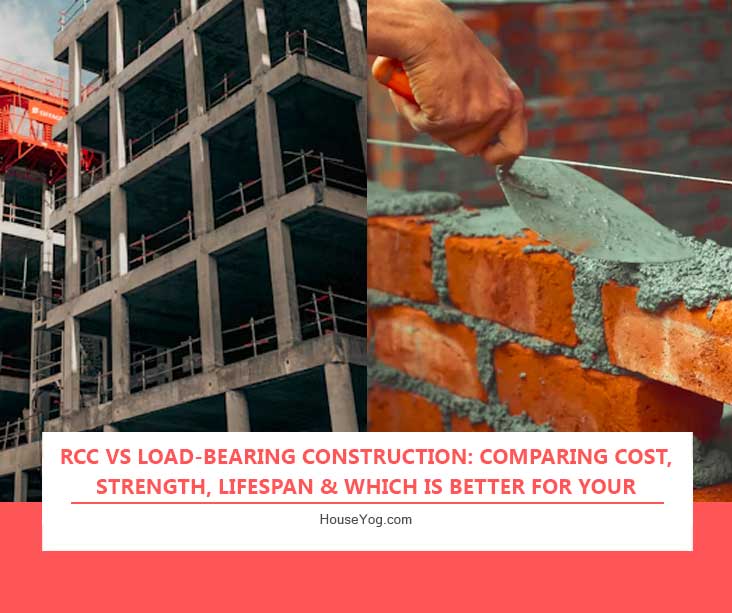
When planning a new house in India, one of the earliest structural decisions you’ll face is this: RCC vs load-bearing construction, which system should you choose for your house?
At first glance, the difference may sound technical. But this decision directly affects your construction cost, structural strength, earthquake safety, foundation design, construction speed, and even your ability to add future floors.
In many smaller towns and villages, load-bearing houses are still common. In urban and semi-urban areas, RCC framed construction has become the dominant choice. However, neither system is automatically “better” in every situation.
Understanding the difference between RCC and load-bearing construction, in terms of cost, safety, soil suitability, lifespan, and long-term flexibility, helps you make a confident, informed decision instead of relying purely on contractor preference.
Before we go deeper into the details, here’s a quick comparison to set the context.
RCC vs Load-Bearing Construction: Quick Comparison
The table below summarises the key differences between RCC and load-bearing construction in terms of cost, strength, lifespan, soil suitability, and future expansion flexibility.
Factor
RCC Framed Structure
Load-Bearing Structure
Structural System
Columns & beams carry the load
Walls carry the structural load
Initial Cost
Slightly higher in small houses
Slightly lower for a single floor
Foundation Type
Isolated/combined footings
Continuous wall footing
Earthquake Resistance
Better (if designed properly)
Limited flexibility
Future Floor Addition
Easier to expand vertically
Difficult beyond 1–2 floors
Construction Speed
Faster with proper planning
Slower masonry-intensive
Wall Thickness
4.5–6 inches possible
9–13.5 inches typically
Design Flexibility
High
Limited
Lifespan
50+ years (proper maintenance)
40–60 years (quality dependent)
Best Suitable For
Urban plots, multi-floor plans
Small single-floor homes
Next, let’s understand how each structural system works in practice.
What Is RCC Framed Construction?
Reinforced Cement Concrete (RCC) framed construction is a structural system where columns and beams form the main load-carrying skeleton of the building.
In simple terms:
The slab load transfers to the beams
Beams transfer load to columns
Columns transfer load to the foundation
Because the structural frame carries the load, walls can be modified or relocated more easily without affecting overall stability (subject to structural review).
The walls in an RCC structure are mostly non-load-bearing partitions. They divide space but do not carry the structural load of the building.
This separation between structural frame and walls gives RCC construction its biggest advantages:
In most urban and semi-urban residential projects across India today, RCC framed construction is the preferred system, especially where owners plan for G+1 or future floor additions.
However, RCC construction requires:
Proper structural design
Reinforcement detailing
Quality-controlled concrete mixing
Skilled supervision during slab casting
Without engineering discipline, even RCC can perform poorly.
What Is Load-Bearing Construction?
In load-bearing construction, walls themselves carry the weight of the slab and roof above.
There is no separate column-beam frame; the masonry walls themselves act as structural elements. The load path typically flows like this:
Slab to Wall, to Continuous Wall Footing to Soil
The walls are usually thicker (9 inches or more) because they must carry vertical loads safely.
Load-bearing construction has traditionally been used in:
Village houses
Small-town single-floor homes
Budget-driven residential projects
Low-rise structures (typically up to G+1 with limitations)
The advantages of load-bearing construction include:
Slightly lower initial cost for small single-floor houses
Simpler execution
Less steel consumption
Familiarity with traditional masons
However, the system has structural limitations:
Limited flexibility in layout
Difficulty in modifying walls later
Restricted vertical expansion
Higher risk if the soil bearing capacity is not adequate
This is why, over time, urban construction in India has shifted strongly toward RCC-framed structures.
RCC vs Load-Bearing Construction: Cost Comparison
Cost is usually the first reason this debate starts.
Many times, we assume that “Load-bearing is cheaper, RCC is expensive.”
That is partially true. But only in certain situations.
For a Small Single-Floor House (600–900 sq ft)
Load-bearing construction may reduce cost slightly because:
No heavy column reinforcement
Less steel consumption
Simpler foundation design (continuous wall footing)
Lower structural engineering involvement
In small single-floor houses of 600–900 sq ft, the structural system may influence total construction cost by roughly 3–7%, depending on steel rates, brick prices, soil condition, and location.
However, this difference reduces when:
Soil requires a stronger foundation
Brick rates are high
Thick walls increase total material volume
RCC lintels and bands are added for safety
In many urban cities today, the real cost difference is not dramatic. If you are estimating your overall house budget, you may also review our detailed guide on construction cost per sq ft in India.
For G+1 or Future Expansion Houses
Here, the equation changes.
If you start with load-bearing and later decide to add another floor:
Wall strengthening may be required
Additional structural bands become necessary
The foundation may not be designed for an extra load
Structural retrofitting costs can become very high
On the other hand, if RCC is designed from the beginning for future floors, the incremental cost of expansion becomes much lower.
So from a long-term cost perspective, RCC often proves more economical.
Practical Insight (Indian Reality)
In cities where land cost is high, most homeowners eventually want vertical expansion.
In such cases, choosing load-bearing purely to save a small initial cost may not be a financially wise decision.
Structural Strength & Earthquake Safety
This is where RCC has a clear advantage.
RCC Framed Structures
Designed as a structural frame
Columns and beams distribute load efficiently
Better resistance to lateral forces
Can be designed as moment-resisting frames
Can include shear walls for additional stability
When properly engineered, RCC structures perform significantly better in seismic zones.
This is one of the primary reasons why modern building codes and structural engineers favour framed systems for multi-storey residential construction.
Load-Bearing Structures
Rely on wall mass
Less flexible under lateral movement
Performance depends heavily on masonry quality
More vulnerable to uneven settlement
In low seismic zones and stable soil, load-bearing structures can perform satisfactorily.
But in moderate to high seismic regions, RCC framed construction is structurally safer — especially for multi-floor buildings.
For most Indian urban plots, especially in seismic zones III, IV, and V, RCC provides higher structural confidence.
Soil Suitability & Foundation Design Differences
The structural system interacts closely with soil conditions.
When Soil Bearing Capacity (SBC) is Good
Load-bearing construction can work efficiently
Continuous wall footing distributes the load uniformly
Loads are concentrated through columns (after proper soil testing and structural calculation)
Isolated or combined footings can be engineered accordingly
Foundation depth and size can be structurally calculated
In practical Indian residential construction, many plots fall into one of these categories:
Filled land
Previously agricultural land
Low-lying moisture-prone land
In such cases, RCC-framed construction gives more structural control.
Construction Speed
Load-bearing construction is masonry-intensive:
Brickwork must reach slab level
Continuous wall alignment is required
Slower progress in large layouts
RCC construction, when planned properly:
Allows staged execution
Faster slab cycles
Parallel work scheduling
Better planning for multi-floor buildings
However, RCC construction demands strict quality control during reinforcement placement, slab casting, and curing. Poor supervision at these stages can affect both schedule and structural performance.
Lifespan Comparison
When constructed with proper materials and maintenance, both RCC and load-bearing houses can last decades.
RCC Framed Structures
Typical design life: 50+ years
Structural durability depends on:
Concrete quality
Proper cover to reinforcement
Waterproofing
Corrosion control
Easier structural repair options are available
In modern urban construction, RCC-framed buildings are designed for long-term multi-floor use. However, proper waterproofing and protection of reinforcement remain critical for achieving that durability.
Load-Bearing Structures
Can last 40–60 years if:
Masonry quality is good
Soil settlement is minimal
Moisture control is maintained
Performance depends heavily on:
Brick/block strength
Mortar quality
Proper plinth protection
In rural and small-town India, many 40–50-year-old load-bearing houses are still standing — but modifications over time often become difficult.
Wall Thickness & Usable Area Difference
This is often ignored in cost discussions.
Load-Bearing Houses
Typically require 9-inch or thicker external walls
Internal walls may also be thick if structural
This increases built-up area consumption
In smaller plots, thicker walls can reduce usable carpet area slightly.
RCC Framed Houses
Columns carry the load
External walls can be 4.5–6 inches (depending on design)
Internal partitions can be thinner
In compact urban plots (20×30, 25×40, etc.), this flexibility helps optimise layout.
For homeowners planning efficient 2BHK or 3BHK layouts, this becomes an important factor.
Future Floor Addition: The Deciding Factor
This is where the choice becomes clearer.
If you are 100% certain that:
You will never add another floor
You have stable soil
You want a small single-floor home
Budget is highly constrained
Load-bearing can work.
But in practical Indian reality:
Families expand
Rental income opportunity emerges
Children may need a separate floor
Urban land becomes expensive
RCC framed construction allows:
Structural design for G+1 or G+2 from the beginning
Easier vertical expansion
Reduced risk during modification
This long-term flexibility is one of the key reasons RCC framed construction has become the preferred structural system in most new urban residential projects across India.
When Load-Bearing Construction Makes Sense
Despite the modern preference for RCC, load-bearing construction is not outdated or “wrong.” In certain situations, it can be practical and economical.
Load-bearing construction may be suitable when:
You are building a small single-floor house
Plot size is modest, and layout is simple
Soil bearing capacity is good and stable
There is no future plan for vertical expansion
Construction is in a low seismic risk area
Budget is tightly constrained
In such cases, a properly designed load-bearing structure can perform satisfactorily for decades.
However, structural bands at plinth, lintel, and roof levels should still be provided for better performance, especially in seismic zones.
The key point is this: load-bearing works best when long-term structural demands are limited.
When RCC Framed Construction Is the Better Long-Term Choice
In most urban and semi-urban projects today, RCC framed construction is the safer long-term choice.
RCC becomes preferable when:
You plan for G+1 or further future floors
Plot value is high, and flexibility matters
Soil condition is uncertain or filled
You want modern room planning flexibility
You are in moderate to high seismic zones
You may modify the layout later
RCC allows structural design calculations based on:
Load analysis
Soil bearing capacity (SBC)
Reinforcement detailing
Foundation engineering
These calculations are typically performed by a structural engineer based on load assumptions and soil test reports. This engineered approach reduces guesswork.
That is why architects and structural engineers across India typically recommend RCC framed construction for most residential buildings today.
Indian Seismic Context (Why Structure Matters)
India is classified into seismic zones II, III, IV, and V based on earthquake risk levels. Many parts of North India, Northeast, and the Himalayan belt fall under higher seismic categories.
In earthquake-prone areas:
Structural frame behaviour becomes critical
Lateral load resistance matters
Proper detailing at beam-column joints becomes important
RCC framed construction, when designed as a moment-resisting frame with proper detailing, performs significantly better under seismic forces compared to traditional unreinforced load-bearing masonry.
This does not mean load-bearing is unsafe everywhere, but it does mean structural engineering becomes more important as seismic risk increases.
For homeowners unsure about soil or seismic category, consulting a structural engineer before finalising the structural system is always advisable. Following proper building standards and structural guidelines is critical for safety. Referring to recognised building codes and engineering best practices ensures structural reliability.
Common Myths in Indian Home Construction
Load-bearing houses are always cheaper
They may reduce the initial cost in small houses. But long-term flexibility and expansion costs often change the equation.
RCC houses are always stronger
RCC is structurally superior when properly designed and executed. Poor-quality concrete, improper curing, or weak reinforcement can compromise performance.
Execution quality matters more than the system alone.
Load-bearing houses cannot last long
Many older homes in India are load-bearing and still standing strong. Longevity depends on soil stability, moisture control, and maintenance.
RCC is only for big buildings
Even compact urban houses benefit from RCC due to layout flexibility and future-proofing.
Final Decision Framework: How to Choose
Instead of asking:
“Which is better — RCC or load-bearing?”
Ask yourself:
Will I ever build another floor?
What is my soil condition?
Am I building in a seismic-sensitive region?
Do I want flexibility in room layout?
Is my budget short-term focused or long-term planned?
If your answer leans toward long-term growth, structural safety, and flexibility, RCC is generally the more practical choice.
If your project is small, simple, single-floor, and budget-constrained, load-bearing can still be appropriate when properly designed.
The right structural choice is based on engineering logic, soil condition, and long-term planning, not just initial cost perception.
FAQs: RCC vs Load-Bearing Construction
1. Which is better: RCC or load-bearing construction?
RCC framed construction is generally better for multi-floor houses, earthquake safety, and future expansion. Load-bearing construction can be suitable for small, single-floor homes with stable soil and no long-term expansion plans. The right choice depends on soil condition, budget, and future requirements.
2. Is RCC construction more expensive than load-bearing?
For small single-floor houses, RCC may cost slightly more initially due to higher steel and structural requirements. However, when future floor expansion is considered, RCC often becomes more economical in the long run.
3. Which construction type is stronger?
RCC-framed structures are structurally stronger and perform better in seismic zones when properly designed and executed. Load-bearing structures rely on wall mass and are less flexible under lateral forces.
4. Can a load-bearing house last 50 years?
Yes, a properly constructed load-bearing house with good soil conditions and moisture control can last several decades. However, modification and vertical expansion are more difficult compared to RCC structures.
5. Which construction is better for weak soil?
RCC framed construction is generally more suitable for weak or filled soil because foundation design can be engineered based on soil bearing capacity. Load-bearing structures may face higher settlement risk in poor soil conditions.
Over to You
Are you planning a new house and unsure about the structural system?
Do you intend to build only one floor, or are you thinking ahead for future expansion?
Share your situation in the comments. The right structural choice depends on your soil, budget, and long-term vision, and it’s better to make thoughtful decisions at the beginning than to correct mistakes later.