
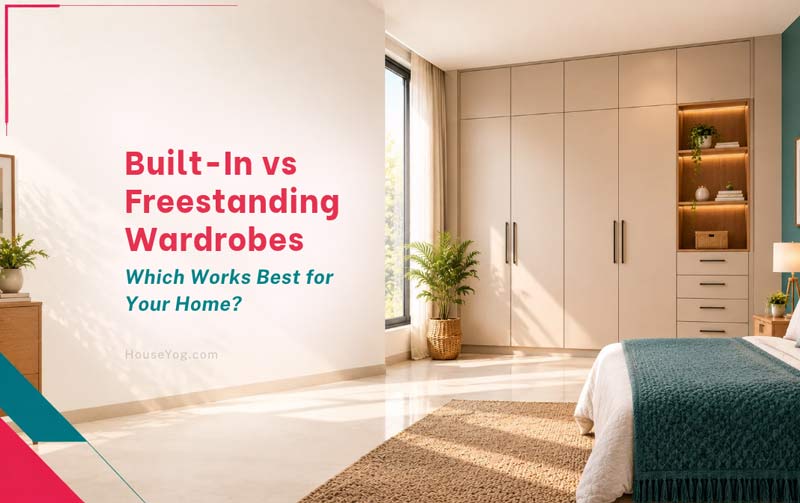

A wardrobe needs to do more than hold clothes. It should make everyday storage easier, fit comfortably into your bedroom and leave enough room to move around. Yet choosing one isn’t always straightforward. A built-in wardrobe can make better use of an awkward corner or an entire wall, while a freestanding unit offers the flexibility to move it or take it with you when you relocate.
So, which is the better choice?
A built-in wardrobe is usually better if you want storage tailored to your room, while a freestanding wardrobe makes more sense if flexibility, portability or a lower initial cost matters most. The right option depends on your bedroom layout, storage needs, budget and how long you expect to stay in the home.
Let’s look at what each option offers and where it makes the most sense.
What Is a Freestanding Wardrobe?
A freestanding wardrobe is a separate piece of furniture that you can position wherever the room layout allows. It may come ready-assembled or in flat-pack form, and you can choose from different sizes, finishes and internal layouts.
Its biggest advantage is flexibility. If you move house, rearrange the bedroom or decide to use the room differently, you can usually move the wardrobe with you. It can also be a practical choice when you need storage quickly or don’t want to commit to permanent cabinetry.
Freestanding wardrobes work particularly well in these situations:
- Rental homes: You can take the wardrobe with you when you move.
- Limited budgets: A basic, ready-made unit may cost less upfront than custom cabinetry.
- Temporary arrangements: It can provide storage while you wait for renovation work or a permanent solution.
- Changing room layouts: You can reposition the unit if your needs change, provided its size and weight allow it.
There are trade-offs, of course. Freestanding wardrobes are available in standard sizes, so they may leave unused space above or beside them. If your room has an awkward corner, a sloping ceiling or an unusually high ceiling, finding a unit that fits neatly can be difficult.
A freestanding wardrobe can still look attractive and work very well. The key is choosing a size that suits the room rather than buying the largest unit that will fit against the wall.
One safety point is worth keeping in mind: tall wardrobes should be secured against tipping, particularly in homes with children. Follow the manufacturer’s anchoring instructions and use fixings suitable for the wall or floor construction.
What Is a Built-In Wardrobe?
A built-in wardrobe is designed and installed to fit a specific space. Rather than choosing a standard furniture size, you can plan the width, height, depth, doors and internal storage around the dimensions of your bedroom.
That makes it particularly useful where space is limited or the room has features that standard furniture cannot accommodate. A customized built-in wardrobe can fit into an alcove, extend across an entire wall or use available height that would otherwise remain empty.
The internal layout can also be customised to suit the way you store your belongings. For example, someone who owns many formal clothes may need more hanging space, while a family sharing a bedroom may benefit from a combination of shelves, drawers and separate storage sections.
A typical built-in wardrobe may include:
- Long and short hanging sections for dresses, coats, shirts and other clothing.
- Drawers for folded clothes, accessories and smaller items.
- Adjustable shelves for bags, linen and everyday essentials.
- Dedicated shoe storage that is easy to reach.
- Upper compartments for suitcases, seasonal clothing and spare bedding.
You can also choose between hinged and sliding doors, different finishes and features such as mirrors or internal lighting.
The main consideration is that a built-in wardrobe is a more permanent investment. It requires accurate measurements, planning and professional installation. Moving it or substantially changing its layout later can be difficult, and the cost is often higher than that of a basic ready-made unit.
For inspiration on layouts, finishes and storage arrangements, browse our wardrobe design ideas.
Built-In vs Freestanding Wardrobes: How Do They Compare?
Both options can provide effective storage. The difference lies in how well each one suits your space, budget and future plans.
| Factor | Built-in wardrobe | Freestanding wardrobe |
| Use of space | Can be tailored to the available width and height | Standard dimensions may leave gaps |
| Storage layout | Shelves, drawers and hanging sections can be customised | Internal layout depends on the model |
| Appearance | Can be integrated with the room’s design | Functions as a separate piece of furniture |
| Initial cost | Custom design and installation can increase the cost | Basic ready-made options are often more affordable |
| Installation | Requires accurate measurement and fitting | Usually quicker to install or assemble |
| Flexibility | Difficult to move or modify substantially | Easier to reposition or relocate |
| Maintenance and repairs | Access to fittings and internal components depends on the design | The unit can often be moved for access |
| Safety | Requires suitable structural fixing and installation | Tall units should be anchored against tipping |
Neither option is automatically better in every bedroom. A well-chosen freestanding wardrobe may be all you need in a spacious room, while a built-in unit can make a noticeable difference in a compact bedroom where every centimetre matters.
Which Wardrobe Is Better for a Small Bedroom?
A built-in wardrobe can be a better choice for a small bedroom because it allows you to plan storage around the room’s dimensions. You can use available wall space more efficiently, avoid awkward gaps and choose doors that work with the bed and circulation space.
Door selection is particularly important. Hinged doors need room to swing open, which can make access awkward when the bed is close to the wardrobe. Sliding doors do not need the same clearance in front, although you still need enough space to stand comfortably and access the contents.
A freestanding wardrobe can work just as well if you find a suitable size and position it carefully. A narrower unit may leave more room to move, while a model with drawers or shelves inside can provide useful storage without taking up additional floor space.
Before deciding, measure the bedroom and mark the positions of the bed, wardrobe, windows and doorways. Include the space needed to open the wardrobe doors and use drawers comfortably.
The aim is not simply to fit more storage into the room. It is to create a layout that remains easy to use every day.
How Much Should You Spend on a Wardrobe?
The cost of a wardrobe depends on its size, materials, finish, internal fittings and installation requirements. A basic freestanding unit will often have a lower initial cost than a custom-built wardrobe, but the difference varies considerably between products.
Built-in wardrobes can cost more because they are measured and made for a specific space. The final price also depends on the board or timber used, door type, hardware, finish and complexity of the internal layout.
When comparing quotations, look beyond the overall price. Check whether shelves, drawers, hanging rails, handles, installation and other fittings are included. Two wardrobes with similar external dimensions may offer very different storage capacity and hardware quality.
It is also worth thinking about how long you expect to use the wardrobe. If you are renting for a short period, spending heavily on fixed cabinetry may not make sense. If you own the home and plan to stay for many years, a well-designed built-in wardrobe may justify the additional investment through its fit and storage convenience.
There is no universal price advantage. Compare the complete cost of the options available to you, along with their expected usefulness over time.
Don’t Overlook Materials, Finishes and Installation
A wardrobe’s appearance matters, but its construction and fittings determine how well it performs with regular use.
For either type, check the quality of the panels, hinges, drawer runners and handles. Doors should open smoothly, shelves should be suitable for their intended loads, and edges should be finished properly. In areas exposed to moisture, such as rooms adjoining bathrooms, material selection and protection against dampness deserve particular attention.
For built-in wardrobes, accurate measurement is essential. Walls and floors are not always perfectly straight or level, so the installer needs to account for actual site conditions. Poorly planned gaps, misaligned doors and inaccessible corners can undermine the advantages of custom cabinetry.
Installation also affects safety. Built-in units should be secured appropriately, and the fixing method must suit the wall construction. Do not assume that every wall can support the same type of fixing.
With freestanding wardrobes, check the manufacturer’s assembly instructions and anchoring requirements. A large unit may need to be secured even if it feels stable when empty.
So, Which Wardrobe Should You Choose?
The best wardrobe is the one that fits your room, storage habits and plans for the home.
Choose a built-in wardrobe if you own the property, want a tailored storage layout or need to make effective use of an awkward or compact bedroom. It is also worth considering when you want the wardrobe to blend with the room’s overall design.
Choose a freestanding wardrobe if you prefer a lower-cost starting point, expect to move house or want the freedom to rearrange your furniture. It can be a perfectly practical long-term solution when the size, storage layout and quality suit your needs.
Before making a decision, measure the room, list what you need to store and compare the available options. Think about your daily routine as well as how the bedroom looks. A wardrobe that fits your belongings and leaves the room comfortable to use will serve you better than one chosen on appearance alone.