

When you start planning your kitchen, everything may look perfect on paper—a clean layout, good storage, and well-thought-out finishes.
But once the kitchen is built and you begin using it every day, small discomforts start to show up. The platform feels slightly too high or a little too low. The counter seems deeper than comfortable. The walkway feels tight, especially when two people are working together.
These are usually not layout problems—they are dimension problems. In most cases, it comes down to incorrect kitchen counter height, depth, and walkway spacing.
And the tricky part is, these measurements are often overlooked or decided casually during construction or kitchen renovation, when they actually have a big impact on daily usability.
If you’re building a new house or renovating your kitchen and you are unsure about the right countertop dimensions, this guide will help you make more informed decisions.
In this article, we’ll break down the standard kitchen platform height, counter depth, and walkway spacing in India in a practical, easy-to-understand way—so you can plan a kitchen that not only looks good but also feels comfortable to use every day.
Quick Reference: Kitchen Platform Height, Depth & Walkway Spacing
If you’re looking for a quick summary, here are the standard kitchen platform height, counter depth, and walkway spacing in India.
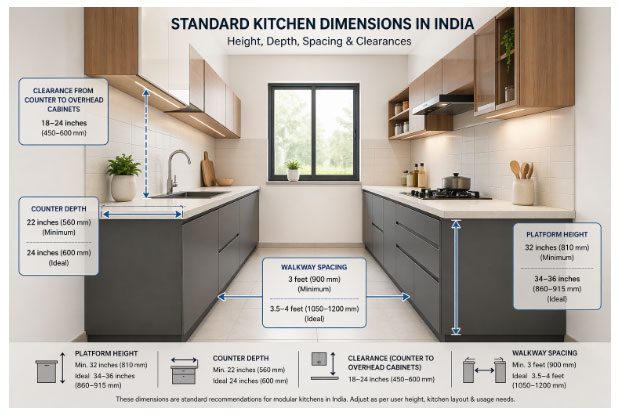
These values provide a practical reference for planning a comfortable and functional kitchen.
| Element | Minimum | Ideal |
| Platform Height | 32 inches (810 mm) | 34–36 inches (860–915 mm) |
| Counter Depth | 22 inches (560 mm) | 24 inches (600 mm) |
| Walkway Space | 3 feet (900 mm) | 3.5–4 feet (1050–1200 mm) |
To make it even simpler, here’s a quick way to remember these standard kitchen measurements:
- Platform height: usually kept between 32–36 inches (around 34 inches works best for most users)
- Counter depth: typically around 24 inches (2 feet)
- Walkway spacing: minimum 3 feet, with 3.5–4 feet being more comfortable
What is the Standard Kitchen Platform Height in India?
The standard kitchen platform height in India typically ranges between 32 to 36 inches (810 mm to 915 mm), with around 34 inches (860 mm) being the most commonly used. This range works well for average height users, which is why many contractors default to it.
However, in practice, there is no one “perfect” height that suits everyone. The ideal kitchen slab height should depend on your height and how you use the kitchen daily.
A simple way to get this right is to relate the platform height to your body. Ideally, your kitchen counter should be placed about 2 to 4 inches below your elbow level. This allows you to work comfortably without bending too much or raising your shoulders while cooking.
When the height is set correctly, everyday tasks like chopping, rolling, or washing feel natural and effortless. But even a slight mismatch can lead to constant posture adjustments, which often result in back or shoulder strain over time.
In Indian households, where more than one person uses the kitchen, it’s not always practical to customise the height for a single user. In such cases, choosing a balanced average height of around 34 to 35 inches usually works well for most families.
One thing to be careful about is how casually this decision is often made on-site. Many homeowners simply follow a mason’s suggestion or replicate another kitchen without considering their own comfort. Over time, these small shortcuts are exactly what make a kitchen feel slightly uncomfortable in daily use.
Getting the platform height right may seem like a small detail during construction—but it has a significant impact on how comfortable and efficient your kitchen feels in the long run.
Kitchen Counter Depth (Width)
The standard kitchen counter depth in India is typically around 24 inches (2 feet or ~600 mm). After adding wall tiles or backsplash finishes, the total depth may extend slightly to about 25 to 26 inches. This is widely considered the ideal kitchen counter width because it balances usability and storage effectively.
Once your platform height is set, counter depth becomes the next important factor that affects everyday comfort. It may seem like a small detail, but it directly impacts how easily you can reach, work, and organise your kitchen.
The logic behind this standard is simple—your hands should be able to comfortably reach the back of the counter without stretching. This ensures that the entire surface remains usable, rather than just the front portion.
Even when overhead cabinets are added, the base counter depth usually remains the same. Upper cabinets are designed to be within reach, so increasing the counter depth doesn’t improve storage—it only makes the workspace harder to use.
This is where a common assumption often goes wrong. Many people believe that a deeper counter will provide more usable space. In reality, once the depth goes beyond about 26 inches, the back area becomes difficult to access. Items placed there are rarely used, cleaning becomes inconvenient, and overall efficiency starts to drop.
A more practical approach, especially in compact Indian kitchens, is to optimise the layout instead of increasing depth. If you need more storage or workspace, extending the length of the counter or using smarter storage solutions like drawers and pull-outs usually works far better than making the counter deeper.
Getting this dimension right ensures that your kitchen counter feels easy to use from edge to edge—something you’ll notice and appreciate every single day.
Kitchen Walkway Spacing Standard
The standard kitchen walkway space in India should be at least 3 feet (900 mm), with an ideal range of 3.5 to 4 feet (1050 to 1200 mm) for comfortable movement.
Kitchen walkway spacing refers to the clear distance available for movement between counters or working zones. While it may seem like a minor detail during planning, it plays a major role in how comfortable and functional your kitchen feels in daily use.
A minimum of 3 feet allows basic movement and access. However, in most Indian homes where the kitchen is used actively, this can feel slightly restrictive. Increasing the space to around 3.5 to 4 feet makes movement smoother, especially when multiple tasks are happening at the same time.
This becomes even more important in parallel kitchens, where two counters face each other. In such layouts, the minimum space between kitchen counters should not be less than 3 feet, while around 4 feet is considered ideal. This extra space makes a noticeable difference when opening drawers, using appliances, or simply moving around comfortably.
In L-shaped or U-shaped kitchens, the requirement may feel less critical, but maintaining at least 3 feet of clear working space is still important to ensure smooth movement between different zones.
The real impact of walkway space becomes clear in everyday situations. Imagine one person cooking at the stove while another is working at the sink. If the space is too narrow, even simple movements can lead to constant interruptions—bumping into each other, struggling to open cabinets fully, or feeling cramped while working. Over time, this not only becomes frustrating but can also affect safety.
A well-planned walkway, on the other hand, allows everything to flow naturally. You can move freely, work comfortably, and use the kitchen the way it’s meant to be used—without feeling restricted.
Like most dimensions in kitchen design, walkway spacing may seem like a small detail during planning. But once you start using the kitchen every day, it quickly becomes one of the most noticeable factors in overall comfort.
Kitchen Ergonomics (Why Dimensions Matter More Than You Think)
By now, we’ve looked at individual dimensions like platform height, counter depth, and walkway space. But a comfortable kitchen is not just about getting these measurements right in isolation—it’s about how they work together.
This is where the idea of kitchen ergonomics comes in. In simple terms, it means designing your kitchen in a way that supports smooth, natural movement while you work.
One of the most commonly used principles in kitchen planning is the “work triangle”. This connects the three most frequently used areas—the sink, the stove, and the refrigerator.
The goal is straightforward: you should be able to move between these points easily, without unnecessary steps or obstacles in between. When this flow is well planned, everyday tasks feel quicker and more intuitive.
On the other hand, even if all your dimensions are technically “standard,” poor placement can still make the kitchen feel inefficient. You may find yourself walking extra steps, adjusting constantly, or working around awkward gaps.
That’s why kitchen ergonomics in India is not just about following standard sizes—it’s about making sure your kitchen actually works well for your daily routine. When the layout and dimensions come together correctly, the entire space feels more comfortable, functional, and easy to use.
Common Kitchen Platform, Depth & Spacing Mistakes
Even when the layout looks good on paper, small mistakes in platform height, counter depth, or walkway spacing can make a kitchen feel uncomfortable in daily use. These issues often go unnoticed during construction but become obvious once you start using the space regularly.
Incorrect Platform Height
Setting the platform too high or too low without considering user height can lead to constant bending or shoulder strain. Even a small mismatch affects comfort over time.
Very Narrow Walkway Spacing
Reducing the space between counters to fit more storage can make movement restricted. It becomes especially inconvenient when two people are working in the kitchen.
Over-Deep Kitchen Counter
Increasing counter depth beyond standard limits may seem useful, but it creates hard-to-reach areas that are rarely used and difficult to clean.
Ignoring User Height & Usage
Following a fixed “standard” without considering who will use the kitchen can lead to discomfort. Kitchen dimensions should be adjusted based on actual usage patterns.
On-Site Decisions Without Planning
Many dimension decisions are made quickly during construction or based on what “usually works.” This often results in a kitchen that feels slightly off in daily use.
FAQs
The standard kitchen platform height in India is typically between 32 to 36 inches, with around 34 inches being most common.
The ideal kitchen counter depth is 24 inches (2 feet), which provides a good balance between usability and storage.
The minimum walkway space is 3 feet, but ideally it should be 3.5 to 4 feet for comfortable movement.
Yes, and it should be. The ideal height depends on the user’s height, typically 2–4 inches below elbow level.
Not always. Counters deeper than 24–26 inches can reduce usability, as it becomes harder to reach the back of the counter.
The ideal gap is 18 to 24 inches (450–600 mm), with around 20–22 inches working well for most kitchens.
Conclusion
A slightly incorrect platform height, an uncomfortable counter depth, or a tight walkway may not seem like major issues during construction—but they can affect how your kitchen feels every single day.
These are small decisions on paper, but they have a long-term impact on comfort, efficiency, and ease of use.
That’s why it’s worth taking the time to get these kitchen measurements right—based on how you actually use the space, not just what is commonly followed.
Because in the end, a well-designed kitchen is not just about how it looks—but how effortlessly it works for you every single day.